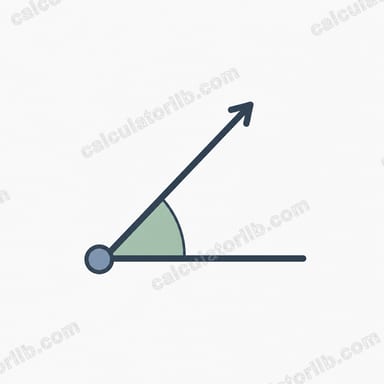

What is a reference angle?
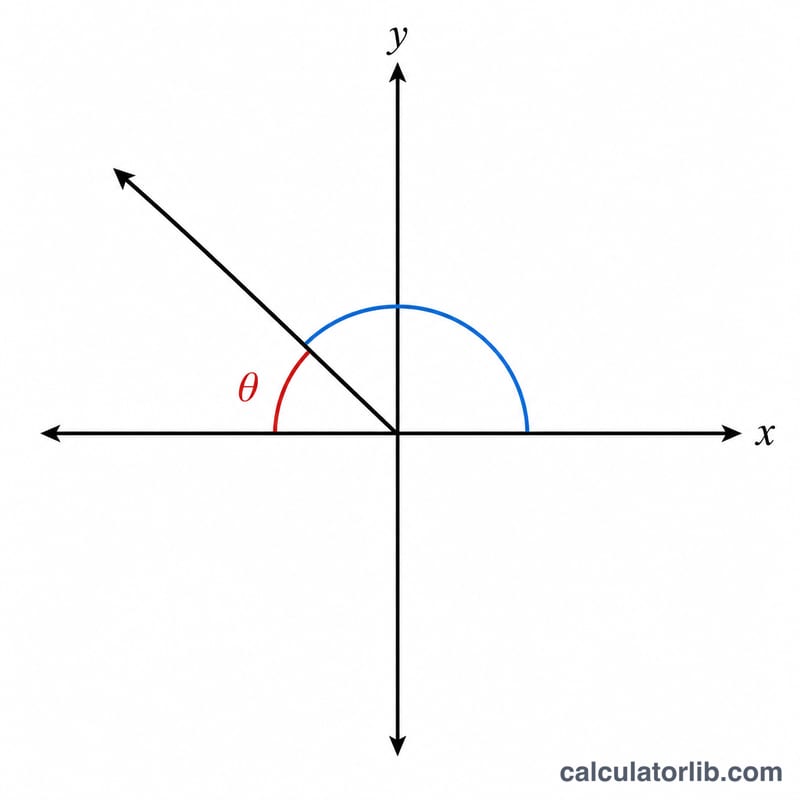
A reference angle is the smallest positive acute angle (between 0° and 90°) formed by the terminal side of an angle and the horizontal x-axis. It is a key tool in trigonometry because the sine, cosine and tangent of any angle share the same magnitude as those of its reference angle — only the sign changes depending on the quadrant. This makes evaluating trig functions of large or negative angles much simpler.
How to use this calculator
Enter any angle and pick whether it is measured in degrees or radians. The calculator first reduces the angle to the standard 0–360° range, determines which quadrant the terminal side lies in, and then returns the reference angle in the same unit you entered. It also shows the normalized angle and the quadrant number so you can check your work.
The formula explained
First normalize: \(a = \text{angle} \bmod 360^\circ\) (adding 360° if the result is negative). Then apply the quadrant rule: in Quadrant 1 the reference angle equals \(a\); in Quadrant 2 it is \(180^\circ - a\); in Quadrant 3 it is \(a - 180^\circ\); and in Quadrant 4 it is \(360^\circ - a\). For radian input the same logic runs internally in degrees and converts the answer back to radians.
$$\theta_{\text{ref}} = \begin{cases} \alpha & 0^\circ \le \alpha \le 90^\circ \\ 180^\circ - \alpha & 90^\circ < \alpha \le 180^\circ \\ \alpha - 180^\circ & 180^\circ < \alpha \le 270^\circ \\ 360^\circ - \alpha & 270^\circ < \alpha < 360^\circ \end{cases} \qquad \alpha = \text{Angle} \bmod 360^\circ$$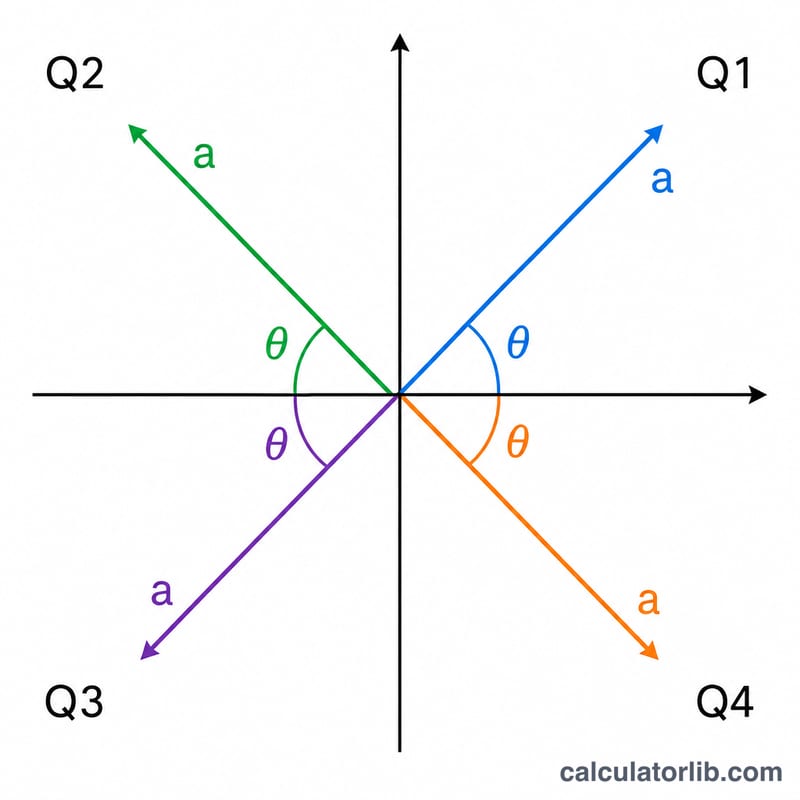
Worked example
Take 210°. It is already within 0–360°, and since \(180^\circ < 210^\circ \le 270^\circ\) it lies in Quadrant 3. The reference angle is \(210^\circ - 180^\circ = \mathbf{30^\circ}\). Therefore \(\sin(210^\circ) = -\sin(30^\circ) = -0.5\), matching the known value.
FAQ
Can I enter negative angles? Yes. A negative angle is normalized by adding 360° until it falls in the 0–360° range, so −30° becomes 330° (Quadrant 4) with a reference angle of 30°.
What about angles over 360°? They are reduced with the modulo operation, so 750° becomes 30° before the quadrant rule is applied.
Is the reference angle always positive? Yes — a reference angle is always between 0° and 90° (0 and π/2 radians) inclusive.