
What Is the Surface Area of a Hemisphere?
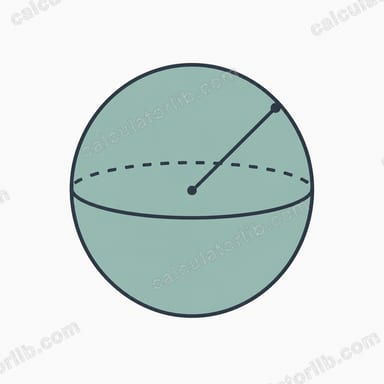
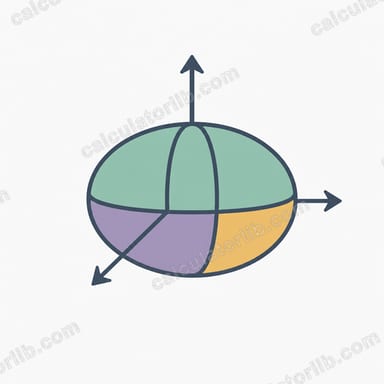
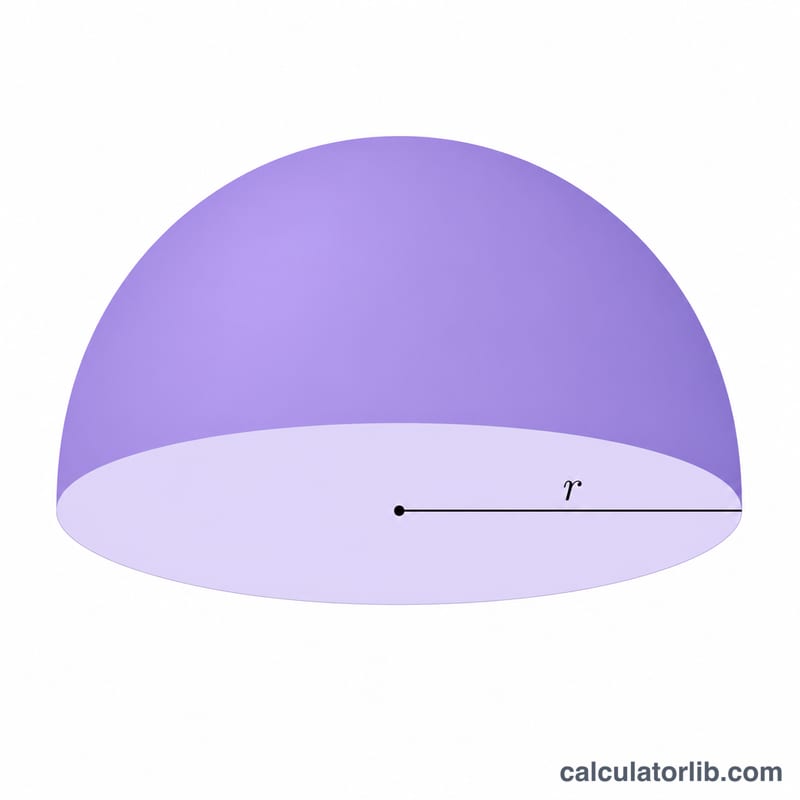
A hemisphere is exactly half of a sphere. Its surface comes in two parts: the curved dome and the flat circular face created when the sphere is cut in half. The total surface area of a solid hemisphere adds both together, while the curved surface area covers only the dome. This calculator works in any consistent unit — millimetres, inches, metres — and is fully universal (pure geometry, no jurisdiction needed).
How to Use This Calculator
Enter the radius r of the hemisphere and the tool instantly returns three values: the total surface area, the curved (dome) area, and the flat base area. Make sure your radius is in the units you want; the area results will be in those units squared.
The Formula Explained
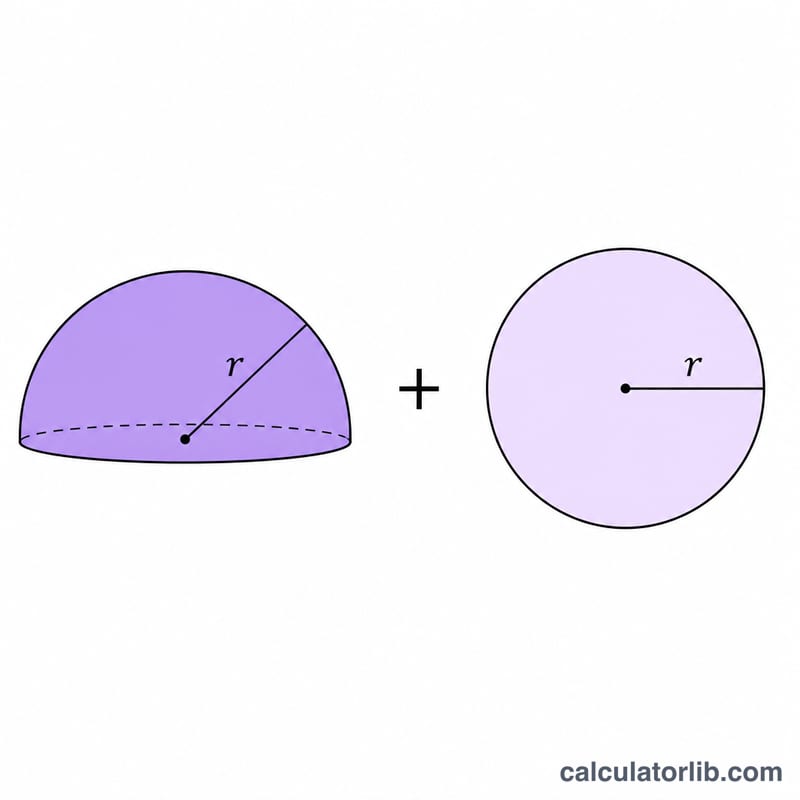
A full sphere has surface area \(4\pi r^{2}\). Half of that is the dome: curved area = \(2\pi r^{2}\). Cutting the sphere also exposes a flat circle whose area is \(\pi r^{2}\). Adding the dome and the circle gives the total surface area of a solid hemisphere:
$$A = 2\pi r^{2} + \pi r^{2} = 3\pi r^{2}$$
Worked Example
Suppose a hemisphere has a radius of 5 units. The curved area is $$2 \times \pi \times 5^{2} = 2 \times \pi \times 25 \approx 157.08.$$ The base area is $$\pi \times 25 \approx 78.54.$$ The total surface area is $$3 \times \pi \times 25 \approx 235.62$$ square units.
FAQ
Does "total" include the flat base? Yes. The total (\(3\pi r^{2}\)) includes the curved dome plus the flat circular base. If you only want the dome, use the curved area (\(2\pi r^{2}\)).
What if I only know the diameter? Divide the diameter by 2 to get the radius, then enter it.
What units does it use? Any consistent unit. If r is in cm, the area is in cm². The math is the same for every unit.