
What Is the Surface Area of a Cylinder?
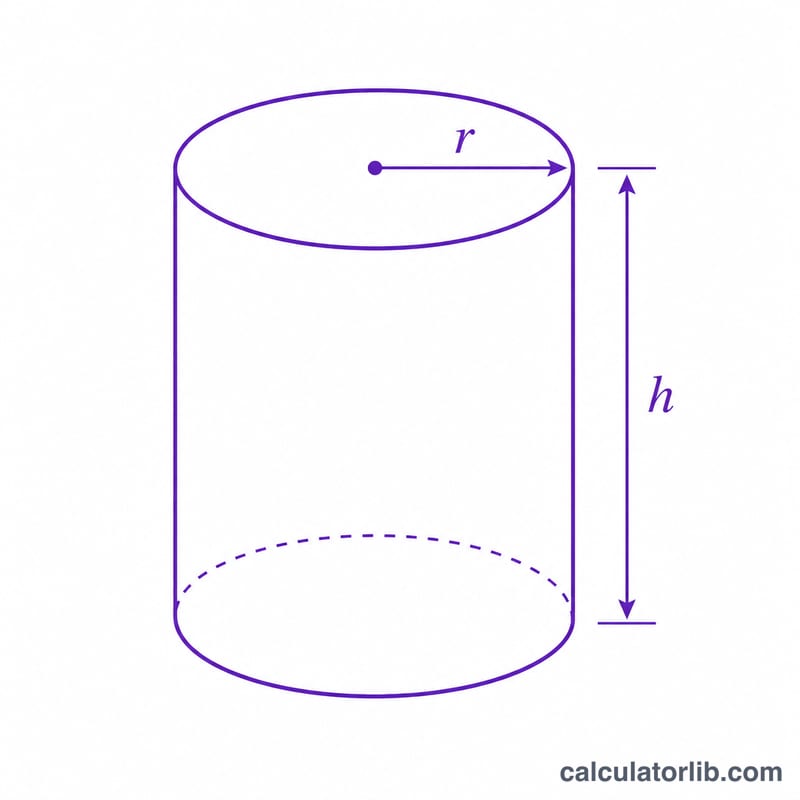
A right circular cylinder has two flat circular ends (bases) joined by a curved side. Its total surface area is the combined area of both circular bases plus the curved lateral surface. This calculator computes the total surface area, the lateral (side) area, and the area of the bases from just the radius and height.
How to Use This Calculator
Enter the radius (r) of the circular base and the height (h) of the cylinder in the same units (cm, m, inches, etc.). The result is returned in square units of whatever unit you used. The tool breaks the answer down so you can see how the lateral surface and the two bases each contribute to the total.
The Formula Explained
The total surface area is given by:
$$A = 2\pi r(r + h)$$
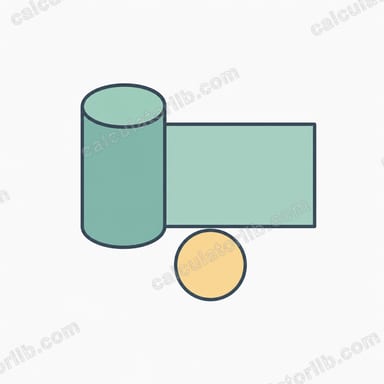
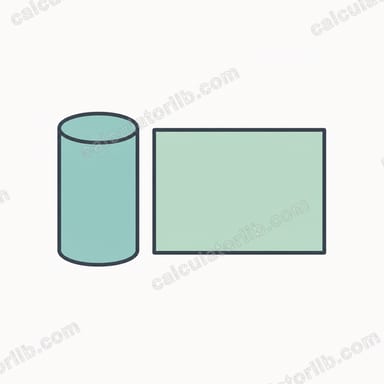
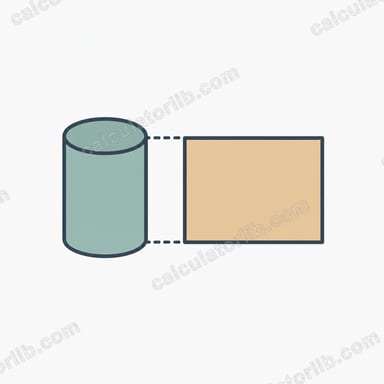
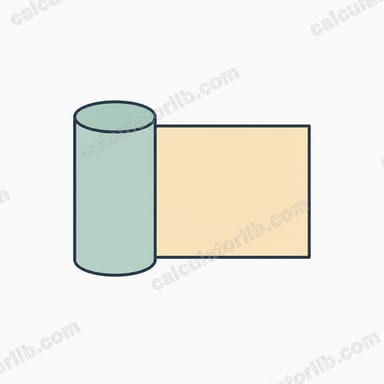
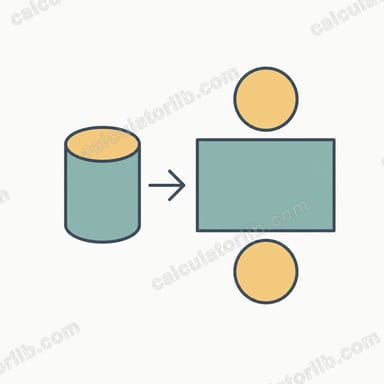
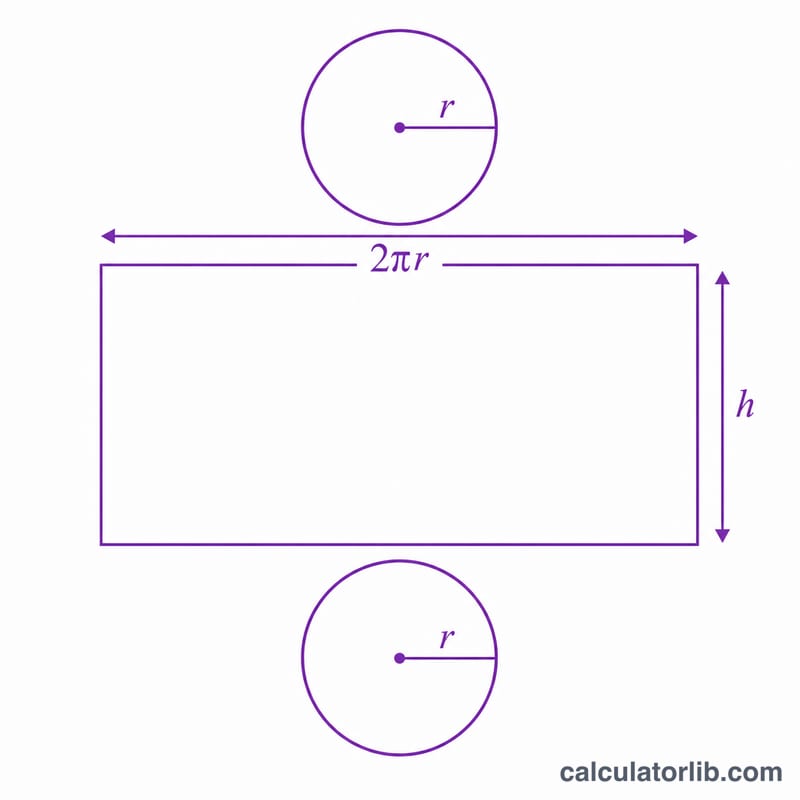
This expands into two parts: the two circular bases contribute \(2\pi r^2\), and the curved lateral surface contributes \(2\pi rh\). Imagine unrolling the side of the cylinder into a flat rectangle — its width is the circumference (\(2\pi r\)) and its height is \(h\), giving an area of \(2\pi rh\).
Worked Example
Suppose a cylinder has a radius of 5 and a height of 10. The lateral area is \(2\pi(5)(10) = 100\pi \approx 314.16\). The two bases give \(2\pi(5^2) = 50\pi \approx 157.08\). Adding them, the total surface area is \(150\pi \approx\) 471.24 square units, which matches $$A = 2\pi(5)(5 + 10) = 2\pi(5)(15) = 150\pi.$$
Frequently Asked Questions
What is the difference between total and lateral surface area? Lateral surface area covers only the curved side (\(2\pi rh\)). Total surface area adds the two circular ends (\(2\pi r^2\)) for a closed cylinder.
Should I use radius or diameter? Use the radius — half the diameter. If you only know the diameter, divide it by 2 first.
What units does the result use? Whatever unit you enter, the area is in those units squared. Enter centimeters and you get square centimeters.