
What is the SSS Triangle Calculator?
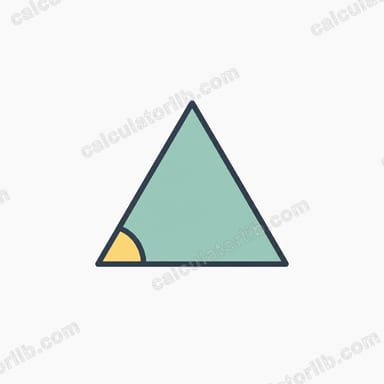
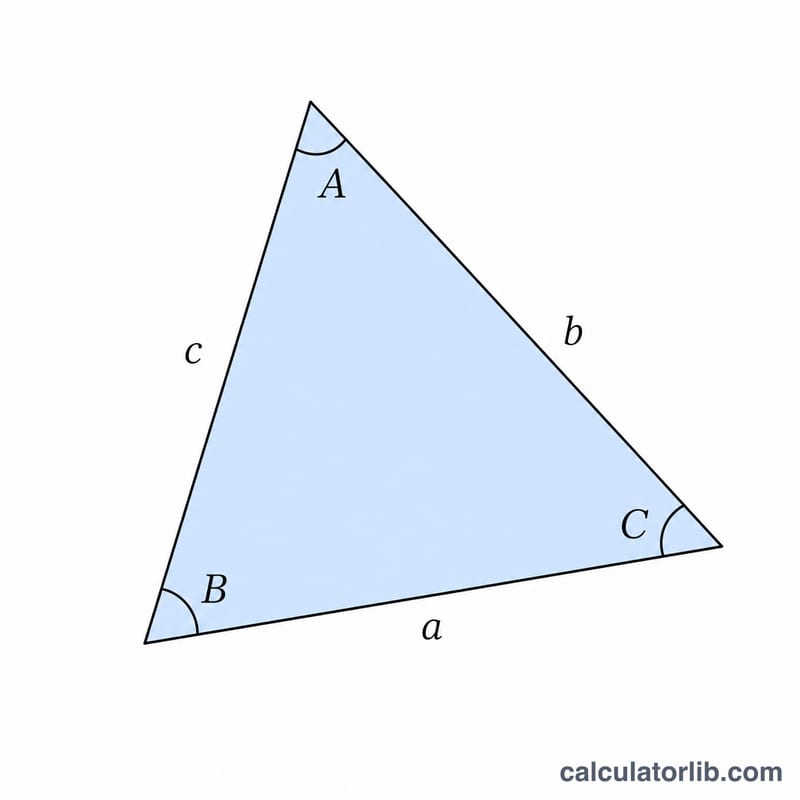
SSS stands for "Side-Side-Side" — the case where you know the lengths of all three sides of a triangle but none of its angles. This calculator uses the Law of Cosines to solve for every interior angle, and then reports the triangle's perimeter and area as well. It works for any valid triangle: acute, right, or obtuse.
How to use it
Enter the three side lengths a, b, and c in any consistent unit (cm, m, in — they just need to match). Press calculate. The tool first checks the triangle inequality: the sum of any two sides must exceed the third. If your sides cannot form a triangle, the angles return zero. Otherwise you instantly get angles A, B, and C in degrees, plus the perimeter and area.
The formula explained
The Law of Cosines rearranges to isolate the cosine of an angle: \(\cos A = (b^{2} + c^{2} - a^{2}) / (2bc)\). Taking the inverse cosine (arccos) gives angle A, which sits opposite side a. The same pattern gives angle B opposite side b. Because the interior angles of any triangle sum to 180°, the third angle is simply \(C = 180^{\circ} - A - B\). The area uses Heron's formula with the semi-perimeter \(s = (a+b+c)/2\):
$$\text{Area} = \sqrt{s\,(s-a)(s-b)(s-c)}$$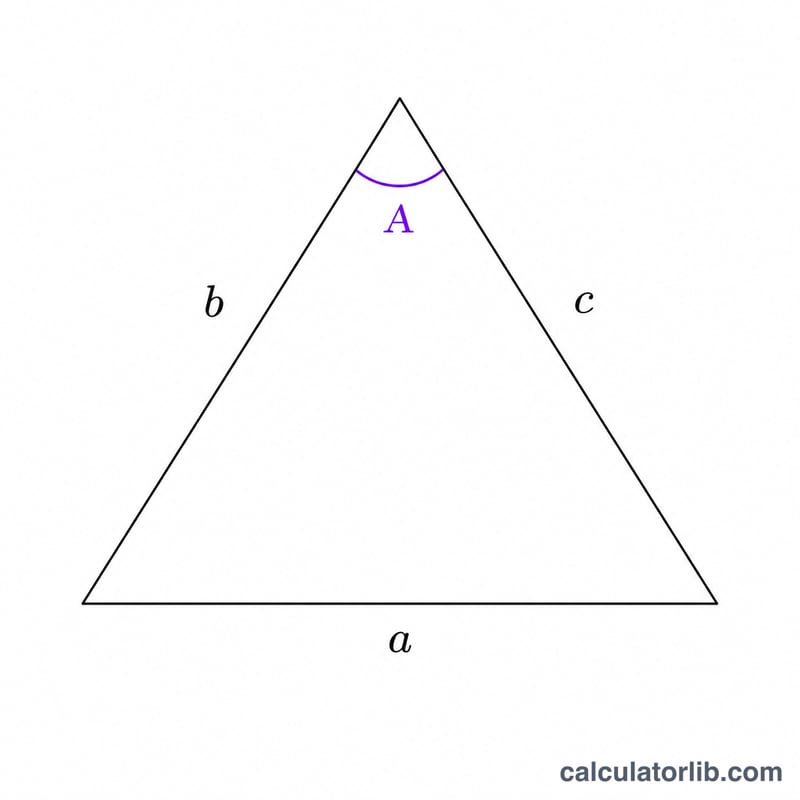
Worked example
Take the classic 3-4-5 right triangle (a=3, b=4, c=5). For angle A: $$\cos A = (16 + 25 - 9) / (2\cdot4\cdot5) = 32/40 = 0.8,$$ so \(A = 36.87^{\circ}\). For angle B: $$\cos B = (9 + 25 - 16) / (2\cdot3\cdot5) = 18/30 = 0.6,$$ so \(B = 53.13^{\circ}\). Then \(C = 180 - 36.87 - 53.13 = 90^{\circ}\), confirming it is a right triangle. Perimeter = 12, and area = \(\sqrt{6\cdot3\cdot2\cdot1} = \sqrt{36} = 6\).
FAQ
What if my sides don't form a triangle? If one side is longer than or equal to the sum of the other two, no triangle exists, and the calculator returns zeros.
Are the angles in degrees or radians? Results are shown in degrees. Multiply by \(\pi/180\) to convert to radians.
Does the unit matter? Angles are unit-independent. Perimeter and area are reported in your input unit and that unit squared, respectively.