
What is the D'Hondt method?
The D'Hondt method (also called the Jefferson method or highest-averages method) is a mathematical procedure for allocating a fixed number of legislative seats among competing political parties in proportion to the votes each received. It is used worldwide in proportional-representation elections, including Belgium, Spain, the European Parliament in many member states, and Japan's House of Councillors proportional seats (adopted from the 1983 election). The algorithm is identical everywhere, so this calculator is universal and not tied to any single country's rules.
How to use this calculator
Enter each party's vote total as a comma-separated list (for example 12000, 9000, 6000, 3000). Optionally enter matching party names in the same order; blank names default to "Party 1", "Party 2", and so on. Set the total number of seats to distribute, then calculate. The result table shows how many seats each party wins, and the totals row confirms they sum exactly to the seats available.
The formula explained
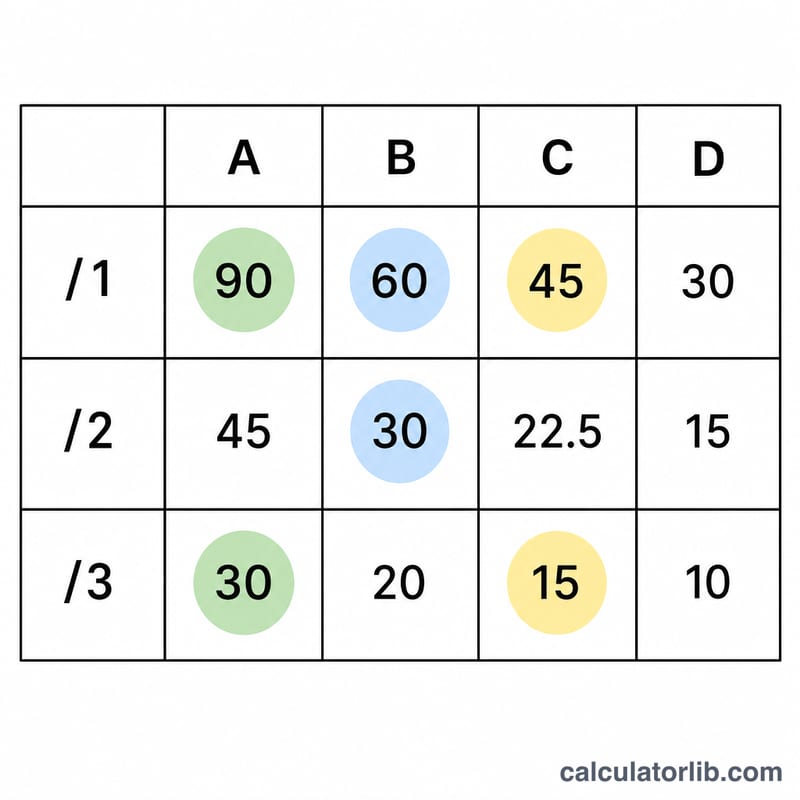
For every party \(i\) with votes \(V_i\), the method computes a sequence of quotients \(V_i/1\), \(V_i/2\), \(V_i/3\), and so on:
$$\text{quotient}_{i,s} = \frac{\text{Votes}_i}{s+1}, \qquad s = 0,1,2,\dots$$All quotients from all parties are pooled, and the largest \(S\) of them win seats — each party receives as many seats as it has quotients in that top \(S\). Equivalently, seats are awarded one at a time: at each step the seat goes to the party with the highest value of \(V_i / (s_i + 1)\), where \(s_i\) is the seats it has already been given:
$$\begin{gathered} \text{repeat } \text{Number of Seats} \text{ times:} \\[0.4em] \text{award next seat to } \arg\max_i \dfrac{\text{Votes}_i}{\text{seats}_i + 1} \end{gathered}$$Ties are broken in favor of the party with more total votes, then by the lower party index.
Worked example
Votes A=12000, B=9000, C=6000, D=3000 with 4 seats. Seat 1 goes to A \((12000/1)\). Seat 2 goes to B \((9000/1)\). Seat 3 is a tie between \(A/2=6000\) and \(C/1=6000\); A wins on more votes. Seat 4 goes to C \((6000/1)\). Final allocation: A=2, B=1, C=1, D=0, summing to 4.
FAQ
Does D'Hondt favor large or small parties? It systematically favors larger parties compared with the Sainte-Lague method, because the divisors 1, 2, 3 grow more slowly.
Will the seats always add up? Yes — exactly \(S\) seats are awarded, one per step, so the totals always equal the seats you entered.
What about a party with zero votes? Its quotients are all zero, so it normally wins no seats unless seats exceed the number of parties with positive votes.