What This Calculator Does
This Scuba Diving Bottom Time calculator estimates how long a diver can stay underwater before reaching a chosen reserve pressure. It is a pure gas-law (physics) tool and is universal — it is not tied to any country. All inputs use metric units: liters (L), atmospheres/bar (atm), meters (m), and liters per minute (L/min).
How to Use It
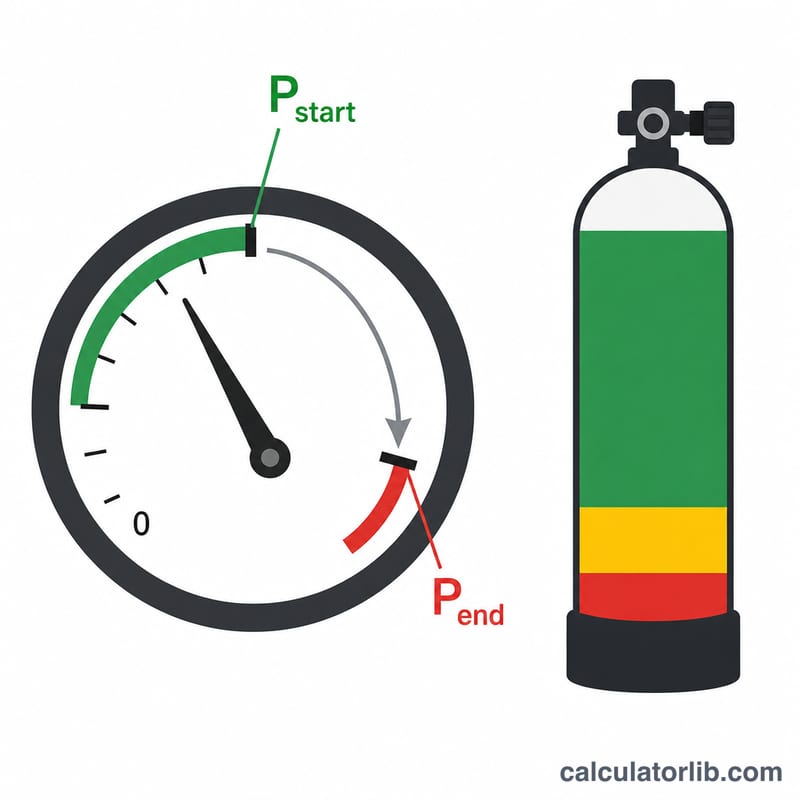
Enter your cylinder's internal water volume, the pressure at the start of the dive, the end (reserve) pressure you want to keep when you exit the water, your average dive depth, and your Surface Air Consumption rate (SAC, also called RMV). The result is the available dive time in minutes while still leaving the reserve in your tank. Setting an end pressure above zero is the main safety feature — it ensures the estimate stops before you run the cylinder empty.
The Formula Explained
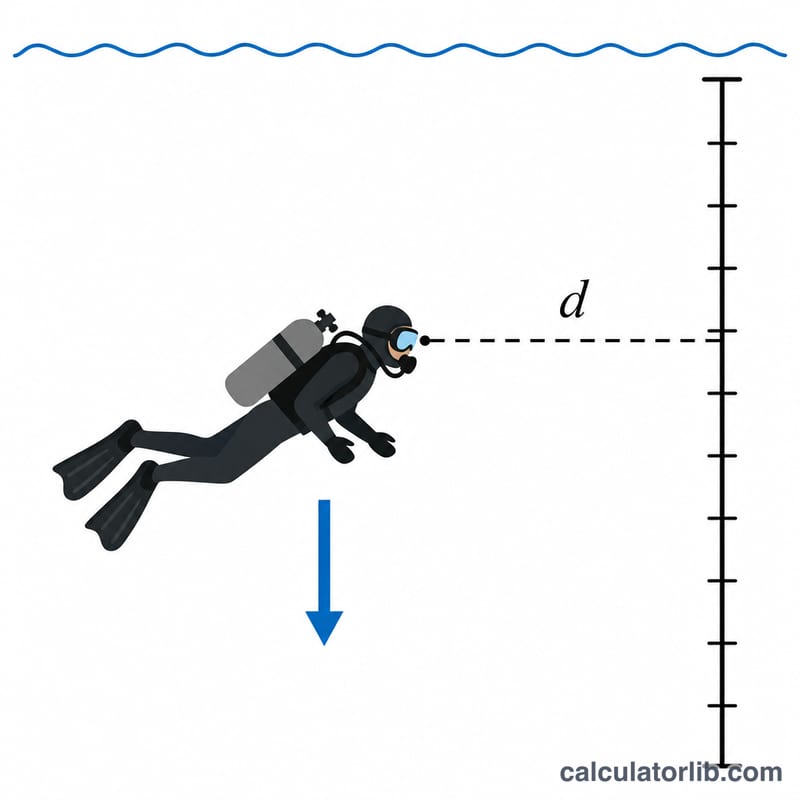
$$T = \frac{\text{Tank Vol} \cdot \left(\text{Start P} - \text{End P}\right)}{\left(1 + \dfrac{\text{Depth (m)}}{10}\right) \cdot \text{SAC}}$$ The term \(V \times (P_{\text{start}} - P_{\text{end}})\) gives the usable breathing gas measured at the surface, in liters. The factor \(\left(1 + \frac{d}{10}\right)\) is the ambient absolute pressure at depth: each 10 m of seawater adds roughly 1 atm, so at 10 m you breathe gas twice as fast as at the surface. Dividing by this factor and by your SAC rate gives the minutes available.
Worked Example
Tank 10 L, start 200 atm, end 50 atm, depth 15 m, SAC 20 L/min. Usable gas = \(10 \times (200 - 50) = 1500\) L. Depth factor = \(1 + \frac{15}{10} = 2.5\). Gas at depth = \(\frac{1500}{2.5} = 600\) L. Dive time = \(\frac{600}{20} = 30\) minutes.
Bottom Time at Different Depths and SAC Rates
The table assumes a 10 L cylinder filled to 200 bar, with a 50 bar reserve kept untouched. That leaves \(10 \times (200 - 50) = 1500\) L of usable gas at surface pressure. Time is computed as \(T = \dfrac{1500}{(1 + d/10) \times \text{SAC}}\), where \(d\) is depth in metres and SAC is in L/min. Results are in minutes, rounded to one decimal.
| Depth | Ambient pressure | SAC 15 L/min | SAC 20 L/min | SAC 25 L/min |
|---|---|---|---|---|
| 10 m | 2 atm | 50.0 | 37.5 | 30.0 |
| 18 m | 2.8 atm | 35.7 | 26.8 | 21.4 |
| 30 m | 4 atm | 25.0 | 18.8 | 15.0 |
| 40 m | 5 atm | 20.0 | 15.0 | 12.0 |
Worked example (18 m, 20 L/min): \(T = \dfrac{1500}{2.8 \times 20} = \dfrac{1500}{56} \approx 26.8\) min.
Gas consumption rises in proportion to ambient pressure, so doubling the depth-based pressure halves the time. These figures show gas supply only. They do not account for no-decompression limits, which are often shorter than the gas-limited time at depth.
Typical SAC Rates and Reserve Pressures
Typical values are given below. They vary by individual and by training agency, and this is general information, not personal advice.
| Item | Commonly cited range |
|---|---|
| SAC/RMV, experienced diver at rest | roughly 10–15 L/min |
| SAC/RMV, typical recreational diver | roughly 15–25 L/min |
| SAC/RMV, novice, or under exertion or stress | 25 L/min or more |
| Cylinder sizes | 10, 12 and 15 L |
| Fill pressures | 200–232 bar |
| Reserve pressure commonly taught | 30–50 bar |
In overhead environments such as caves or wrecks, the rule of thirds is commonly used instead: one third of the gas for going in, one third for coming out, and one third held as reserve.
Your own SAC is best measured from your logged dives at known depths. Your SAC can rise with cold, current, heavy work or anxiety, so a conservative planning value is often used. Follow the guidance of your training agency and instructor.
FAQ
Does this replace a dive computer or NDL tables? No. This is a planning estimate of gas duration only. It ignores no-decompression limits, nitrogen loading, ascent/descent and safety-stop gas, temperature and gas compressibility. Always respect your dive computer and tables.
Why divide by (1 + depth/10)? Because gas is breathed at ambient pressure. At 20 m the ambient pressure is about 3 atm, so a given lungful contains three times the surface mass of gas, draining the tank three times faster.
What if end pressure is higher than start pressure? Then there is no usable gas and the calculator returns 0 minutes. Your end (reserve) pressure must always be lower than your start pressure.