
What is the Hiking Time Calculator?
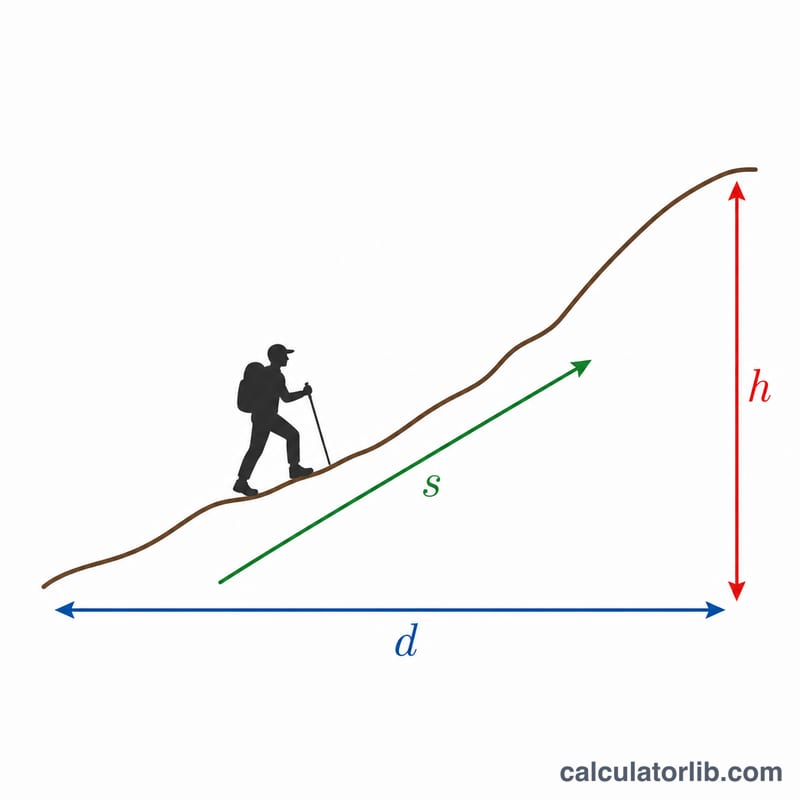
This calculator estimates how long a walk or hike will take using Naismith's Rule, a planning method devised by Scottish mountaineer William W. Naismith in 1892. The rule allows roughly 1 hour for every 5 km of horizontal distance, plus an additional 1 hour for every 600 metres of ascent. It is widely used by hikers, mountaineers, and rescue services worldwide to plan routes and judge how much daylight a trip will need.
How to use it
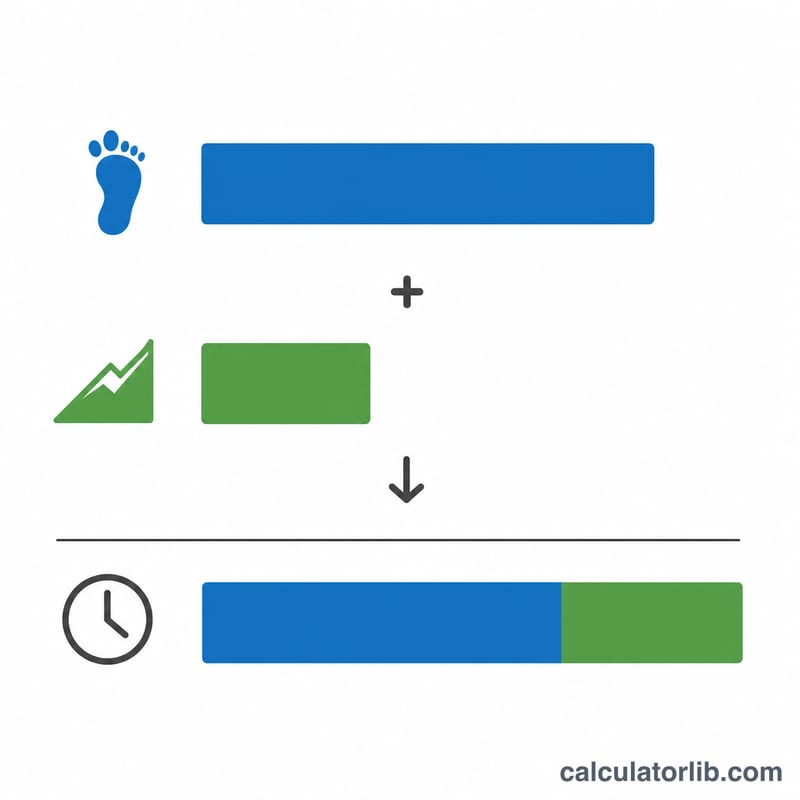
Enter the total trail distance in kilometres, the total ascent (cumulative elevation gain) in metres, and your expected walking speed in km/h. The default speed of 5 km/h reflects Naismith's original assumption; reduce it to 4 km/h for rough terrain or heavy packs. The result shows your estimated time in hours and minutes, broken down into flat-walking time and the extra time the climb adds.
The formula explained
The calculation is $$T = \frac{\text{Distance (km)}}{\text{Speed (km/h)}} + \frac{\text{Ascent (m)}}{600}$$ The first term is the time to cover the horizontal distance at your chosen pace. The second term adds time purely for climbing: 600 m of vertical gain costs about one extra hour regardless of how spread out it is. Descent is ignored in the classic rule, though many walkers add corrections for steep downhills.
Worked example
For a 12 km hike with 600 m of ascent at 5 km/h: flat time = \(12 \div 5 = 2.4\) hours; ascent time = \(600 \div 600 = 1.0\) hour. Total = 3.4 hours, or 3 hours 24 minutes.
FAQ
Does it account for rest breaks? No — Naismith's Rule gives moving time only. Add 10–15 minutes per hour for breaks, photos and lunch.
Is it accurate for everyone? It's an estimate for a fit walker on reasonable ground. Adjust your speed down for difficult terrain, bad weather, or a tired group.
What about going downhill? The classic rule ignores descent. Some variants subtract time for gentle descents and add time for steep ones; this tool uses the original simple form.