
What this calculator does
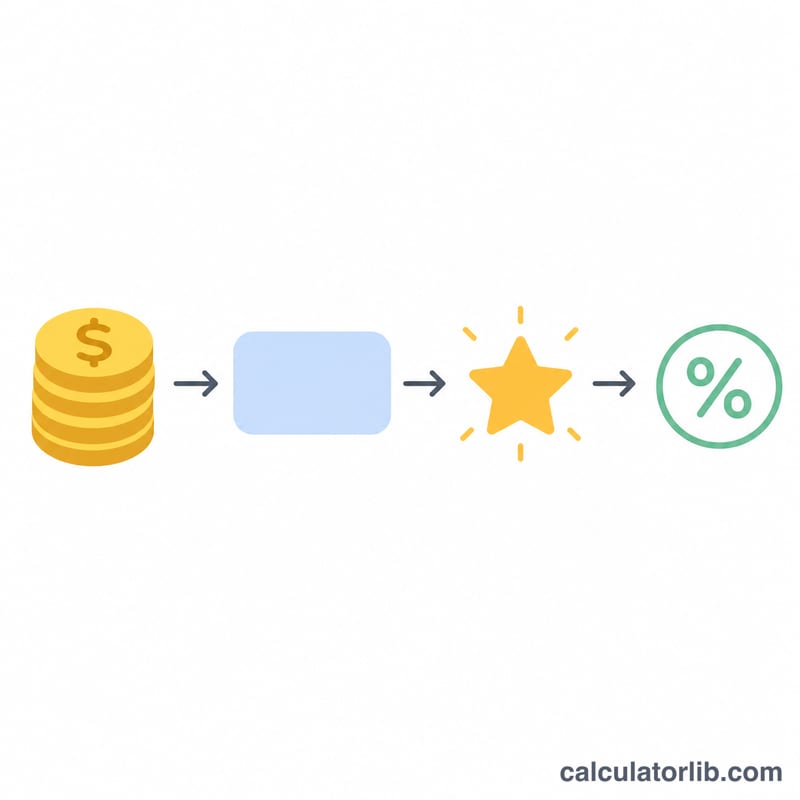
When a top-up, charge, or purchase earns you reward points (loyalty points, e-money points, store points, and similar), the points behave like a rebate on what you paid. This tool compares the amount charged against the points received and reports your effective return rate and net effective cost, so you can judge which charge tier is the best value. The math is pure percentage arithmetic and works with any currency.
How to use it
Enter the charge / payment amount (the money you actually pay), the points earned for that charge, and the value per point in currency units. Most programs treat 1 point as 1 currency unit, so the default value per point is 1 — but you can raise or lower it to model points worth more or less than face value. Run several charge tiers and pick the one with the highest return rate.
The formula explained
First the points are converted to money: \(\text{pointMoneyValue} = \text{pointsEarned} \times \text{pointValue}\). The effective return rate is that value as a percentage of what you paid:
$$\text{returnRate} = 100 \times \frac{\text{pointMoneyValue}}{\text{chargeAmount}}$$Your real outlay is \(\text{netCost} = \text{chargeAmount} - \text{pointMoneyValue}\), and the net cost rate is \(100 - \text{returnRate}\). A higher return rate (equivalently a lower net cost rate) means a better-value charge.
Worked example
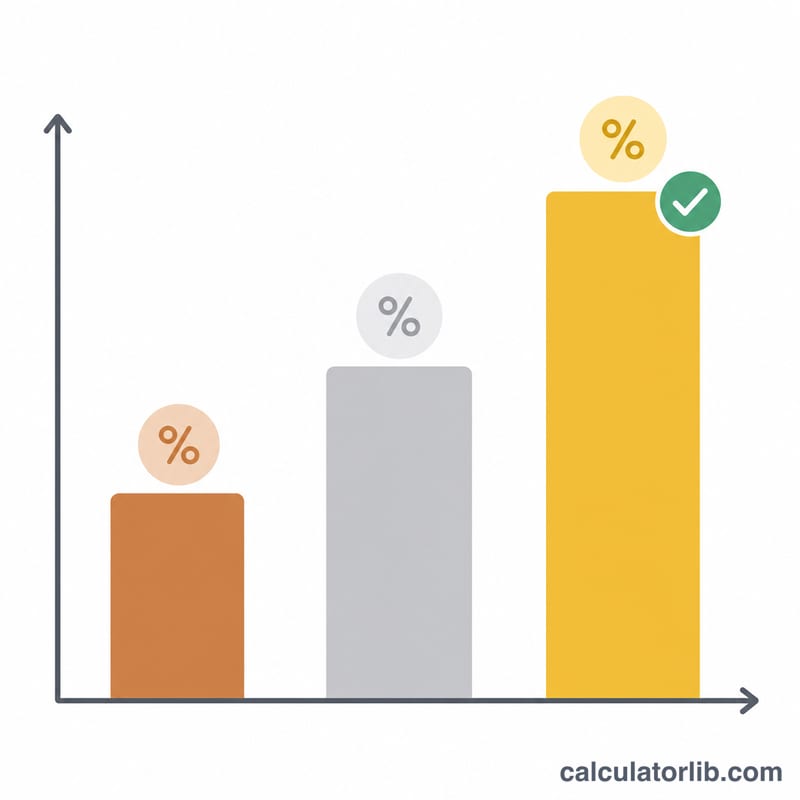
Charge 10,000 and receive 1,000 points worth 1 each. Point money value = 1,000. Return rate = $$100 \times \frac{1{,}000}{10{,}000} = \textbf{10\%}.$$ Net cost = \(10{,}000 - 1{,}000 = \textbf{9{,}000}\), a 90% net cost rate. Compare a 5,000 charge that earns 600 points: return rate = $$100 \times \frac{600}{5{,}000} = 12\%.$$ Because \(12\% > 10\%\), the 5,000 tier is the better deal.
FAQ
Can the return rate exceed 100%? Yes, if points are worth more than the charge. The net cost then goes negative, meaning you effectively profit.
What if I earn zero points? The return rate is 0% and your net cost equals the full charge amount.
Why must the charge amount be above zero? The return rate divides by the charge amount, so a zero charge is undefined and the tool returns an error.