What is a Point Slope Calculator?
A point slope calculator is a tool that determines the slope of a line between two points on a coordinate plane. The slope represents the steepness or incline of a line, measuring the rate of change in the y-coordinate relative to the change in the x-coordinate. It's a fundamental concept in coordinate geometry and linear equations.
When to Use a Point Slope Calculator
You might find a point slope calculator useful in these situations:
- When analyzing the rate of change between two data points in scientific or economic graphs
- When determining whether lines are parallel, perpendicular, or neither in geometric problems
- When finding the equation of a line passing through two specific points in coordinate geometry
How to Calculate the Slope
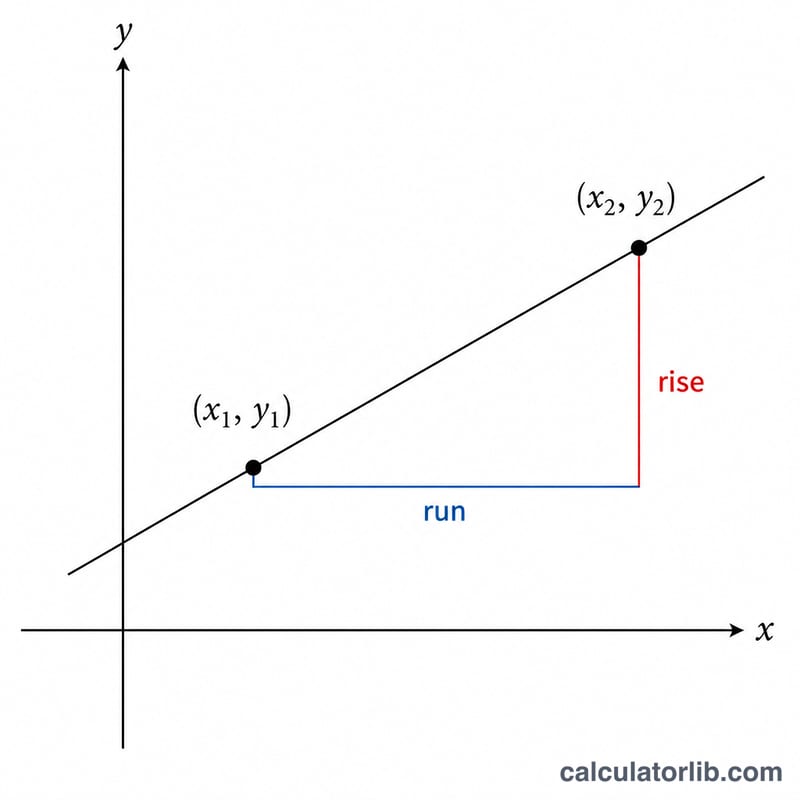
To calculate the slope between two points (x₁, y₁) and (x₂, y₂), you use the following formula:
Slope (m) = (y₂ - y₁) / (x₂ - x₁)
Important notes about slope calculation:
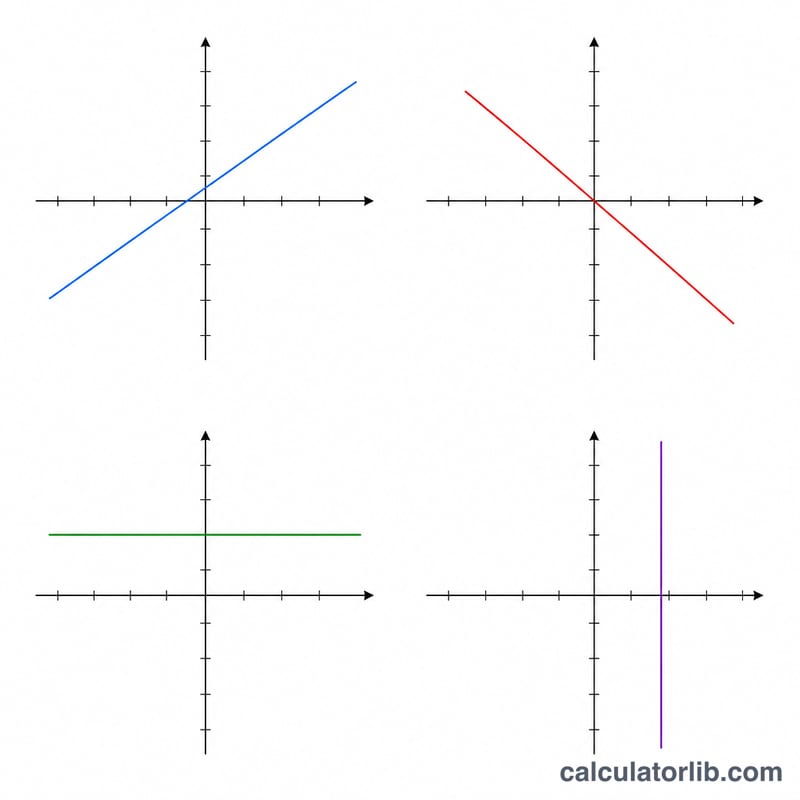
- If the denominator (x₂ - x₁) equals zero, the slope is undefined, indicating a vertical line with equation x = x₁
- A positive slope indicates an upward incline from left to right
- A negative slope indicates a downward incline from left to right
- A slope of zero indicates a horizontal line
Examples
Example 1: Calculate the slope between two points
Find the slope of the line passing through the points (2, 5) and (6, 9).
| Given | Value |
|---|---|
| Point 1 (x₁, y₁) | (2, 5) |
| Point 2 (x₂, y₂) | (6, 9) |
| Calculation | m = (9 - 5) / (6 - 2) = 4 / 4 = 1 |
| Result | Slope = 1 |
Example 2: Calculate the slope of a horizontal line
Calculate the slope of the line passing through the points (3, 4) and (7, 4).
| Given | Value |
|---|---|
| Point 1 (x₁, y₁) | (3, 4) |
| Point 2 (x₂, y₂) | (7, 4) |
| Calculation | m = (4 - 4) / (7 - 3) = 0 / 4 = 0 |
| Result | Slope = 0 (Horizontal line) |
Example 3: Calculate the slope of a vertical line
Find the slope of the line passing through the points (5, 2) and (5, 8).
| Given | Value |
|---|---|
| Point 1 (x₁, y₁) | (5, 2) |
| Point 2 (x₂, y₂) | (5, 8) |
| Calculation | m = (8 - 2) / (5 - 5) = 6 / 0 = undefined |
| Result | Slope = undefined (Vertical line) |
Common Slope Values and Their Meaning
| Slope Value | Meaning |
|---|---|
| Positive (m > 0) | Line rises from left to right |
| Negative (m < 0) | Line falls from left to right |
| Zero (m = 0) | Horizontal line |
| Undefined | Vertical line |
| m = 1 | Line rises at 45 degrees |
| m = -1 | Line falls at 45 degrees |
Related Calculators
For more calculations related to lines and slopes, you might find these calculators useful:
- Rise Over Run Calculator
- Slope Percentage Calculator
- Point Slope Form Calculator
- Linear Equation Calculator
- Midpoint Calculator
Key Terms in Slope and Point-Slope Form
- Slope (m): A number describing how steep a line is and which way it tilts. It is the change in y divided by the change in x. A positive slope rises left to right, a negative slope falls, and a slope of 0 is horizontal.
- Rise: The vertical change between two points, \(y_2 - y_1\).
- Run: The horizontal change between two points, \(x_2 - x_1\).
- Coordinates \((x_1, y_1)\) and \((x_2, y_2)\): The ordered pairs that locate two distinct points on the plane. The first number is the horizontal position (x) and the second is the vertical position (y).
- Undefined slope: When \(x_2 = x_1\), the run is 0 and division by zero is not allowed. The line is vertical, with equation \(x = x_1\), and has no slope value.
- Parallel lines: Two non-vertical lines that have equal slopes, \(m_1 = m_2\). They never intersect.
- Perpendicular lines: Two lines that meet at a right angle. Their slopes are negative reciprocals, so \(m_1 \cdot m_2 = -1\). For example, slopes 2 and \(-\tfrac{1}{2}\).
- Point-slope form: \(y - y_1 = m(x - x_1)\). It gives the equation of a line from its slope m and any one point \((x_1, y_1)\) on it.
- Slope-intercept form: \(y = mx + b\), where m is the slope and b is the y-intercept, the value of y where the line crosses the y-axis (x = 0).
Which slope tool do you need?
- Slope calculator: slope, angle, distance and line equation between two points.
- Point-slope calculator (this page): the slope m from two points, ready for the point-slope form y − y₁ = m(x − x₁).
- Slope-intercept calculator: the slope m and y-intercept b of the line y = mx + b through two points.
- Slope percentage calculator: the percent grade from rise and run (rise ÷ run × 100).
- Slope to degrees: the angle of a slope in degrees and radians.
- Degrees to slope percent: the percent grade of an angle given in degrees.