
What the Rise Over Run Calculator Does
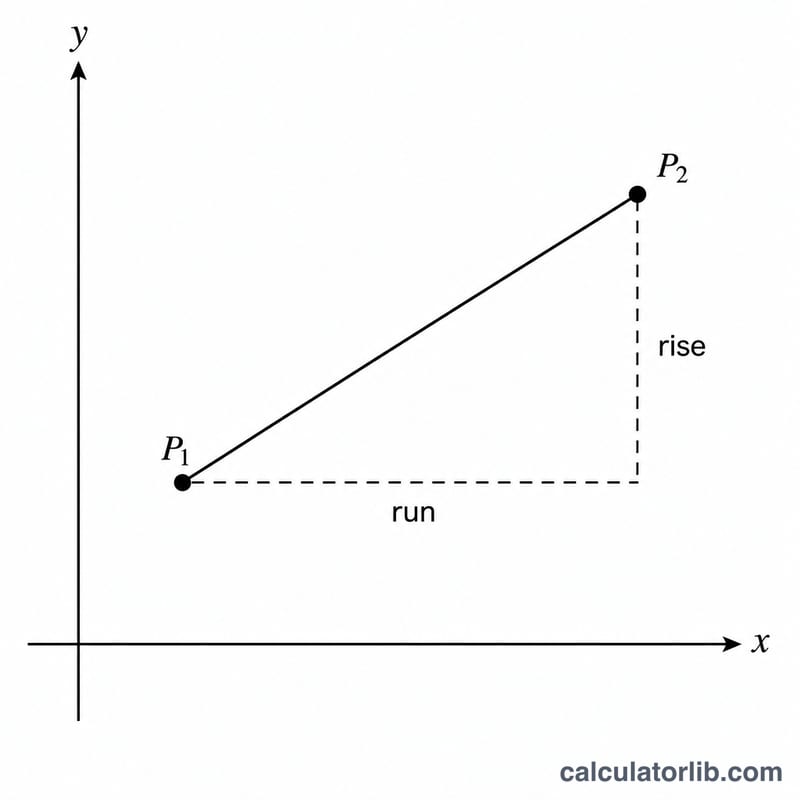
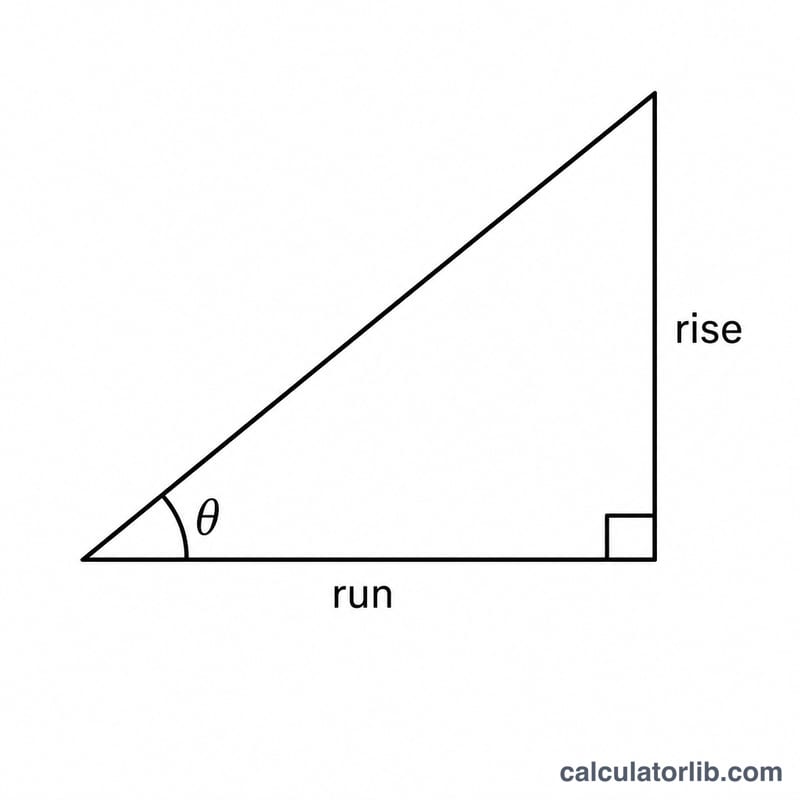
This calculator finds the slope of a straight line from two points on a coordinate plane. You provide the coordinates of two points — the first point (X1, Y1) and the second point (X2, Y2) — and the tool computes four things at once: the rise (vertical change), the run (horizontal change), the slope (m), and the angle the line makes with the horizontal, expressed in degrees.
It is a quick aid for algebra, geometry, trigonometry, and physics problems where you need to describe how steeply a line climbs or falls.
The Inputs
- X1, Y1 – the coordinates of your first point.
- X2, Y2 – the coordinates of your second point.
All four values can be positive, negative, or zero. Order does not affect the slope, as long as you keep each point's X and Y together.
The Formula
The calculator uses the standard slope definition:
$$\text{m} = \frac{\text{rise}}{\text{run}} = \frac{y_2 - y_1}{x_2 - x_1}$$
It first computes the rise as \(y_2 - y_1\) and the run as \(x_2 - x_1\). The slope is rise divided by run. If the run is zero (a perfectly vertical line), the slope is undefined — the tool returns infinity, because you cannot divide by zero. The angle is then found with \(\text{angle} = \arctan(\text{slope})\), converted from radians to degrees.
Worked Example
Suppose your points are (1, 2) and (4, 8):
- Rise = \(y_2 - y_1 = 8 - 2 = 6\)
- Run = \(x_2 - x_1 = 4 - 1 = 3\)
- Slope = \(\frac{6}{3} = 2\)
- Angle = \(\arctan(2) \approx 63.43°\)
So the line rises 2 units for every 1 unit it moves right, and it climbs at about 63.4 degrees from horizontal.
Frequently Asked Questions
What does a negative slope mean? A negative slope means the line falls as you move from left to right. The calculator returns a negative angle in that case.
Why is my slope shown as infinity? That happens when X1 equals X2, making the run zero. The line is vertical, so its slope is undefined.
What if the slope is zero? A slope of zero means the line is perfectly horizontal (\(y_2 = y_1\)), and the angle is 0 degrees.