
What the Remainder Calculator Does
This calculator performs integer-style division on two numbers you supply and tells you two things at once: the integer quotient (how many whole times the divisor fits into the dividend) and the remainder (the amount left over). It is the same idea behind the modulo or "mod" operation written as % in most programming languages and spreadsheets. Instead of doing long division by hand, you enter the numbers and get both results instantly.
The Two Inputs
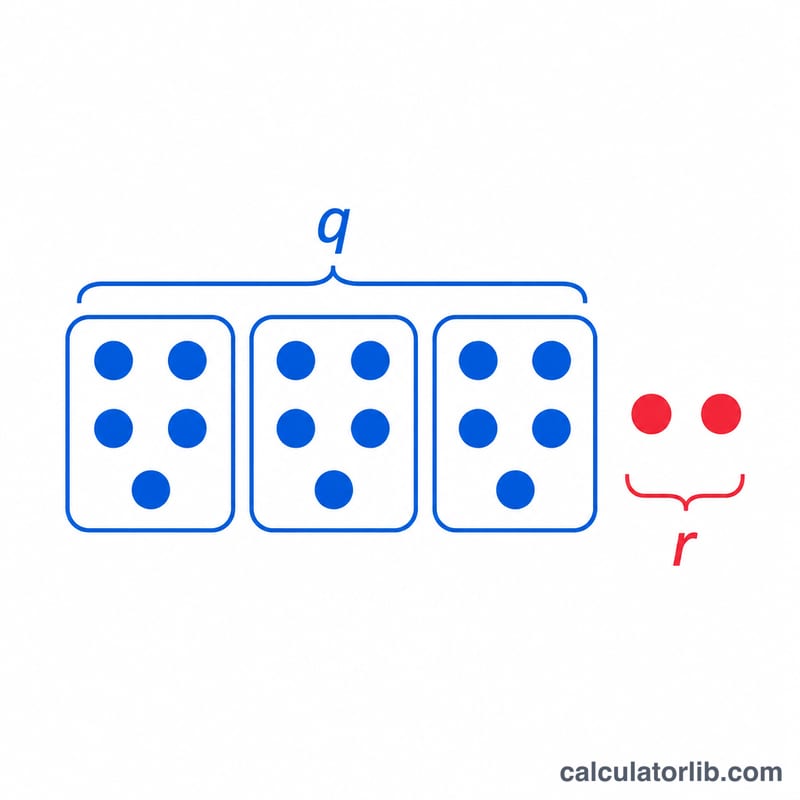
- Dividend – the number being divided (the total amount you want to split up).
- Divisor – the number you divide by (the size of each group). This must not be zero.
Both fields accept decimal values, not just whole numbers, so the tool works for fractional dividends and divisors too.
The Formula
The remainder is calculated as:
$$\text{Remainder} = \text{Dividend} - \left( \left\lfloor \frac{\text{Dividend}}{\text{Divisor}} \right\rfloor \times \text{Divisor} \right)$$Here \( \lfloor\ \rfloor \) means "round down to the nearest whole number" (the floor function). The quotient is simply \( \left\lfloor \frac{\text{Dividend}}{\text{Divisor}} \right\rfloor \) — the whole-number part of the division. Internally the remainder uses the same logic as the % operator, so the leftover always carries the sign of the dividend. If the divisor is 0, division is undefined and the calculator returns an "Error: Division by zero" message instead of a result.
Worked Example
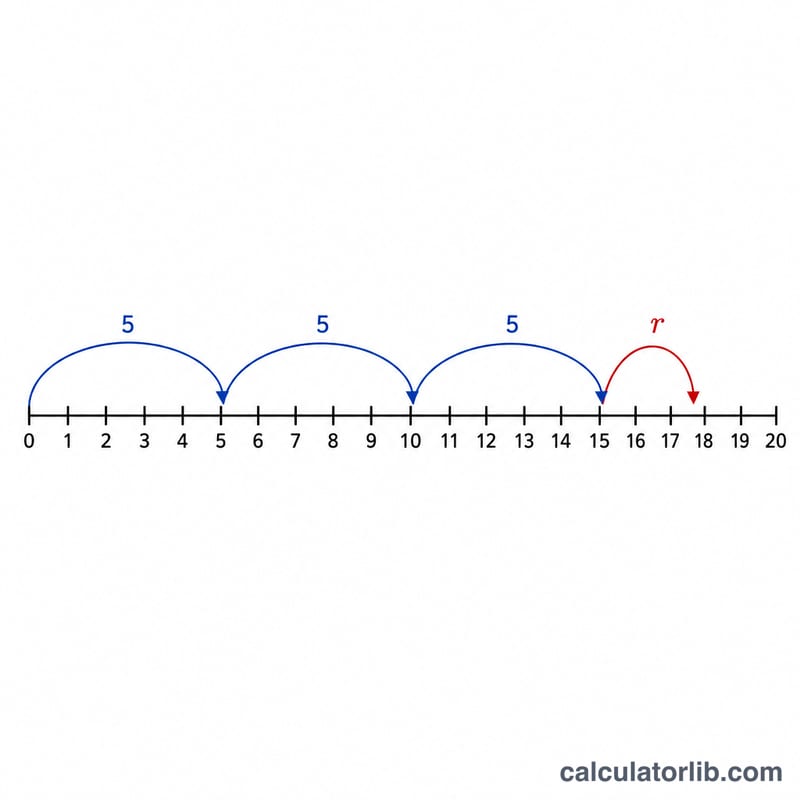
Suppose you have a Dividend of 17 and a Divisor of 5:
- Quotient = \( \left\lfloor 17 \div 5 \right\rfloor = \lfloor 3.4 \rfloor = \mathbf{3} \)
- Remainder = \( 17 - (3 \times 5) = 17 - 15 = \mathbf{2} \)
So 5 fits into 17 three whole times, with 2 left over. This is exactly what 17 % 5 returns in code.
Frequently Asked Questions
Can I use decimal numbers? Yes. For example, a dividend of 7.5 and a divisor of 2 gives a quotient of 3 and a remainder of 1.5, because \( 7.5 - (3 \times 2) = 1.5 \).
What happens if the divisor is 0? Division by zero is mathematically undefined, so the calculator does not return a number. It displays "Error: Division by zero" instead.
What if the dividend is smaller than the divisor? The quotient is 0 and the remainder equals the dividend itself. For instance, 3 ÷ 8 gives a quotient of 0 and a remainder of 3, since 8 does not fit into 3 even once.