
What Is a Cofunction?
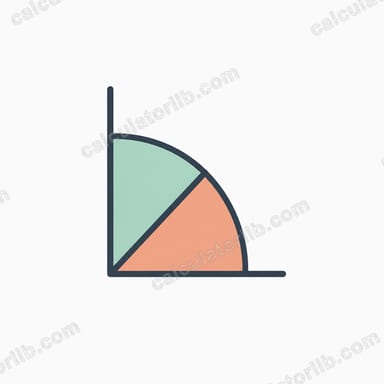
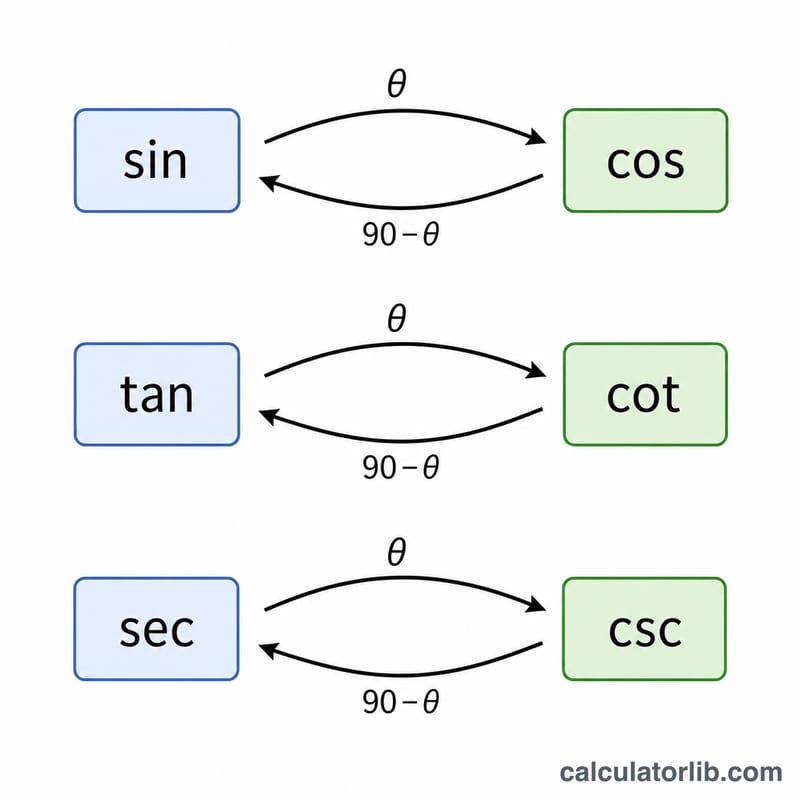
In trigonometry, every function has a "cofunction" — a partner whose value at the complementary angle is identical. Sine pairs with cosine, tangent with cotangent, and secant with cosecant. The complementary angle is whatever you add to your angle to reach 90° (or \(\frac{\pi}{2}\) radians). This calculator finds that complement and rewrites each trig ratio in terms of its cofunction.
How to Use It
Enter your angle \(\theta\), choose whether it is in degrees or radians, and the calculator returns the complementary angle along with the three cofunction relationships. For an angle of 30°, the complement is 60°, so \(\sin(30^{\circ}) = \cos(60^{\circ})\), \(\tan(30^{\circ}) = \cot(60^{\circ})\), and \(\sec(30^{\circ}) = \csc(60^{\circ})\).
The Formula Explained
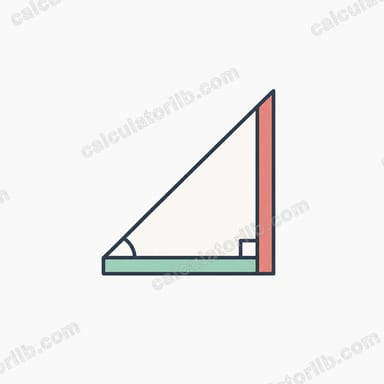
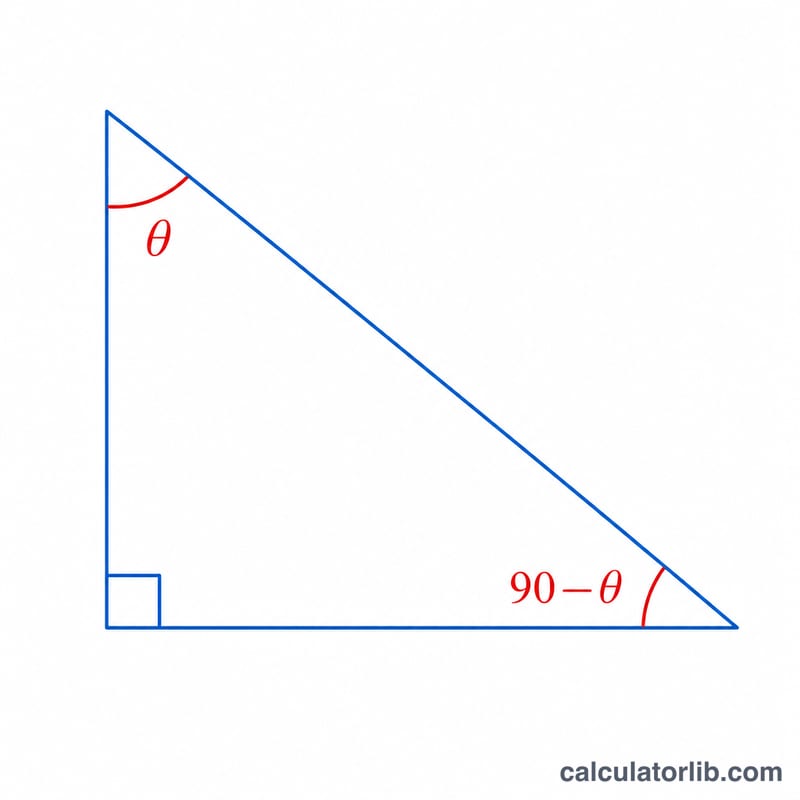
The identities come directly from the geometry of a right triangle: the two non-right angles always sum to 90°, so the side that is "opposite" one angle is "adjacent" to the other. This swaps sine and cosine roles. In symbols: $$\sin(\theta) = \cos\left(90^{\circ} - \text{Angle }(\theta)\right)$$ \(\tan\theta = \cot(90^{\circ} - \theta)\), \(\sec\theta = \csc(90^{\circ} - \theta)\). The reverse pairings (\(\cos\theta = \sin(90^{\circ} - \theta)\), etc.) hold equally well.
Worked Example
Suppose \(\theta = 25^{\circ}\). The complement is $$90 - 25 = 65^{\circ}$$ Therefore \(\sin(25^{\circ}) = \cos(65^{\circ}) \approx 0.4226\), \(\tan(25^{\circ}) = \cot(65^{\circ}) \approx 0.4663\), and \(\sec(25^{\circ}) = \csc(65^{\circ}) \approx 1.1034\). The calculator does the complement arithmetic instantly so you can apply any cofunction identity.
FAQ
Do cofunction identities work in radians? Yes. Just replace 90° with \(\frac{\pi}{2}\). The calculator handles both units.
What if my angle is greater than 90°? The identities still hold algebraically; the complement simply becomes negative, which is mathematically valid.
Why are they called cofunctions? The "co" prefix (cosine, cotangent, cosecant) literally means "complement of" — the function of the complementary angle.