What Is the Cotangent Calculator?
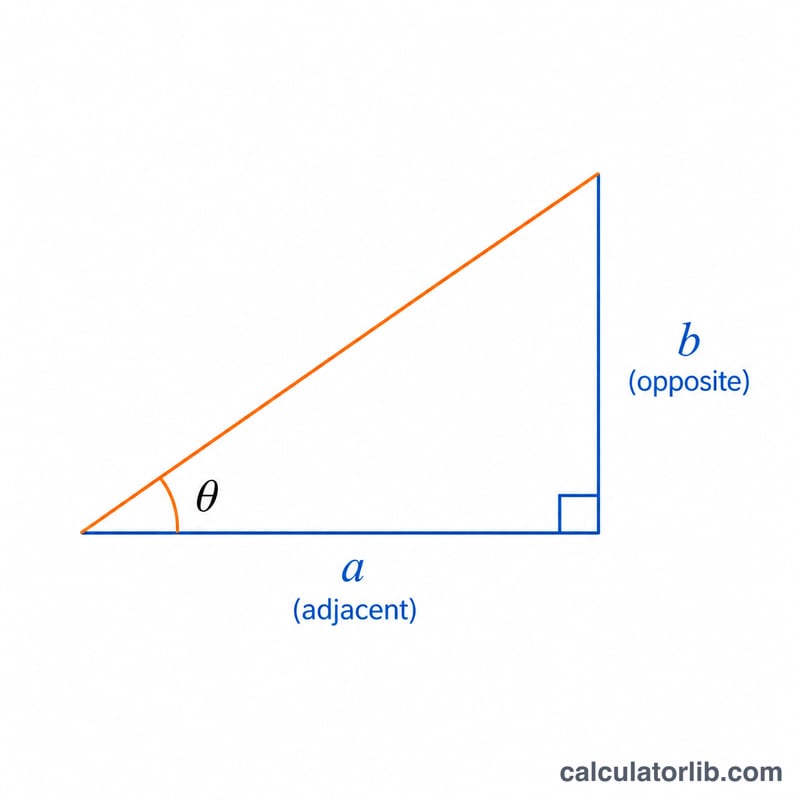
The cotangent calculator finds the trigonometric cotangent of an angle, written \(\cot(\theta)\). Cotangent is one of the six standard trigonometric functions and is defined as the ratio of the cosine of an angle to its sine — or equivalently, the reciprocal of the tangent. It is used widely in trigonometry, physics, engineering, and geometry to describe relationships between sides and angles.
How to Use It
Enter the angle, then choose whether the value is in degrees or radians. The calculator converts degrees to radians internally, then computes \(\cot(\theta) = \cos(\theta)/\sin(\theta)\). The result is shown along with the angle expressed in radians for reference. Note that cotangent is undefined when \(\sin(\theta) = 0\) — that happens at 0°, 180°, 360°, and every multiple of 180°.
The Formula Explained
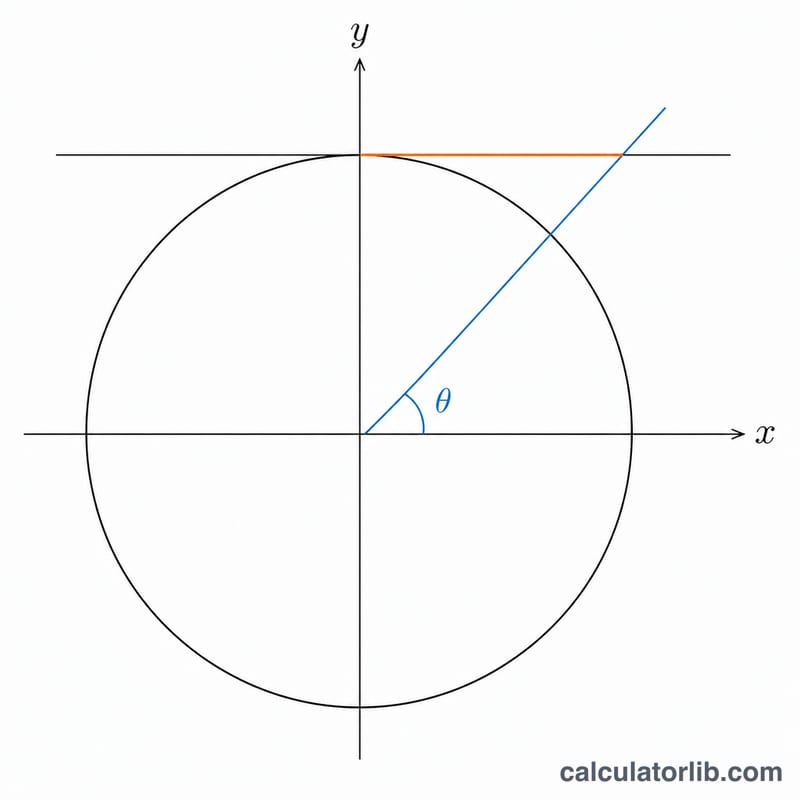
The core identity is \(\cot(\theta) = \cos(\theta)/\sin(\theta) = 1/\tan(\theta)\). Because the unit-circle sine appears in the denominator, the function grows without bound as the angle approaches a multiple of 180° and the sine approaches zero. For all other angles the ratio gives a finite, exact value.
$$\cot(\theta) = \frac{\cos\left(\text{Angle} \cdot \frac{\pi}{180}\right)}{\sin\left(\text{Angle} \cdot \frac{\pi}{180}\right)}$$Worked Example
For \(\theta = 45°\): \(\cos(45°) \approx 0.70710678\) and \(\sin(45°) \approx 0.70710678\), so $$\cot(45°) = \frac{0.70710678}{0.70710678} = 1$$ For \(\theta = 30°\): \(\cos(30°) \approx 0.8660254\), \(\sin(30°) = 0.5\), so $$\cot(30°) = \frac{0.8660254}{0.5} \approx 1.7320508$$ (which is \(\sqrt{3}\)).
Interpreting the Cotangent Result
- Sign by quadrant: cot is positive in quadrant I (0°–90°) and quadrant III (180°–270°), where sine and cosine have the same sign. It is negative in quadrant II (90°–180°) and quadrant IV (270°–360°), where they have opposite signs.
- Period: cot repeats every 180° (π radians): \(\cot(\theta + 180^\circ) = \cot\theta\). This is why cot 30° and cot 210° are both √3.
- Behavior across a period: within each interval between two undefined angles (for example 0° to 180°), cot decreases continuously from +∞ to −∞, passing through 1 at 45°, 0 at 90° and −1 at 135°.
- Complementary relationship: \(\cot\theta = \tan(90^\circ - \theta)\). For example, \(\cot 30^\circ = \tan 60^\circ = \sqrt{3}\).
- Odd function: \(\cot(-\theta) = -\cot\theta\), so the graph is symmetric about the origin. For example, \(\cot(-45^\circ) = -1\).
- Near undefined angles: at multiples of 180° the graph has vertical asymptotes. As θ approaches 0° from above, cot grows toward +∞. As θ approaches 0° from below (for example −0.001°), it falls toward −∞. The same happens around 180° and 360°.
- Zeros: cot is 0 at 90° + k·180° (90°, 270°, …), where cosine is 0.
Because computers store π only approximately, entering exactly 180° or π radians may return a very large number rather than "undefined". Treat such a value as the asymptote, not a real result.
FAQ
What is \(\cot(90°)\)? Since \(\cos(90°) = 0\) and \(\sin(90°) = 1\), \(\cot(90°) = 0\).
Why is cotangent sometimes undefined? When \(\sin(\theta) = 0\) (at 0°, 180°, 360°…), dividing by zero is undefined, so cotangent has no value at those angles.
Is cot the same as 1/tan? Yes — cotangent is the reciprocal of tangent wherever tangent is defined and nonzero.