
What This Calculator Does
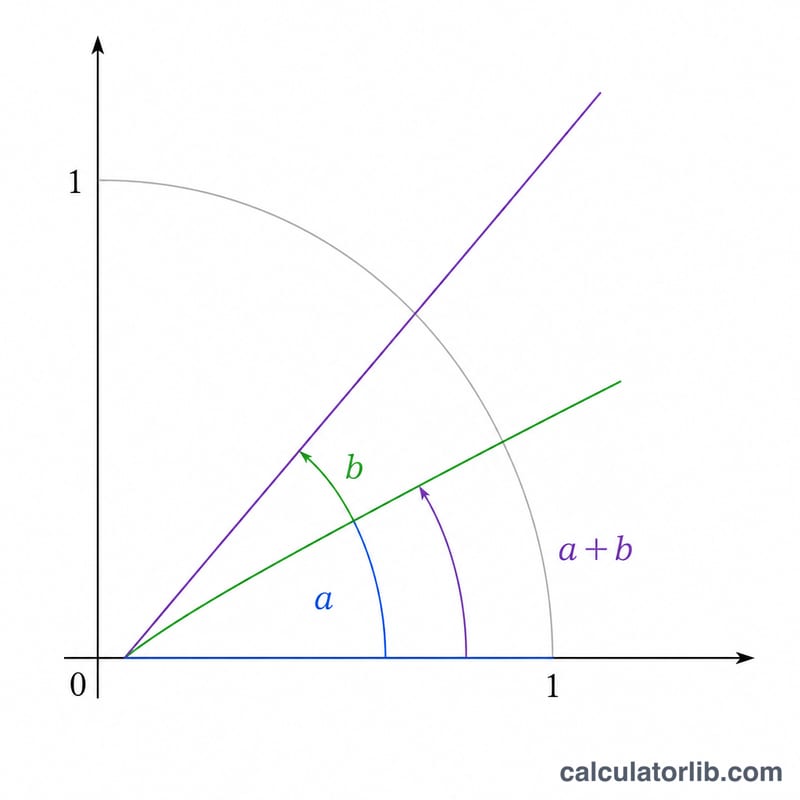
The Sum and Difference Identities Calculator evaluates the four core trigonometric identities for two angles a and b: \(\sin(a+b)\), \(\sin(a-b)\), \(\cos(a+b)\) and \(\cos(a-b)\). These identities let you express the trig function of a combined angle in terms of the sine and cosine of the individual angles, which is essential for simplifying expressions, solving equations, and proving other identities.
How to Use It
Enter your two angles in the Angle a and Angle b fields, choose whether they are in degrees or radians, and the calculator returns all four results at once. Decimal angles are fully supported, and radian mode accepts values such as \(\pi/6 \approx 0.5236\).
The Formulas Explained
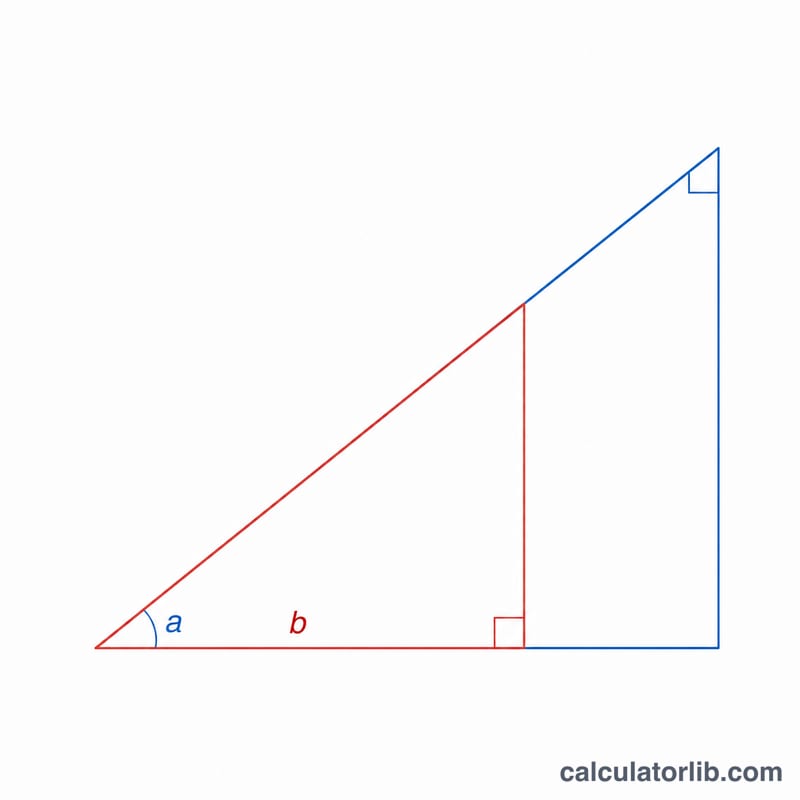
The identities are: $$\begin{aligned} \sin(\text{a} \pm \text{b}) &= \sin\text{a}\cos\text{b} \pm \cos\text{a}\sin\text{b} \\ \cos(\text{a} \pm \text{b}) &= \cos\text{a}\cos\text{b} \mp \sin\text{a}\sin\text{b} \end{aligned}$$ Notice the sign pattern: for sine the signs match the input (+ gives +), while for cosine they are reversed (+ gives −). Internally the calculator converts degrees to radians and evaluates each term with standard sine and cosine functions.
Worked Example
Let \(a = 30°\) and \(b = 45°\). Then \(\sin 30° = 0.5\), \(\cos 30° = 0.8660\), \(\sin 45° = \cos 45° = 0.7071\). So $$\sin(75°) = 0.5 \cdot 0.7071 + 0.8660 \cdot 0.7071 \approx 0.9659,$$ and $$\cos(75°) = 0.8660 \cdot 0.7071 - 0.5 \cdot 0.7071 \approx 0.2588.$$ The calculator confirms both instantly.
FAQ
Why do the cosine signs flip? The minus sign comes directly from the derivation using the unit circle and the rotation of points; it is a defining feature of the cosine identity.
Can I use negative angles? Yes. Negative inputs work correctly and follow the standard even/odd properties of sine and cosine.
Are these the same as the angle addition formulas? Yes — "sum and difference identities" and "angle addition/subtraction formulas" refer to the same set of identities.