
What Is the Inverse Matrix Calculator?
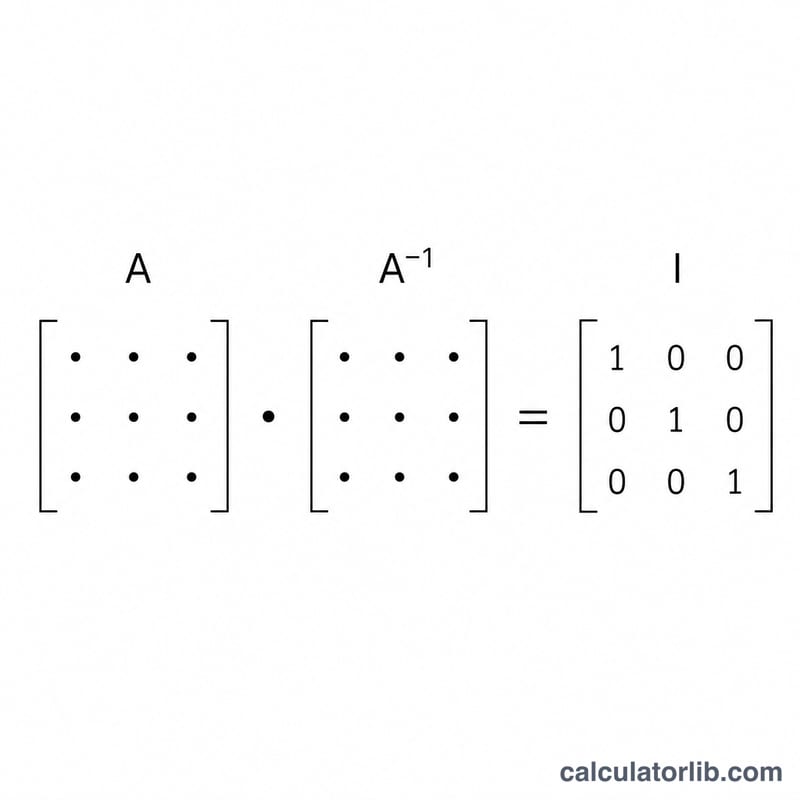
This tool computes the inverse of a square matrix — either 2×2 or 3×3. The inverse of a matrix A, written \(A^{-1}\), is the matrix that satisfies \(A\cdot A^{-1} = I\), where \(I\) is the identity matrix. An inverse exists only when the determinant is non-zero; otherwise the matrix is called singular and cannot be inverted.
How to Use It
Choose your matrix size (2×2 or 3×3), enter each entry in the corresponding cell, and the calculator returns the determinant and the full inverse matrix. For a 2×2 matrix only the top-left four cells (a11, a12, a21, a22) are used. If the determinant is zero, the tool tells you the matrix has no inverse.
The Formula Explained
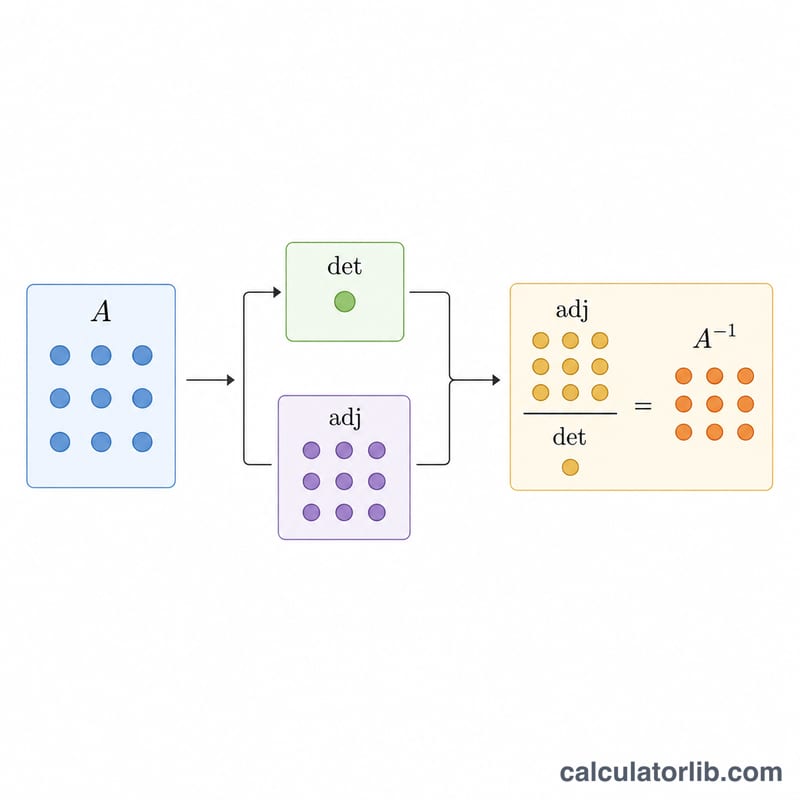
The general method uses the adjugate: $$A^{-1} = \frac{\operatorname{adj}(A)}{\det(A)}$$ The adjugate is the transpose of the cofactor matrix. For a 2×2 matrix \(\begin{bmatrix} a & b \\ c & d \end{bmatrix}\) this simplifies to $$A^{-1} = \frac{1}{ad-bc} \begin{bmatrix} d & -b \\ -c & a \end{bmatrix}$$ For a 3×3 matrix we compute nine cofactors, transpose them, and divide each by the determinant.
Worked Example
Take \(A = \begin{bmatrix} 4 & 7 \\ 2 & 6 \end{bmatrix}\). The determinant is $$(4\cdot 6) - (7\cdot 2) = 24 - 14 = 10$$ The inverse is $$\frac{1}{10}\begin{bmatrix} 6 & -7 \\ -2 & 4 \end{bmatrix} = \begin{bmatrix} 0.6 & -0.7 \\ -0.2 & 0.4 \end{bmatrix}$$ You can verify \(A\cdot A^{-1}\) gives the identity matrix.
FAQ
Why does my matrix have no inverse? Because its determinant is zero — the rows or columns are linearly dependent, so the matrix is singular.
Does the inverse always exist? No. Only square matrices with a non-zero determinant are invertible.
How can I check the result? Multiply the original matrix by the computed inverse; you should get the identity matrix (1s on the diagonal, 0s elsewhere).