
What this calculator does
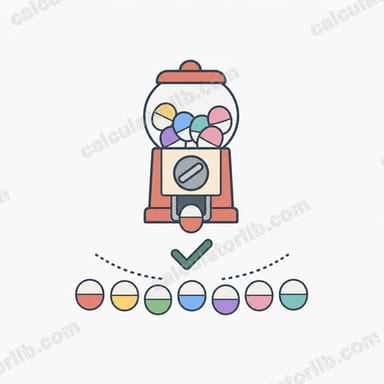
This tool estimates how many gacha pulls, capsule-toy purchases, trading cards, or sticker packs you should expect to open before you have collected at least one of every item in a complete set. It is the classic "Coupon Collector's Problem" from probability theory. The result is an average over many attempts: any single playthrough can be luckier or unluckier. This is universal math and applies to any country or platform.
How to use it
Enter the total number of distinct item types in the set you want to complete (for example, a 6-item capsule lineup or a 66-card series) and read off the expected number of draws. The calculator assumes every item is equally likely to appear on each draw.
The formula explained
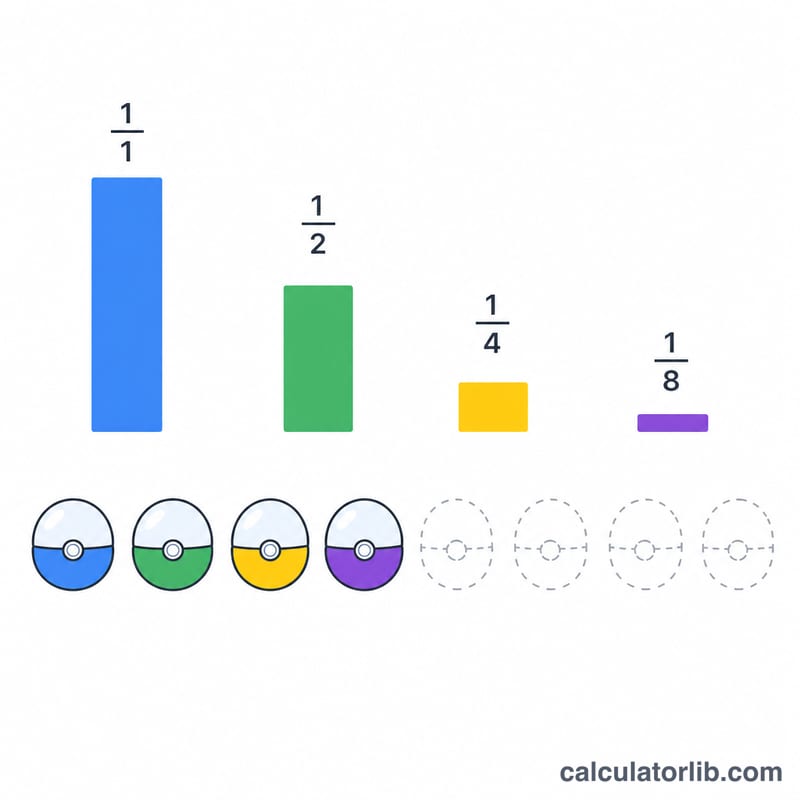
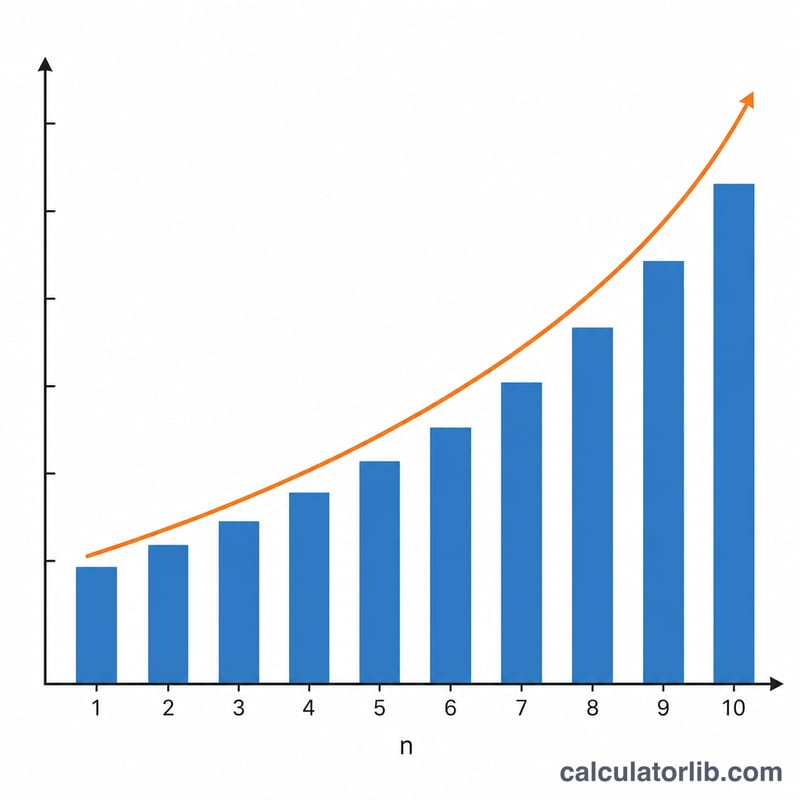
If there are n equally-likely item types, the expected number of draws to complete the set is $$E(n) = n \times H(n)$$ where \(H(n)\) is the n-th harmonic number: \(H(n) = 1 + 1/2 + 1/3 + \ldots + 1/n\). The intuition: once you already own \(i-1\) distinct items, the chance the next draw is something new is \((n-(i-1))/n\), so it takes on average \(n/(n-(i-1))\) draws to find the i-th new item. Adding these up from \(i=1\) to \(n\) gives n times the sum of \(1/k\).
Worked example
For a 6-item set: $$H(6) = 1 + \frac{1}{2} + \frac{1}{3} + \frac{1}{4} + \frac{1}{5} + \frac{1}{6} = 2.45$$ so \(E = 6 \times 2.45 =\) 14.7 draws. The first item is guaranteed in 1 draw, but the last, hardest-to-get item alone takes about 6 draws on average.
FAQ
Does this work for rarity tiers or unequal drop rates? No. The formula assumes every item is equally likely. If your gacha has rare and common items with different rates, you need the more general weighted coupon-collector model, which gives a larger number.
Is the answer a guarantee? No, it is the long-run average. You might finish faster or much slower; the distribution has a long tail.
How do I estimate cost? Multiply the expected draws by your price per draw to get an expected budget.