What is Half-Life?
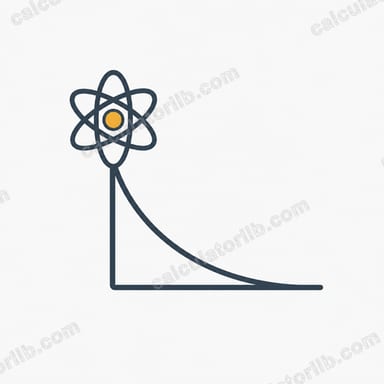
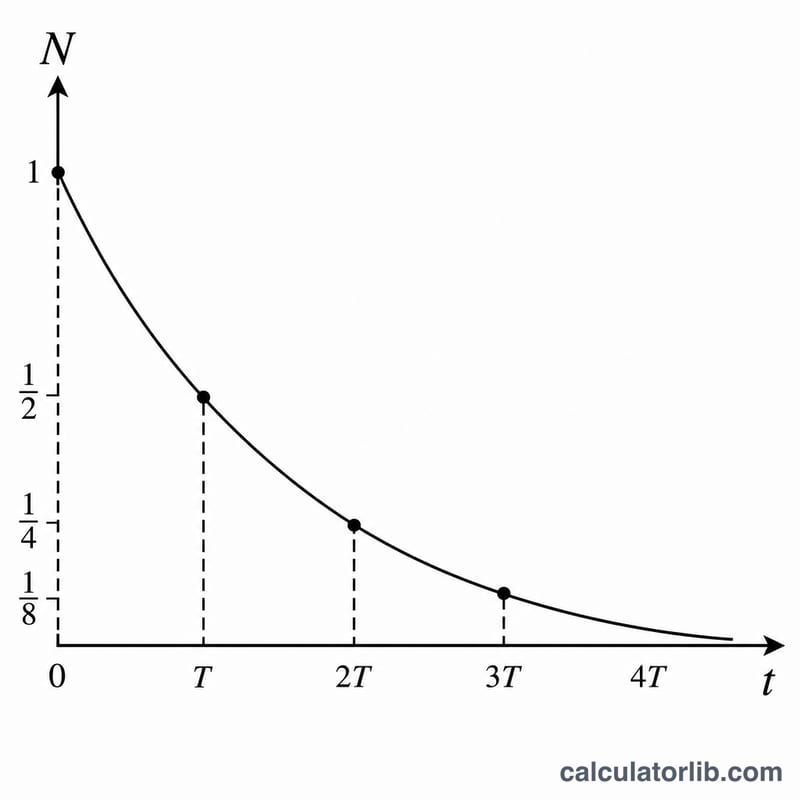
The half-life of a substance is the time required for half of it to decay (radioactive isotopes), be eliminated (drugs in the body), or otherwise reduce to 50% of its original quantity. Halflife governs first-order decay processes and underlies carbon dating, drug dosing intervals, and reactor calculations.
The Formula
$$N(t) = N_0 \cdot \left(\frac{1}{2}\right)^{t / T}$$
where \(N_0\) is the starting quantity, \(N(t)\) is the remaining quantity after time \(t\), and \(T\) is the half-life. The relationship is symmetric — given any three of the four variables, you can solve for the fourth:
- Remaining: \(N(t) = N_0 \times 0.5^{t/T}\)
- Initial: \(N_0 = N(t) \times 2^{t/T}\)
- Time: \(t = T \times \dfrac{\log(N(t)/N_0)}{\log(0.5)}\)
- Half-life: \(T = t \times \dfrac{\log(0.5)}{\log(N(t)/N_0)}\)
Worked Examples
Carbon-14: Half-life \(T = 5{,}730\) years. After 11,460 years (2 half-lives), only 25% of the original C-14 remains. After 17,190 years (3 half-lives), 12.5% remains.
Drug elimination: A drug with a 6-hour half-life and a 100 mg starting dose decays to 50 mg at 6h, 25 mg at 12h, 12.5 mg at 18h, etc.
Iodine-131 (medical imaging): \(T = 8.02\) days. To estimate when a patient's body has reduced a tracer by 99%, solve $$t = 8.02 \times \frac{\log(0.01)}{\log(0.5)} \approx 53.3 \text{ days.}$$
Half-life vs Mean Lifetime vs Decay Constant
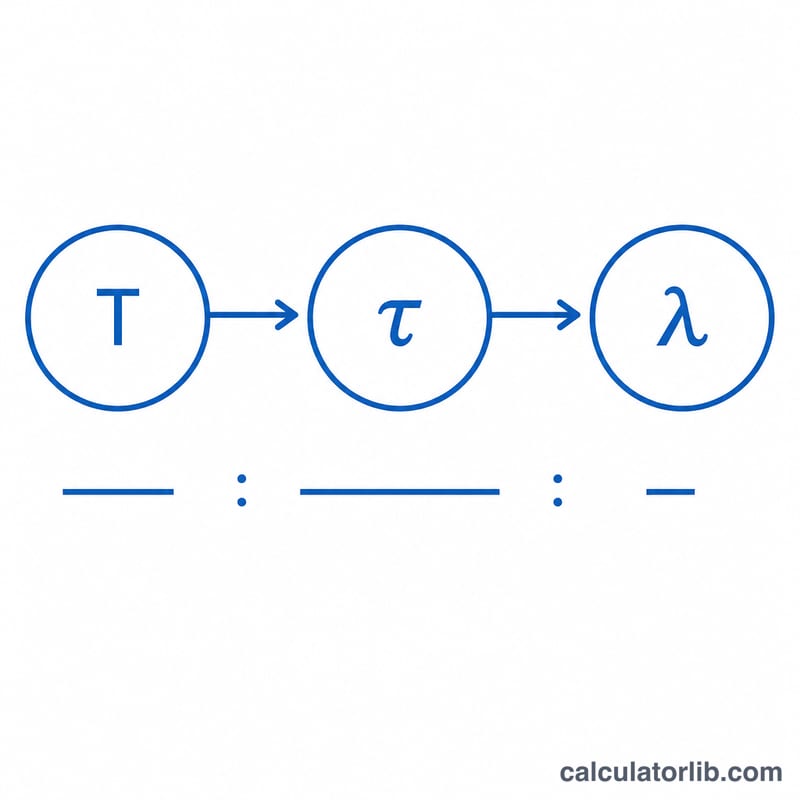
Three related but distinct quantities describe the same exponential decay:
- Half-life \(T\) — time for half to decay. The "everyday" parameter.
- Mean lifetime \(\tau\) — average lifetime of one particle/molecule before decay. \(\tau = T / \ln(2) \approx T \times 1.4427\).
- Decay constant \(\lambda\) — probability per unit time. \(\lambda = \ln(2) / T \approx 0.693 / T\).
Use whichever fits your context — physicists tend to use \(\lambda\), doctors quote half-life, and biologists use mean lifetime.
Multi-step Decay & Mixed Substances
Real samples often contain multiple isotopes or mixed compounds, each with its own half-life. The total quantity at time \(t\) is the sum of \(N_{0i} \times 0.5^{t/T_i}\) over each component \(i\). This calculator models a single half-life — to handle mixtures, run the calc separately for each component and add the results.
Caveats
- First-order assumption. The formula assumes constant fractional decay rate. Drug elimination follows it for most medications, but enzyme-saturated kinetics (alcohol, some drugs at high doses) is zero-order — different formula.
- No decay product tracking. The calculator returns remaining parent material, not daughter products. For radioactive chains (U-238 → Ra-226 → Rn-222), each step needs its own calc.
- Time units must match. If half-life is in days, time \(t\) must also be in days — the calculator uses dimensionless ratio \(t/T\).