
What this calculator does
The Running Calorie Burn Calculator estimates how many calories (kcal) you burn during a run and how far you travel, based on your running pace, body weight, and how long you run. It is a general fitness tool that applies universally. The MET values used here come from Japan's Ministry of Health, Labour and Welfare "Physical Activity Reference for Health Promotion 2013," which mirrors the international Compendium of Physical Activities, so the numbers are standard worldwide.
How to use it
Pick your running pace from the dropdown. Each option pairs a running speed (in meters per minute and km/h) with its corresponding MET value, so one selection drives both the distance and the calorie estimate. Then enter your body weight in kilograms and your running time in minutes. The calculator returns the calories burned in kcal and the distance covered in meters.
The formula explained
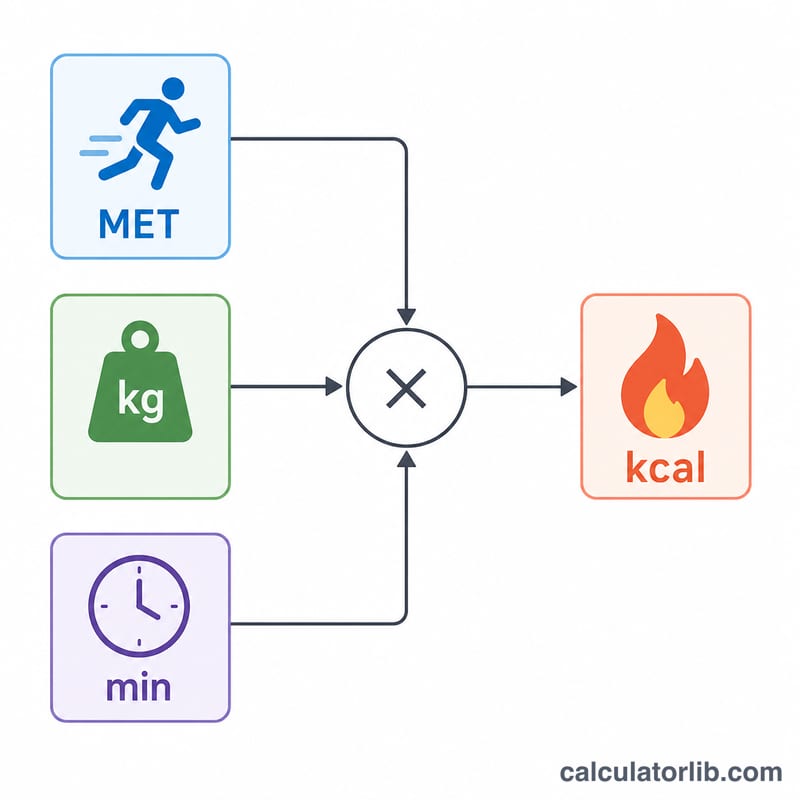
Calories are computed as $$\text{Calories} = \text{MET} \times \text{Weight (kg)} \times \frac{\text{Time (min)}}{60} \times 1.05$$ The duration in hours equals the minutes you ran divided by 60. The factor 1.05 is the standard conversion: one MET corresponds to roughly 1.05 kcal burned per kilogram of body weight per hour. Distance is simply the running speed in meters per minute multiplied by the running time in minutes.
Worked example
Suppose you select the "139 m/min (8.3 km/h) — 9 MET" pace, weigh 60 kg, and run for 30 minutes. Duration in hours is \(30 / 60 = 0.5\) h. $$\text{Calories} = 9 \times 60 \times 0.5 \times 1.05 = 283.5 \text{ kcal}$$ $$\text{Distance} = 139 \times 30 = 4{,}170 \text{ m}$$ (about 4.17 km). So a half-hour run at this pace burns roughly 284 kcal and covers around 4.2 km.
FAQ
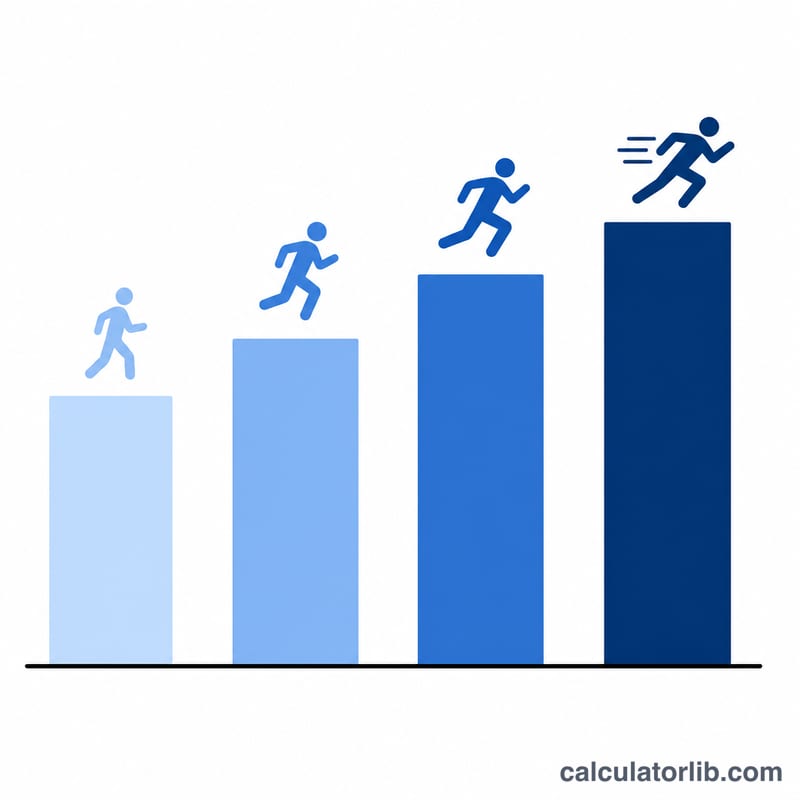
Why is MET tied to the pace? Faster running has a higher metabolic cost, so each pace option carries its own MET value. The dropdown sets both speed (for distance) and MET (for calories) at once.
What is a MET? A MET (Metabolic Equivalent of Task) compares the energy cost of an activity to resting. Running at 9 MET burns about nine times as much energy as sitting still.
How accurate is the estimate? MET-based formulas are good population averages but do not account for individual fitness, terrain, or wind. Treat the result as a useful approximation rather than an exact figure.