
What this calculator does
The Swimming Calorie Burn Calculator estimates how many calories (kilocalories) you burn during a swim. It uses the metabolic equivalent of task (MET) energy-expenditure formula, where each swimming style and intensity has a standard MET value. The MET values come from the revised Physical Activity METs Table published by the Japanese National Institute of Health and Nutrition, which is itself derived from the international Compendium of Physical Activities, so they apply universally regardless of country.
How to use it
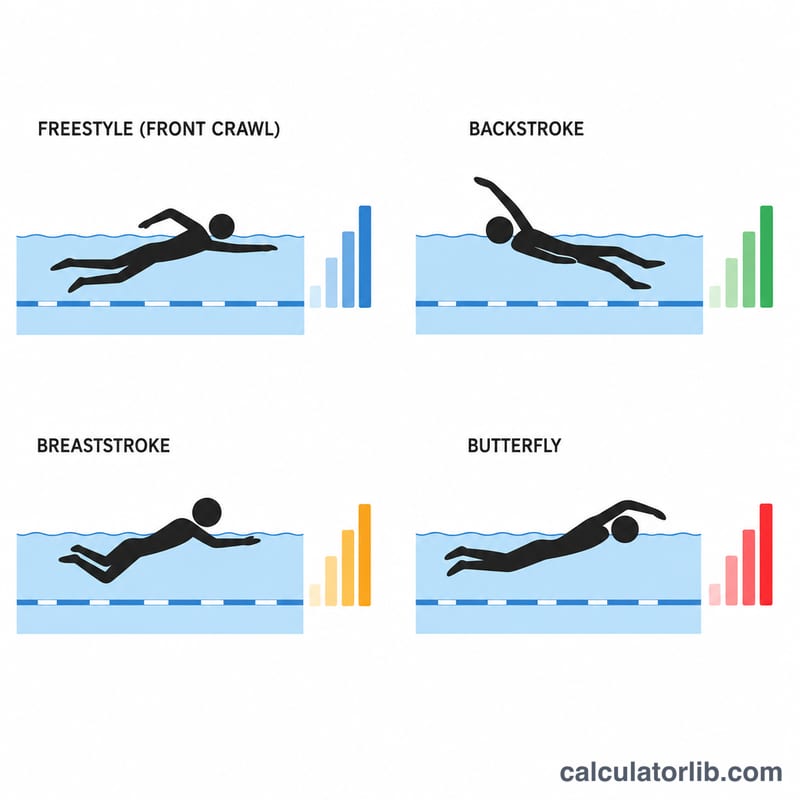
Pick the swimming style and intensity that best matches your session (for example front crawl at a moderate pace, breaststroke, or butterfly). Enter how long you swam in minutes and your body weight in kilograms. The calculator returns the exercise intensity in METs and the estimated calories burned in kcal.
The formula explained
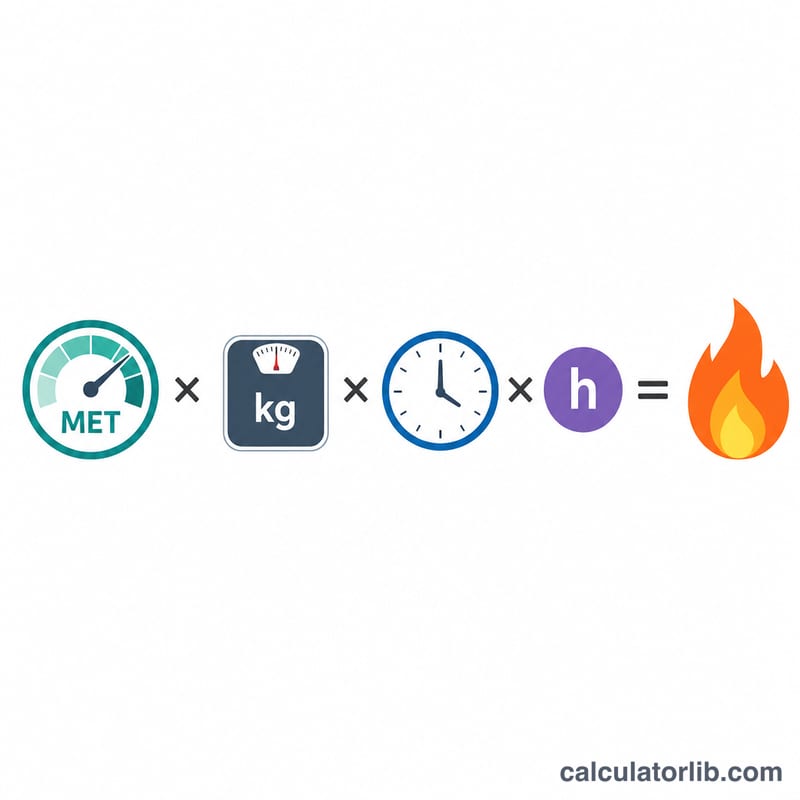
The calculation is: $$\text{calories (kcal)} = \text{MET} \times \text{body weight (kg)} \times \text{duration (hours)} \times 1.05$$. The factor 1.05 is the standard conversion that one MET corresponds to roughly 1.05 kcal burned per kilogram of body weight per hour. Because the formula needs hours, the entered minutes are divided by 60. This produces gross energy expenditure and does not subtract your resting metabolic rate.
Worked example
Suppose you swim front crawl at a moderate pace (MET = 8.3) for 90 minutes and weigh 60 kg. First convert time: \(90 / 60 = 1.5\) hours. Then: $$8.3 \times 60 \times 1.5 \times 1.05 = 784.35 \text{ kcal}$$ The calculator reports an exercise intensity of 8.3 METs and about 784 kcal burned.
FAQ
Why does intensity matter so much? MET values scale directly with how hard you work. Butterfly (13.8 METs) burns nearly three times the calories of recreational backstroke (4.8 METs) for the same time and weight.
Is this exact? No. It is a population-average estimate. Actual burn varies with technique, efficiency, water temperature, and fitness level.
Should I subtract resting calories? This tool reports gross calories. If you want net active calories, you can subtract roughly 1 MET worth of energy, but the simple gross formula is the most common convention.