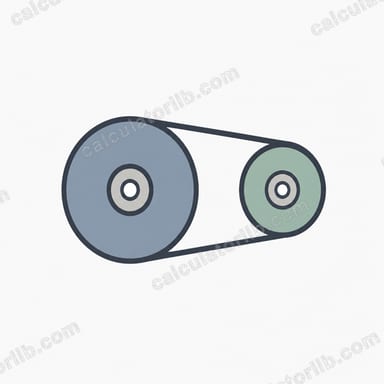

What Is a Pulley Calculator?
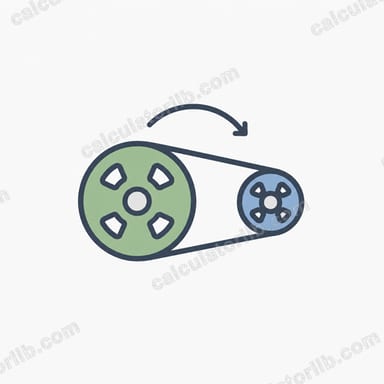
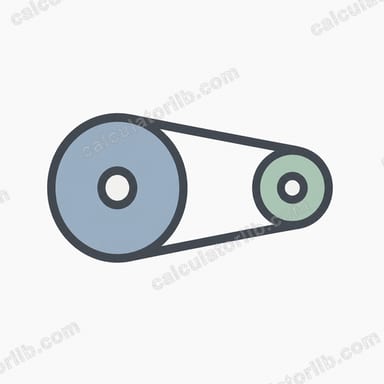
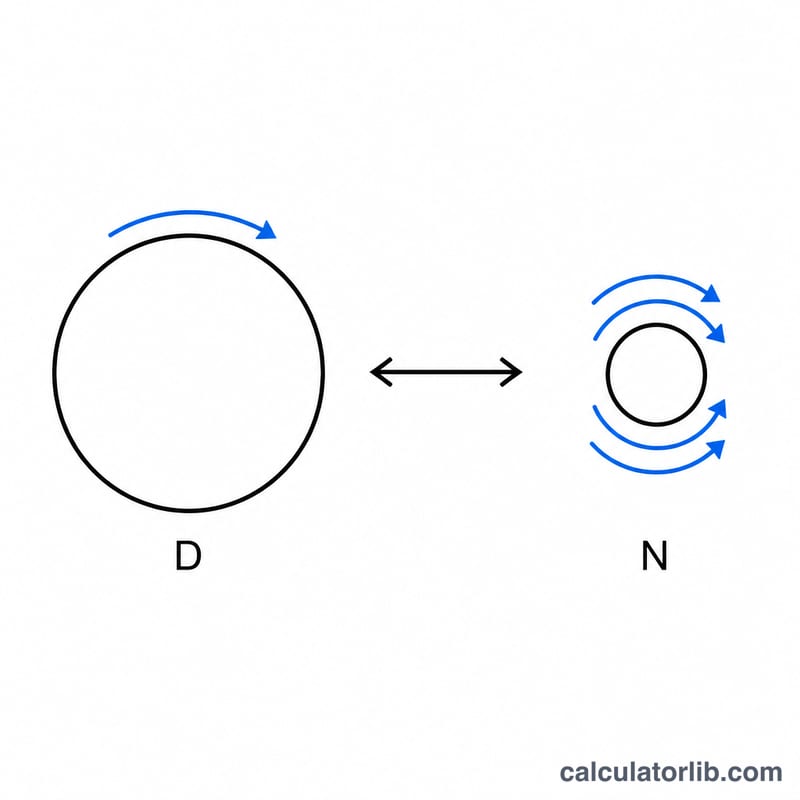
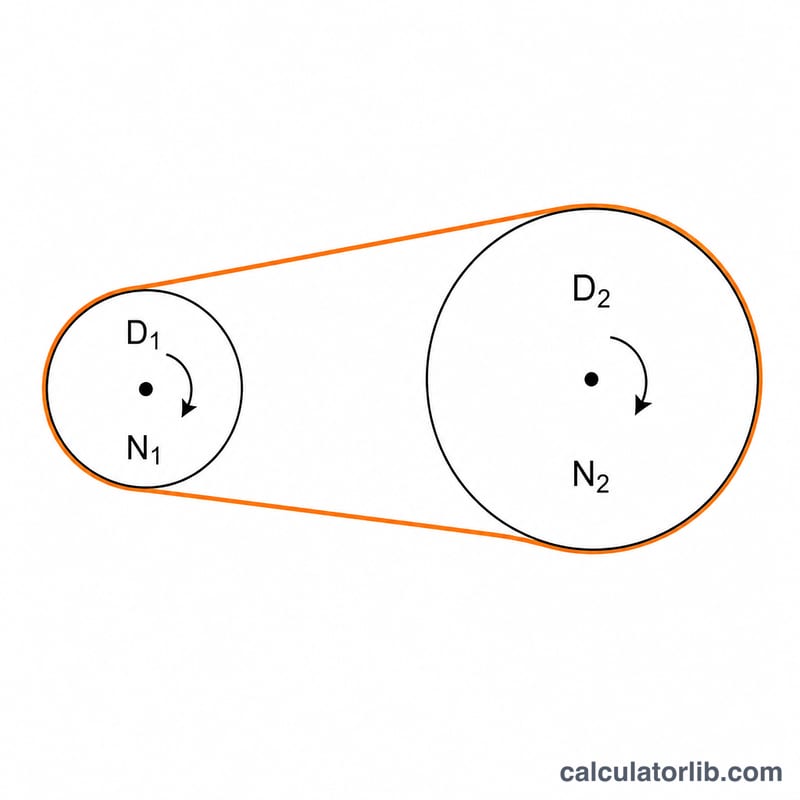
A pulley calculator works out the relationship between two pulleys connected by a belt. It uses the fundamental pulley law \(\text{D1} \times \text{N1} = \text{D2} \times \text{N2}\), where D is the pulley diameter and N is the rotational speed in RPM. The driver pulley (connected to the motor) transfers motion to the driven pulley, and their diameters and speeds are inversely proportional. A smaller driven pulley spins faster; a larger one spins slower.
How to Use It
Enter any three of the four values — driver diameter (D1), driver speed (N1), driven diameter (D2), and driven speed (N2). Leave the value you want to find blank (or zero) and the calculator solves for it. By default it solves for the driven pulley speed N2. The tool also reports the speed ratio \(\text{D1} / \text{D2}\), which tells you the multiplication factor between input and output speed.
The Formula Explained
Because the belt moves at one constant linear speed, the surface speed of both pulleys must match. This gives the proportion $$\text{D1} \times \text{N1} = \text{D2} \times \text{N2}$$ Rearranging to solve for the unknown driven speed: $$\text{N2} = \frac{\text{D1} \times \text{N1}}{\text{D2}}$$ The same equation rearranges to find any of the four quantities.
Worked Example
A motor pulley of 100 mm diameter spins at 1750 RPM and drives a 200 mm pulley. The driven speed is $$\text{N2} = \frac{100 \times 1750}{200} = \mathbf{875 \text{ RPM}}$$ The speed ratio is \(100 / 200 = 0.5\), meaning the output turns at half the input speed but with roughly double the torque.
FAQ
Does pulley material matter? No — the relation depends only on diameters and speeds, not the material.
Can I use radius instead of diameter? Yes, as long as you use the same units consistently for both pulleys, the ratio is identical.
What about torque? Torque is inversely related to speed: if the driven pulley is twice as large, it runs half as fast but delivers about twice the torque (ignoring friction losses).