
What Is Pulley Mechanical Advantage?
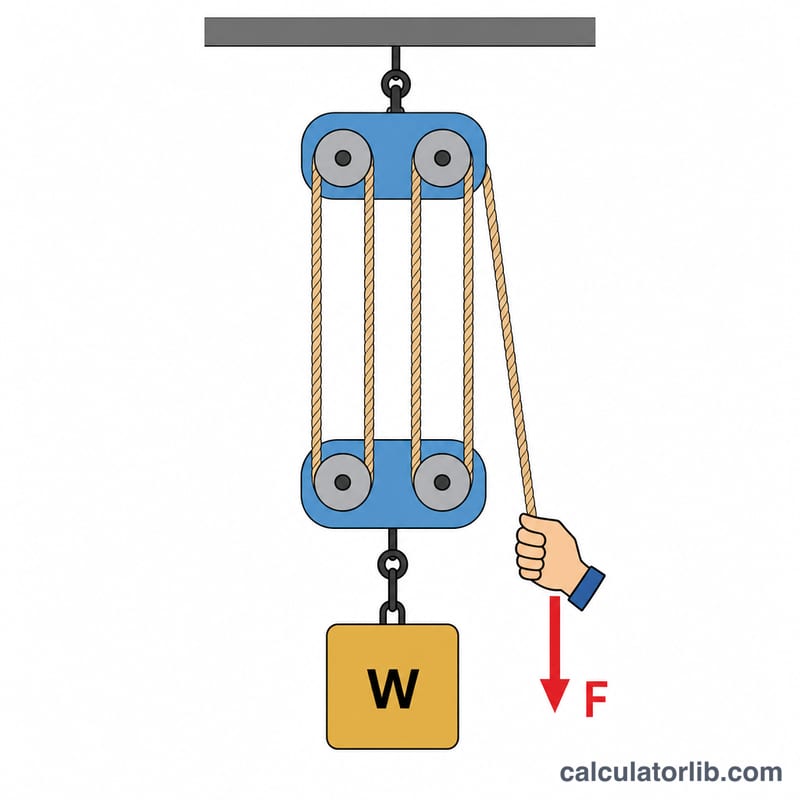
A pulley system makes lifting heavy loads easier by trading distance for force. The mechanical advantage (MA) tells you how many times the system multiplies your pulling force. For an ideal block-and-tackle, the MA equals the number of rope segments that directly support the movable block — the load.
How to Use This Calculator
Enter the number of supporting rope segments (count every length of rope pulling up on the movable pulley) and the load weight in newtons. The calculator returns the mechanical advantage and the effort force you must apply to hold or slowly raise the load. Multiply your mass in kilograms by 9.81 to convert to newtons if needed.
The Formula Explained
The two equations are simple: \(\text{MA} = N\), where N is the number of supporting segments, and \(\text{Effort} = \text{Load} \div \text{MA}\). Because energy is conserved, the rope you pull must travel N times farther than the load rises. This is the ideal, frictionless case — real systems need slightly more effort to overcome friction and rope stiffness.
$$\text{MA} = \text{Segments} \qquad \text{Effort} = \frac{\text{Load (N)}}{\text{Segments}}$$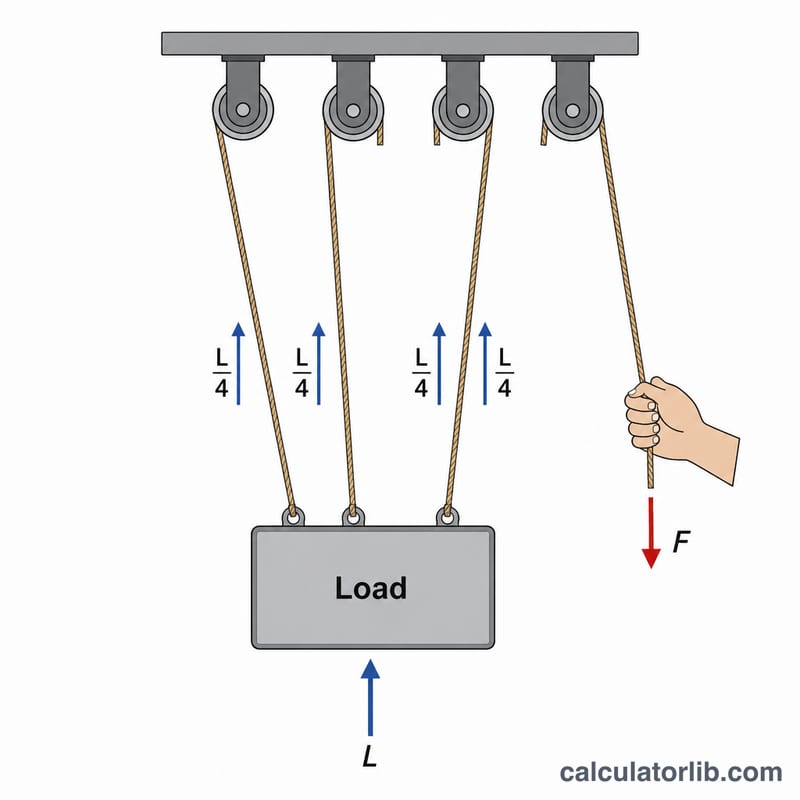
Worked Example
Suppose a system has 4 supporting rope segments and you want to lift a 1000 N load. The mechanical advantage is \(\text{MA} = 4\). The effort needed is
$$1000 \div 4 = 250 \text{ N}$$You'd pull 4 metres of rope for every 1 metre the load rises.
FAQ
How do I count supporting segments? Count only the rope segments that pull upward on the movable block holding the load. Segments leading to a fixed pulley used only to change direction do not add to the MA.
Does adding pulleys always reduce effort? Yes ideally, but each pulley adds friction and weight, so beyond a point the real benefit shrinks.
Is the rope length affected? Yes — the higher the MA, the more rope you must pull through to move the load a given distance.