
What Is Deceleration?
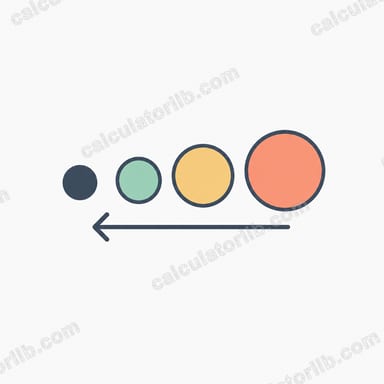
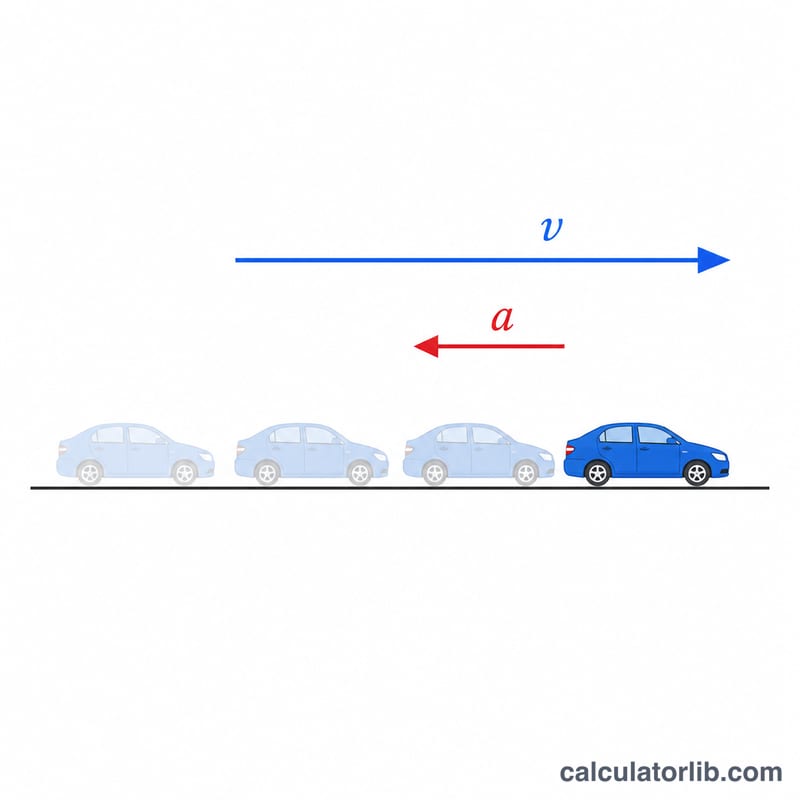
Deceleration is acceleration that reduces an object's speed — it is simply negative acceleration relative to the direction of motion. This calculator finds the magnitude of that deceleration from a change in velocity, using either the distance over which the object slows down or the time it takes. Results are universal SI values (m/s²) and apply to any moving object: cars, runners, projectiles, or machinery.
How to Use It
Enter the initial velocity and final velocity in metres per second. Then choose your method: if you know the distance traveled while slowing, select "Using distance" and fill in the distance; if you know the time the slowdown took, select "Using time" and fill in the time. The calculator returns the deceleration magnitude, the signed acceleration, the equivalent g-force, and the estimated time taken.
The Formula Explained
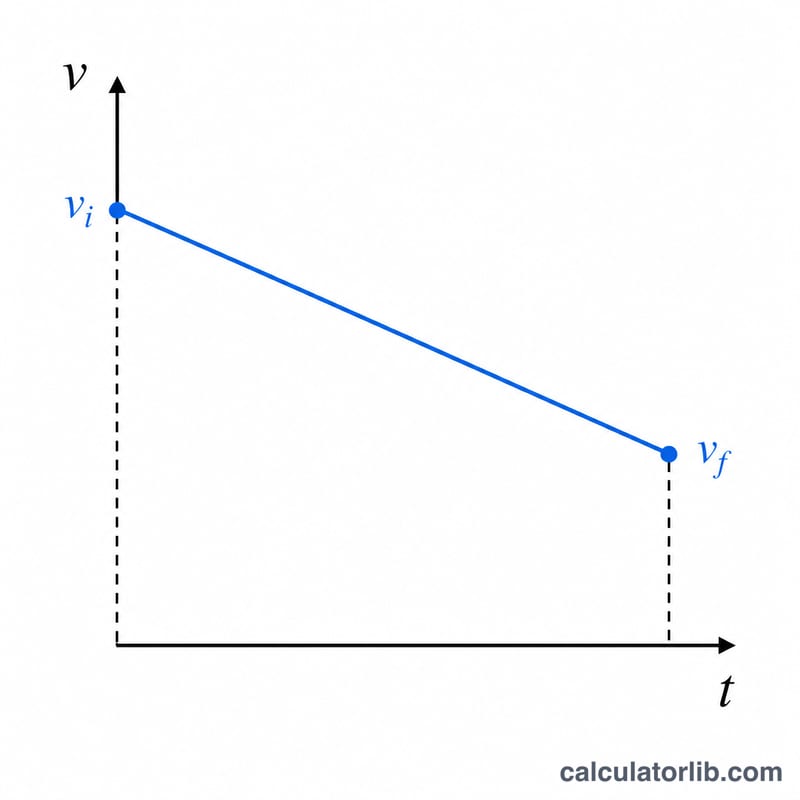
From kinematics, when distance is known we use $$a = \frac{\left|\text{Final velocity}^{2} - \text{Initial velocity}^{2}\right|}{2 \cdot \text{Distance}}$$ When time is known we use $$a = \frac{\left|\text{Final velocity} - \text{Initial velocity}\right|}{\text{Time}}$$ A negative result means the object is slowing; the deceleration is reported as the absolute value. Dividing by \(9.80665\) m/s² converts the result to g-force, a handy comfort/safety reference.
Worked Example
A car traveling at 30 m/s brakes to a stop (0 m/s) over 75 m. $$a = \frac{0^{2} - 30^{2}}{2 \times 75} = \frac{-900}{150} = -6 \text{ m/s}^2$$ The deceleration magnitude is 6 m/s², roughly 0.612 g — a firm but ordinary braking maneuver. Average speed is 15 m/s, so it takes about 5 seconds.
FAQ
Is deceleration always negative? The acceleration value is negative when speed decreases, but "deceleration" usually refers to its positive magnitude, which is what we headline.
What units should I use? Use metres per second for velocity, metres for distance, and seconds for time to get an answer in m/s².
What is a safe deceleration? Comfortable car braking is around 3 m/s² (~0.3 g); hard emergency braking approaches 8–10 m/s² (~0.8–1 g).