
What Is Free Cash Flow Yield?
Free cash flow (FCF) yield measures how much cash a company generates for each dollar invested in its stock. It compares the free cash flow attributable to each share against the current share price. A higher FCF yield generally signals that you are paying less for each dollar of cash the business produces, which value investors often view as attractive.
How to Use This Calculator
Enter the company's free cash flow per share (operating cash flow minus capital expenditures, divided by shares outstanding) and the current price per share. The calculator divides the two values and converts the result to a percentage. Use trailing or forward FCF depending on the analysis you want to perform.
The Formula Explained
The equation is simply
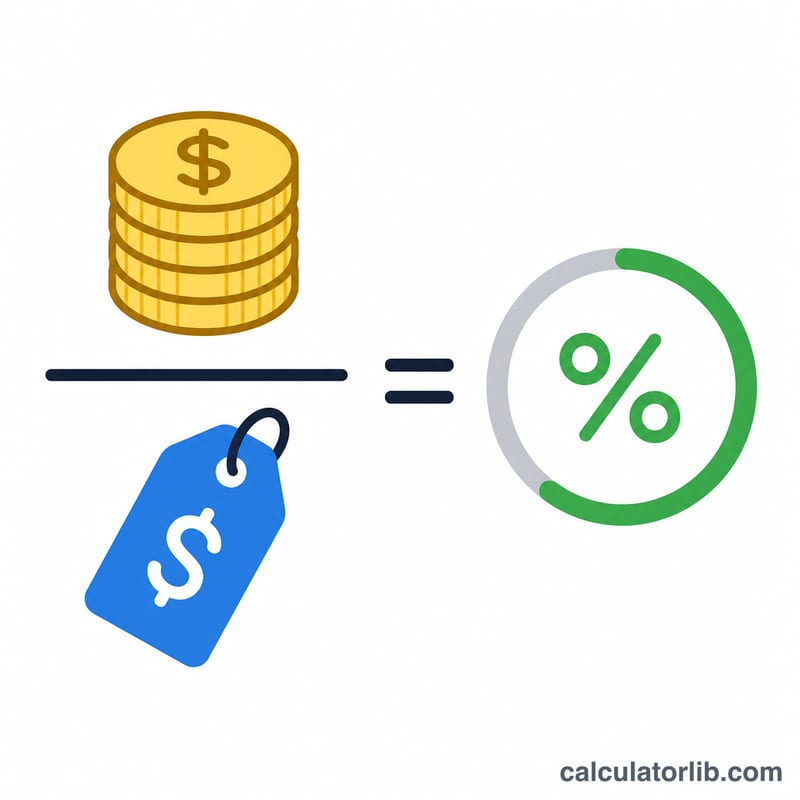
$$\text{FCF Yield} = \frac{\text{FCF per Share}}{\text{Price per Share}} \times 100\%$$Because it is expressed as a percentage, it is easy to compare against bond yields, dividend yields, or a required rate of return. It is effectively the inverse of the price-to-free-cash-flow (P/FCF) multiple.
Worked Example
Suppose a company produces $5.00 of free cash flow per share and its stock trades at $100. The FCF yield is
$$\$5 \div \$100 = 0.05 = 5\%$$That means for every $100 invested, the business generates $5 of free cash each year.
FAQ
What is a good FCF yield? Many investors look for yields above 5%, but a "good" yield depends on the industry, growth rate, and interest-rate environment.
How is FCF per share calculated? Take free cash flow (operating cash flow minus capital expenditures) and divide by the weighted-average diluted shares outstanding.
How does FCF yield differ from dividend yield? Dividend yield only counts cash actually paid to shareholders, while FCF yield counts all free cash the company generates, whether distributed or retained.