
What Is Levered Free Cash Flow?
Levered free cash flow (LFCF) is the cash a company has left over after it has met all of its operating, investment, and mandatory debt obligations. Because it is calculated after debt service, it represents the cash that is genuinely available to equity shareholders — for dividends, buybacks, or reinvestment. This contrasts with unlevered free cash flow, which is measured before any debt payments.
How to Use This Calculator
Enter four figures from a company's financial statements: EBITDA (earnings before interest, taxes, depreciation, and amortization), the change in net working capital, capital expenditures (CapEx), and mandatory debt repayments for the period. The calculator subtracts the three cash outflows from EBITDA and returns the levered free cash flow instantly.
The Formula Explained
The model used here is:
$$\text{LFCF} = \text{EBITDA} - \text{Change in WC} - \text{CapEx} - \text{Debt Payments}$$
A positive change in working capital ties up cash (so it is subtracted), while CapEx and mandatory debt repayments are clear cash outflows. A positive LFCF signals healthy cash generation; a negative figure means the business is consuming cash to stay current with its obligations.
Worked Example
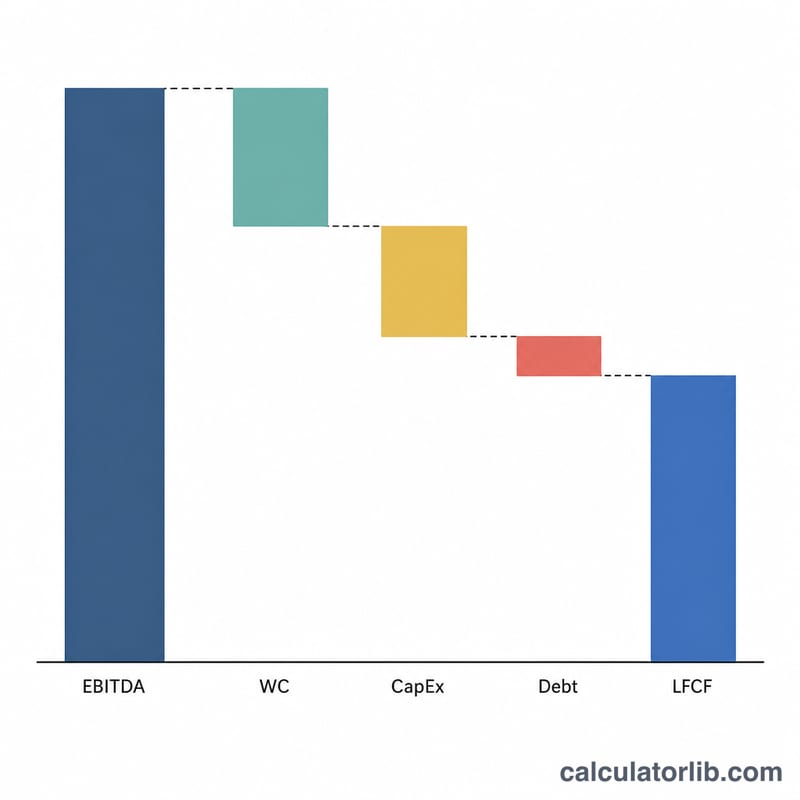
Suppose a company reports EBITDA of $1,000,000, a working capital increase of $50,000, CapEx of $200,000, and mandatory debt payments of $150,000. Then:
$$\text{LFCF} = 1{,}000{,}000 - 50{,}000 - 200{,}000 - 150{,}000 = \$600{,}000$$
The firm generated $600,000 of cash available to equity holders during the period.
FAQ
How is LFCF different from unlevered free cash flow? Unlevered free cash flow is calculated before debt payments and interest, representing cash available to all capital providers; levered free cash flow is after debt service and belongs to equity holders.
Why subtract the change in working capital? An increase in working capital (e.g., growing receivables or inventory) consumes cash, so it reduces free cash flow. If working capital decreases, enter a negative number to add cash back.
Can LFCF be negative? Yes. Heavy CapEx or large debt repayments can push LFCF below zero, indicating the company may need external financing.