
What Is a Biweekly Pay Calculator?
A biweekly pay calculator converts your annual salary into the gross amount you receive in each two-week paycheck. Many employers pay on a biweekly schedule, which means you get paid every two weeks — for a total of 26 paychecks per year. This tool shows your per-paycheck gross pay along with weekly and monthly equivalents so you can budget with confidence.
How to Use It
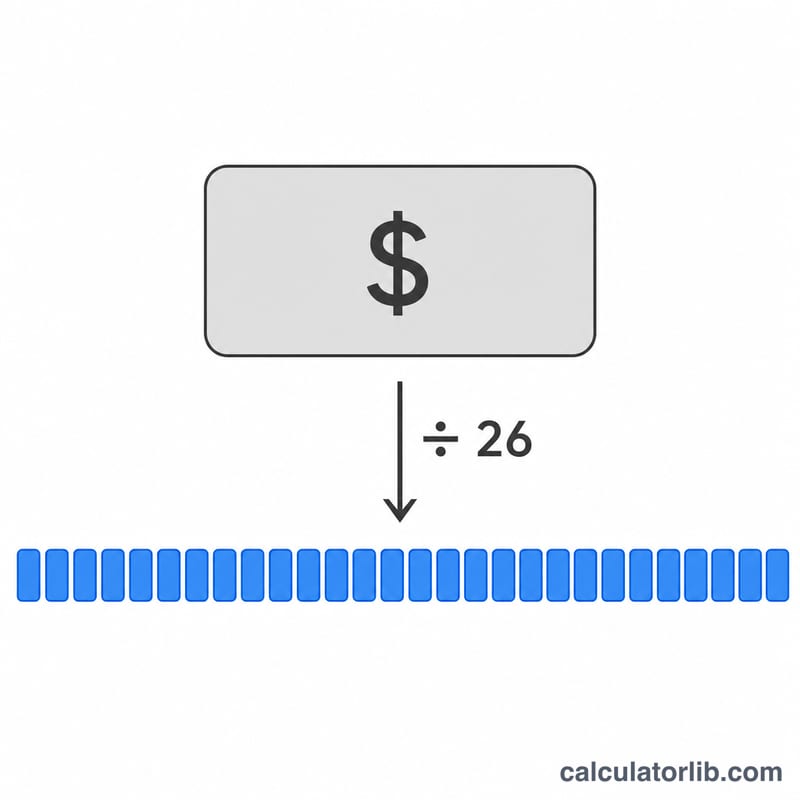
Enter your gross annual salary (before taxes and deductions) and the calculator instantly divides it by 26 to give your biweekly gross pay. It also displays your weekly pay (annual ÷ 52) and monthly pay (annual ÷ 12) for easy comparison. All amounts are gross figures — your actual take-home pay will be lower after taxes, insurance, and retirement contributions.
The Formula Explained
The math is simple: $$\text{Biweekly Pay} = \frac{\text{Annual Salary (\$)}}{26}$$ The number 26 comes from a 52-week year split into two-week periods (\(52 \div 2 = 26\)). This differs from a semimonthly schedule, which pays twice a month for 24 paychecks a year — so a biweekly schedule produces two "extra" paychecks annually compared to semimonthly.
Worked Example
Suppose your annual salary is $52,000. Your biweekly gross pay is $$\$52{,}000 \div 26 = \$2{,}000.00$$ Your weekly pay would be \(\$52{,}000 \div 52 = \$1{,}000.00\), and your monthly pay \(\$52{,}000 \div 12 \approx \$4{,}333.33\).
FAQ
How many biweekly paychecks are in a year? There are 26 biweekly pay periods in a standard year, occasionally 27 in years where pay dates line up that way.
Is biweekly the same as semimonthly? No. Biweekly pays every two weeks (26 checks), while semimonthly pays twice a month (24 checks). Biweekly checks are slightly smaller but more frequent.
Is this my take-home pay? No, the result is gross pay before any taxes or deductions. Net pay will be lower.