
What Is Semi-Monthly Pay?
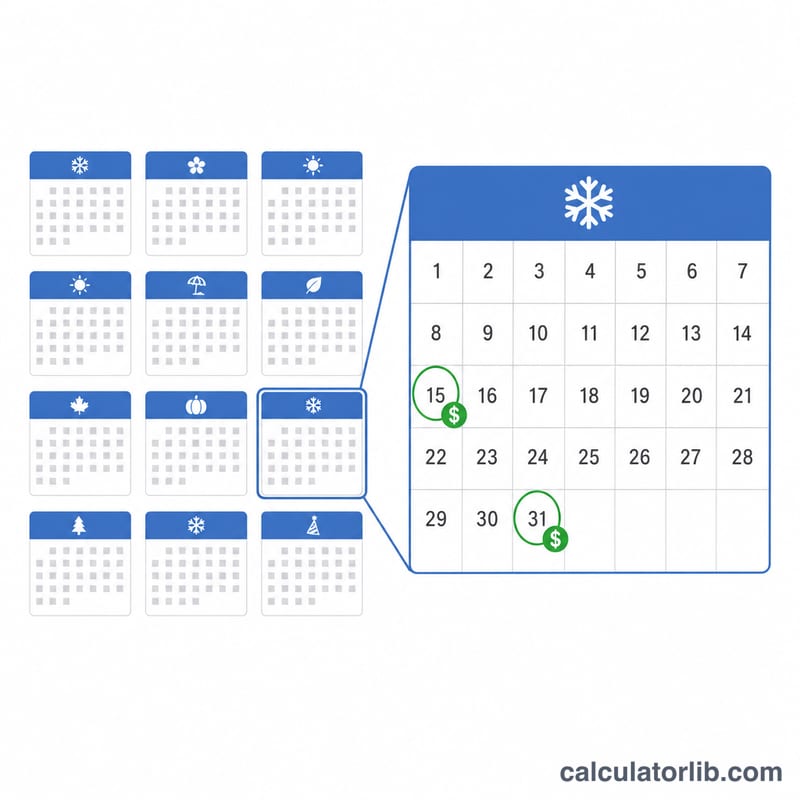
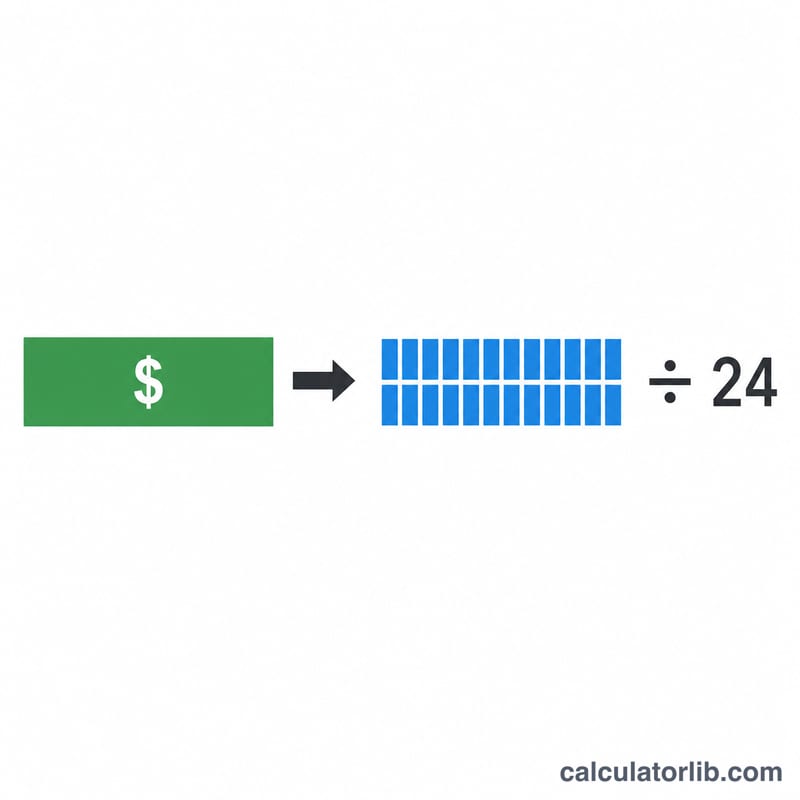
Semi-monthly pay is a payroll schedule where you receive a paycheck twice every month — typically on fixed dates such as the 15th and the last day of the month. Because there are 12 months in a year and two paydays each month, a semi-monthly schedule produces exactly 24 paychecks per year. This is different from a bi-weekly schedule, which pays every two weeks and results in 26 paychecks.
How to Use This Calculator
Enter your gross annual salary and the calculator instantly divides it by 24 to show your gross semi-monthly paycheck. It also displays the equivalent monthly and annual figures so you can compare schedules at a glance. Note that these are gross amounts — taxes, retirement contributions, and other deductions are not included.
The Formula Explained
The math is simple:
$$\text{Semi-Monthly Pay} = \frac{\text{Annual Salary (\$)}}{24}$$The 24 comes from \(2 \times 12\) (2 paydays \(\times\) 12 months). Unlike bi-weekly pay (annual \(\div\) 26), each semi-monthly check is the same amount every period, which makes budgeting predictable.
Worked Example
Suppose your annual salary is $60,000. Dividing by 24 gives $2,500 per paycheck:
$$\frac{\$60{,}000}{24} = \$2{,}500$$For comparison, the monthly equivalent is \(\$60{,}000 \div 12 = \$5{,}000\), and each month you'd receive two $2,500 checks that add up to that $5,000.
FAQ
Is semi-monthly the same as bi-weekly? No. Semi-monthly pays 24 times a year on set dates; bi-weekly pays 26 times a year every two weeks, so bi-weekly checks are slightly smaller.
Are these amounts before or after taxes? They are gross (before-tax) figures. Your actual take-home pay will be lower after deductions.
Why are some months "three-paycheck" months? That happens with bi-weekly schedules, not semi-monthly. With semi-monthly pay you always get exactly two checks per month.