
What This Calculator Does
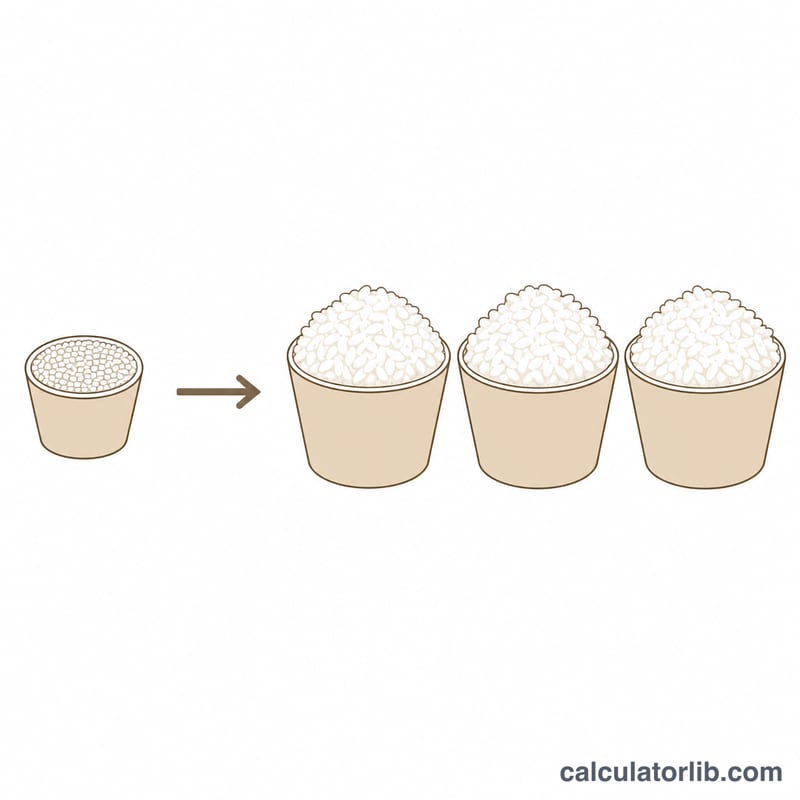
The Uncooked to Cooked Rice Calculator estimates how much cooked rice you will end up with after cooking a given amount of dry, uncooked rice. Rice absorbs water as it cooks and roughly triples in volume and weight, so a small amount of dry rice goes a long way. This tool helps you plan portions, scale recipes, and avoid making far too much (or too little) rice.
How to Use It
Enter the amount of uncooked rice you plan to cook, choose your unit (cups, grams, or ounces), and set the yield ratio. The default ratio of 3 works well for most white rice. Brown rice tends to yield slightly less (around 2.5–3×), and some long-grain varieties can yield a bit more. Press calculate to see your cooked rice total.
The Formula Explained
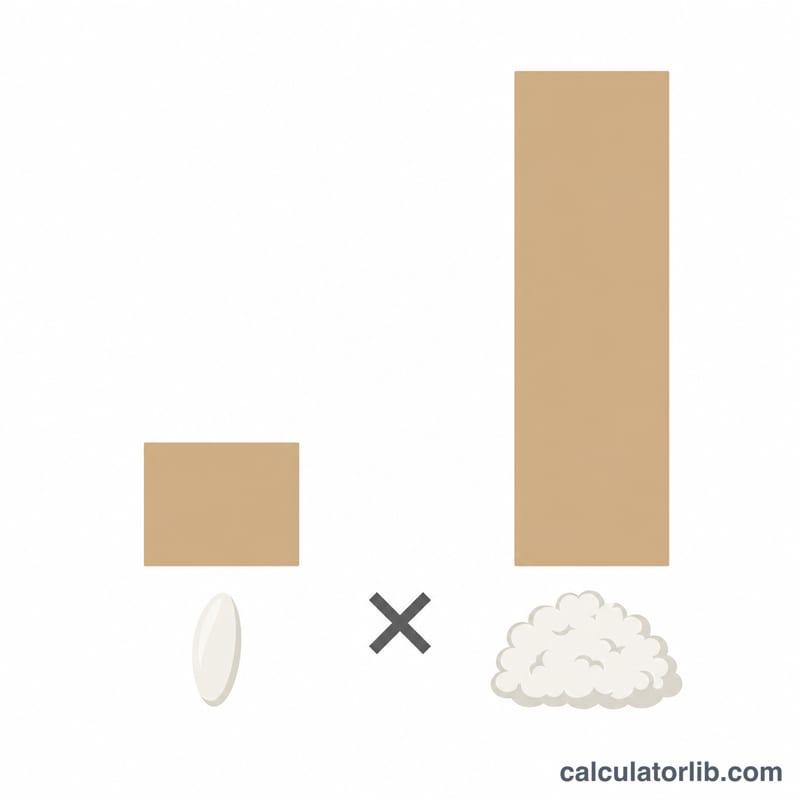
The math is simple multiplication: $$\text{Cooked Rice} = \text{Uncooked Rice} \times \text{Yield Ratio}$$ The yield ratio captures how much the rice expands. White rice typically expands about threefold, so 1 cup of dry rice produces roughly 3 cups cooked.
Worked Example
Suppose you measure out 2 cups of uncooked white rice and use the standard yield ratio of 3. The calculation is \(2 \times 3 = 6\), so you can expect about 6 cups of cooked rice — enough for roughly 4 to 6 servings.
FAQ
Why does rice triple in size? Dry rice grains absorb water during cooking, swelling in both volume and weight, which produces the roughly 3× expansion.
Is the ratio the same for brown rice? Not exactly. Brown rice usually yields about 2.5–3×. Adjust the ratio field to match your variety for a more accurate estimate.
Does this work for weight too? Yes. The multiplier applies to grams and ounces as well as cups, though water content makes weight ratios approximate.