

What Is the Hourly to Biweekly Pay Calculator?
This calculator converts an hourly wage into gross biweekly pay — the amount you earn every two weeks before taxes and deductions. A biweekly pay schedule is one of the most common in the United States, producing 26 paychecks per year. If you know your hourly rate and how many hours you work each week, this tool tells you exactly what a single biweekly paycheck looks like, along with weekly and annual estimates.
How to Use It
Enter your hourly rate (for example, $25.00) and the number of hours you work per week (40 for a standard full-time schedule). The calculator multiplies them to get your weekly pay, then doubles it for the biweekly figure. It also shows your projected annual gross pay across 52 weeks.
The Formula Explained
The core math is simple:
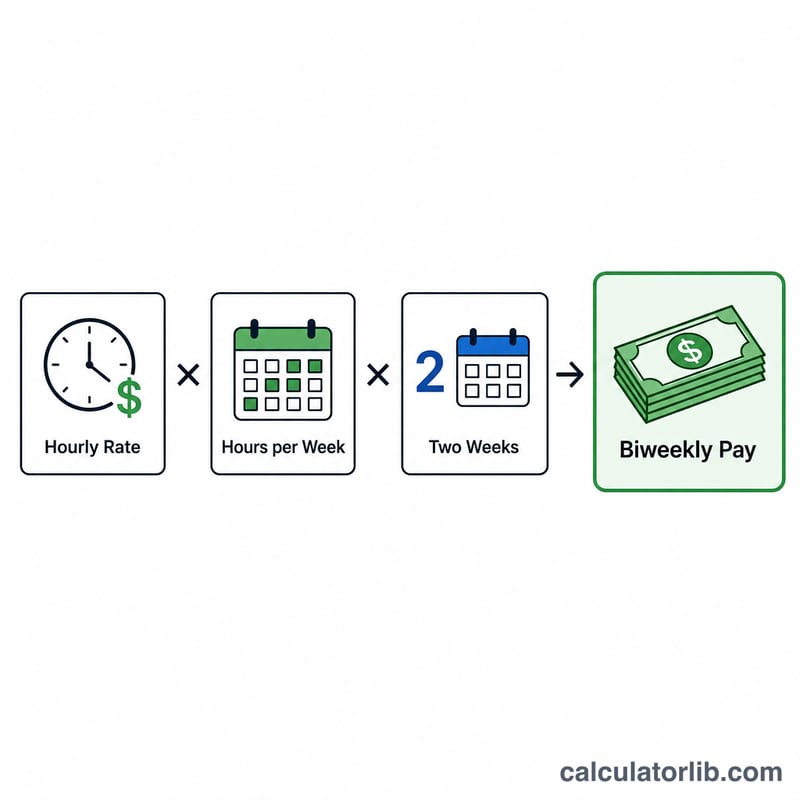
$$\text{Biweekly Pay} = \text{Hourly Rate} \times \text{Hours/Week} \times 2$$
Because a biweekly period covers two work weeks, we calculate one week's earnings (rate \(\times\) hours) and multiply by two. Annual pay uses 52 weeks, which equals 26 biweekly paychecks.
Worked Example
Suppose you earn $25.00 per hour and work 40 hours per week. Weekly pay is $$25 \times 40 = \$1{,}000.$$ Biweekly pay is $$\$1{,}000 \times 2 = \$2{,}000.$$ Annual pay is $$\$1{,}000 \times 52 = \$52{,}000 \text{ gross}.$$
FAQ
Is this gross or net pay? These figures are gross (before taxes, insurance, and retirement deductions). Your take-home pay will be lower.
How many biweekly paychecks are in a year? 26, because \(52 \div 2 = 26\) pay periods.
What if my hours change each week? Use your average weekly hours for the most accurate estimate, or recalculate for each period.