
What Is Free Cash Flow to Equity (FCFE)?
Free Cash Flow to Equity (FCFE) is the amount of cash a business generates that is available to be distributed to its equity shareholders after all operating expenses, reinvestment in fixed assets and working capital, and net debt cash flows have been accounted for. Analysts use FCFE in equity valuation — discounting projected FCFE at the cost of equity gives an estimate of a company's equity value, which is the basis of the FCFE discounted cash flow model.
How to Use This Calculator
Enter five figures, typically taken from a company's income statement and cash flow statement: net income, depreciation & amortization, capital expenditures (capex), the change in net working capital, and net borrowing (new debt raised minus debt repaid). The calculator instantly returns FCFE and shows each component so you can audit the result. Use negative values where appropriate — for example, a decrease in working capital is entered as a negative change.
The Formula Explained
The standard FCFE equation is:
$$\text{FCFE} = \text{Net Income} + \text{D\&A} - \text{CapEx} - \text{Change in WC} + \text{Net Borrowing}$$
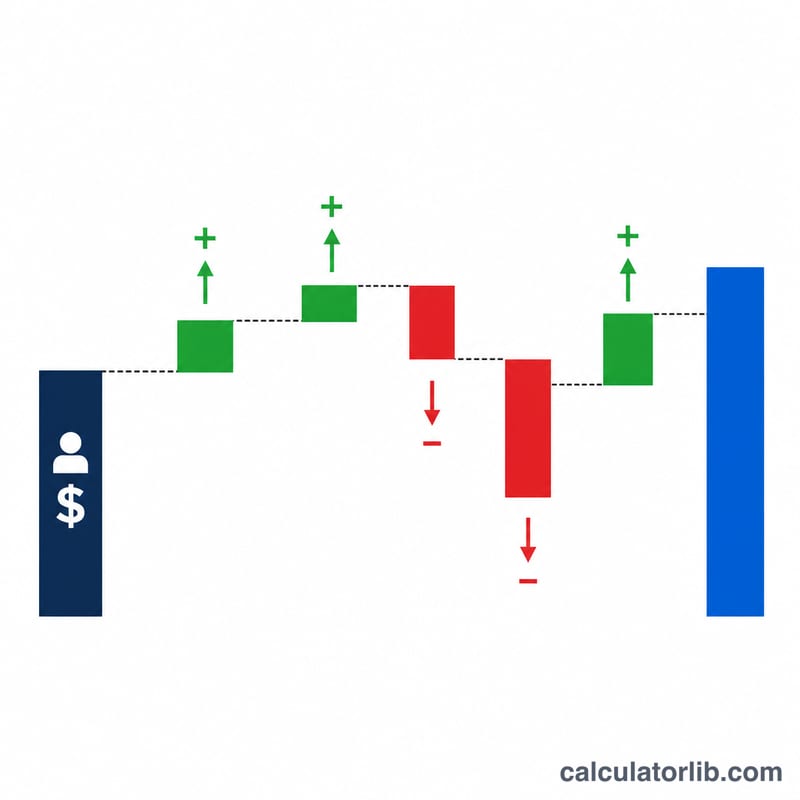
Depreciation is added back because it is a non-cash expense that reduced net income. CapEx and increases in working capital consume cash, so they are subtracted. Net borrowing is added because debt raised provides cash to equity holders (and debt repaid reduces it).
Worked Example
Suppose a company reports net income of $100,000, depreciation of $20,000, capex of $30,000, an increase in working capital of $10,000, and net borrowing of $15,000. Then $$\text{FCFE} = 100{,}000 + 20{,}000 - 30{,}000 - 10{,}000 + 15{,}000 = \$95{,}000$$ This $95,000 represents the cash that could theoretically be paid to shareholders without harming operations.
FAQ
How is FCFE different from FCFF? Free Cash Flow to the Firm (FCFF) is the cash available to all capital providers (debt and equity), while FCFE is only what's left for equity holders after debt cash flows.
What does a negative FCFE mean? Negative FCFE indicates the company is consuming more cash than it generates for shareholders, often due to heavy reinvestment or debt repayment — common in fast-growing firms.
Where do I find the inputs? Net income comes from the income statement; depreciation, capex, working capital changes, and net borrowing come from the cash flow statement.