

What Is Earnings Yield?
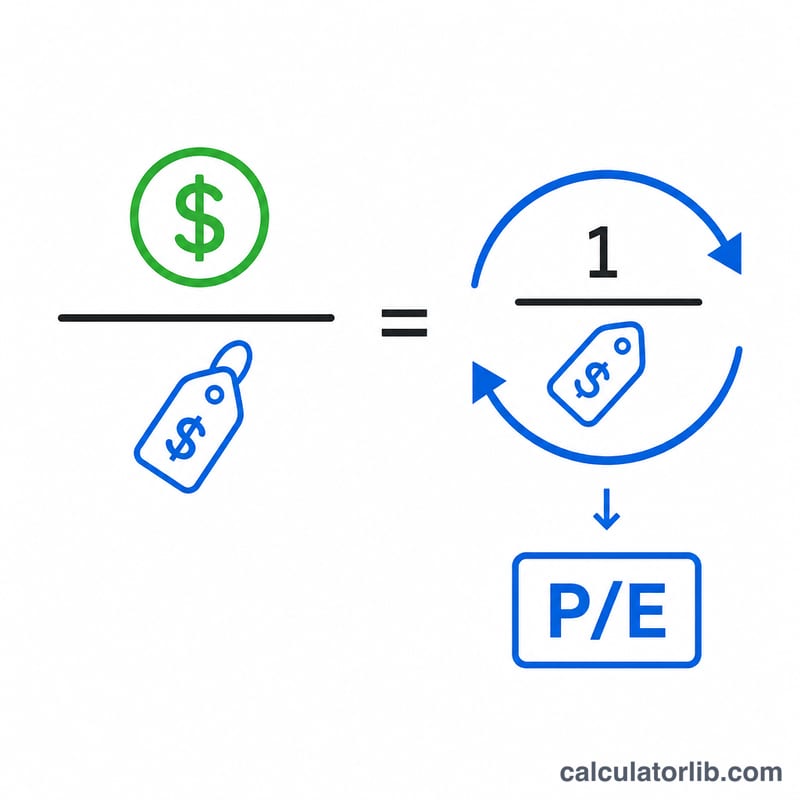
The earnings yield is the percentage of each invested dollar that a company earns in profit over a year. It is calculated by dividing earnings per share (EPS) by the current share price. Because it is the inverse of the well-known price-to-earnings (P/E) ratio, the earnings yield lets investors compare a stock's profit return directly against bond yields, savings rates, or other equities on a like-for-like basis.
How to Use This Calculator
Enter the company's earnings per share (EPS) and its current share price. The calculator returns the earnings yield as a percentage and the implied P/E ratio. A higher earnings yield generally signals a cheaper valuation relative to profits, while a lower yield can mean the stock is expensive or that high growth is priced in.
The Formula Explained
$$\text{Earnings Yield} = \frac{\text{EPS}}{\text{Price}} \times 100$$ Since \(\text{P/E} = \text{Price} \div \text{EPS}\), the earnings yield is simply \(1 \div \text{P/E}\). For example, a stock trading at a P/E of 20 has an earnings yield of 5%.
Worked Example
Suppose a stock has EPS of $5 and trades at $100 per share. $$\text{Earnings Yield} = 5 / 100 = 0.05 = 5\%$$ The implied P/E is \(100 / 5 = 20\). So for every $100 invested, the business earns $5 in profit per year.
FAQ
Is a higher earnings yield better? Often yes, as it suggests more profit per dollar invested, but always consider growth, debt, and earnings quality.
How does it compare to bond yields? Investors compare a stock's earnings yield to government bond yields to gauge the equity risk premium.
Should I use trailing or forward EPS? Either works; trailing uses past 12-month earnings, forward uses analyst estimates. Be consistent when comparing companies.