
What Is Retained Earnings?
Retained earnings are the cumulative net profits a company keeps and reinvests in the business rather than distributing to shareholders as dividends. They appear in the equity section of the balance sheet and grow each profitable period that the company pays out less than it earns. This calculator works for any company and any currency — it is a universal accounting tool.
How to Use This Calculator
Enter three figures from your financial statements: the beginning retained earnings (the closing balance from the prior period), the net income for the current period (enter a loss as a negative number), and the total dividends paid to shareholders. The calculator instantly returns your ending retained earnings and the net change for the period.
The Formula Explained
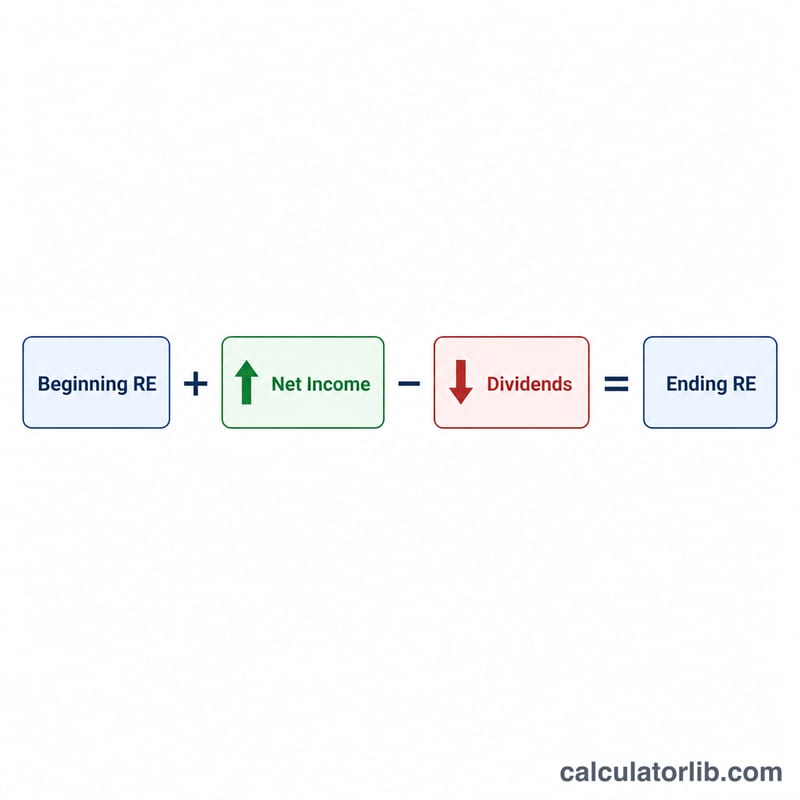
The retained earnings formula is straightforward:
$$\text{Ending RE} = \text{Beginning RE} + \text{Net Income} - \text{Dividends}$$
You start with what you already kept, add this period's profit, and subtract anything paid out. If the company posted a net loss, net income is negative and reduces retained earnings. Dividends — whether cash or stock — always reduce the balance because they represent earnings handed back to owners.
Worked Example
Suppose a company begins the year with $100,000 in retained earnings, earns $50,000 in net income, and pays $20,000 in dividends. The ending retained earnings are:
$$\$100{,}000 + \$50{,}000 - \$20{,}000 = \mathbf{\$130{,}000}$$
The net change for the year is \(\$50{,}000 - \$20{,}000 = \$30{,}000\).
FAQ
Can retained earnings be negative? Yes. A negative balance is called an accumulated deficit and usually means cumulative losses and dividends have exceeded cumulative profits.
Do stock dividends count? Yes — both cash and stock dividends reduce retained earnings, so include their total value in the dividends field.
What if I had a net loss? Enter the loss as a negative number (e.g. \(-15000\)) and the formula will correctly subtract it from your retained earnings.