
What is centripetal acceleration?
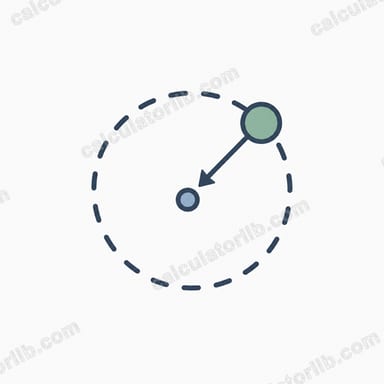
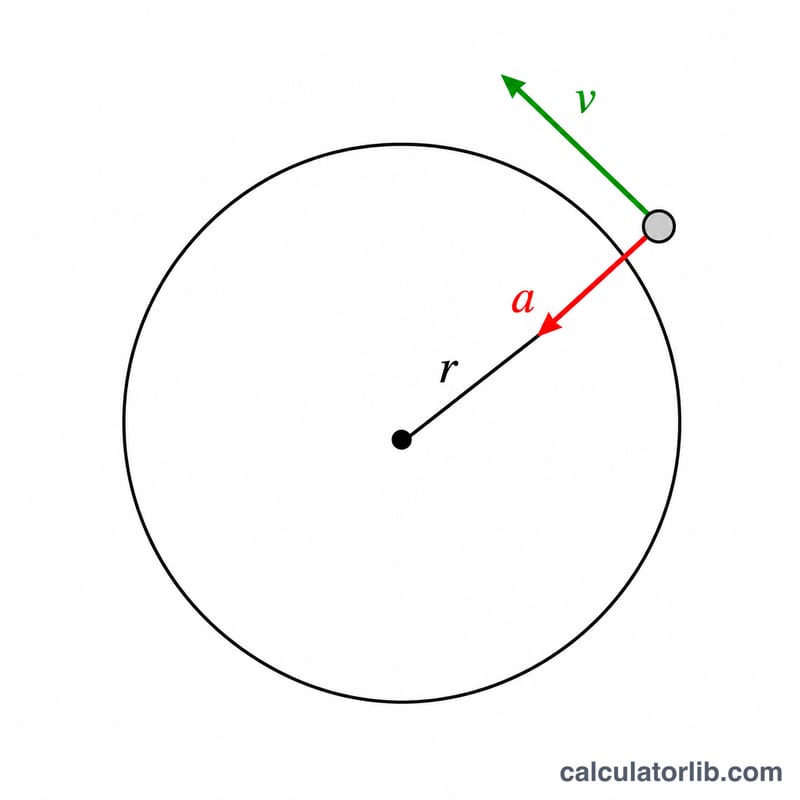
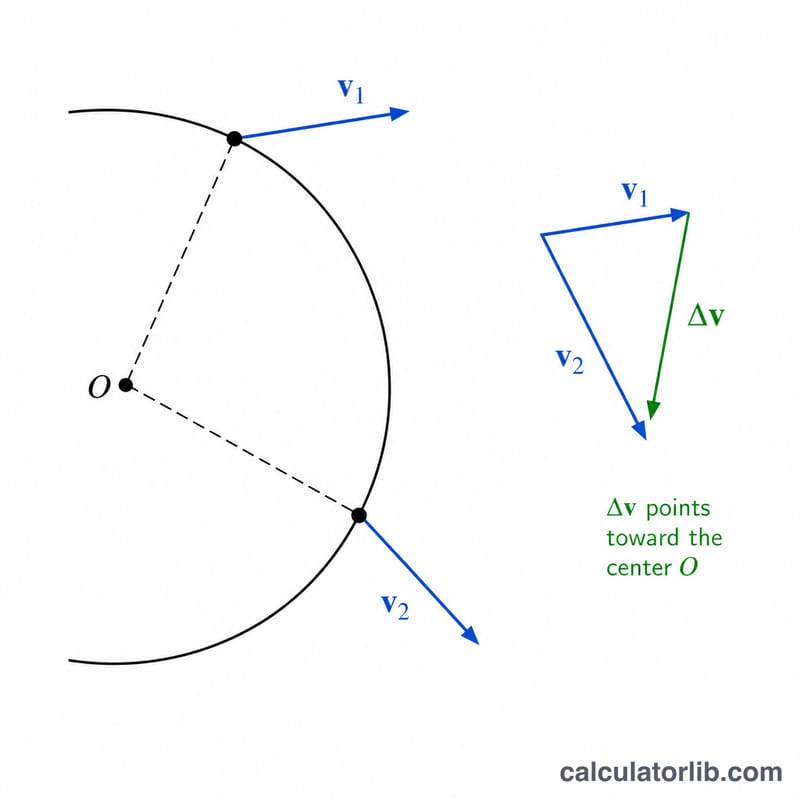
Centripetal acceleration is the rate of change of velocity that keeps an object moving along a circular path. Even when an object travels at a constant speed around a circle, its direction is constantly changing, so it is always accelerating toward the center of the circle. This inward acceleration is called centripetal (meaning "center-seeking") acceleration.
How to use this calculator
Enter the tangential velocity v (the linear speed along the circular path, in metres per second) and the radius r of the circle (in metres). The calculator instantly returns the centripetal acceleration in m/s², plus the angular velocity \(\omega = v/r\) in rad/s.
The formula explained
The core equation is $$a = \frac{v^2}{r}$$ Because the angular velocity \(\omega\) relates to linear speed by \(v = \omega \cdot r\), you can also write the acceleration as $$a = \omega^2 \cdot r$$ Both forms give the identical result. The acceleration grows with the square of the speed, so doubling the speed quadruples the inward acceleration, while a larger radius reduces it.
Worked example
A car rounds a curve of radius \(r = 5\) m at a speed \(v = 10\) m/s. The centripetal acceleration is $$a = \frac{v^2}{r} = \frac{(10)^2}{5} = \frac{100}{5} = 20 \text{ m/s}^2$$ The angular velocity is $$\omega = \frac{v}{r} = \frac{10}{5} = 2 \text{ rad/s}$$
FAQ
Is centripetal acceleration the same as centripetal force? No. Force equals mass times this acceleration: \(F = m \cdot a = m \cdot \frac{v^2}{r}\). The acceleration is what the force produces.
What direction does it point? Always toward the center of the circle, perpendicular to the velocity.
Does constant speed mean zero acceleration? No. Velocity is a vector; its direction changes even at constant speed, so there is a non-zero centripetal acceleration.