
What is a gear ratio?
A gear ratio describes how a pair of meshing gears trades speed for torque. It is the number of teeth on the driven (output) gear divided by the number of teeth on the driver (input) gear. A ratio greater than 1 is a reduction: the output turns slower but with more torque. A ratio less than 1 is an overdrive: faster output, less torque. This tool is a universal mechanical calculator and applies anywhere.
How to use this calculator
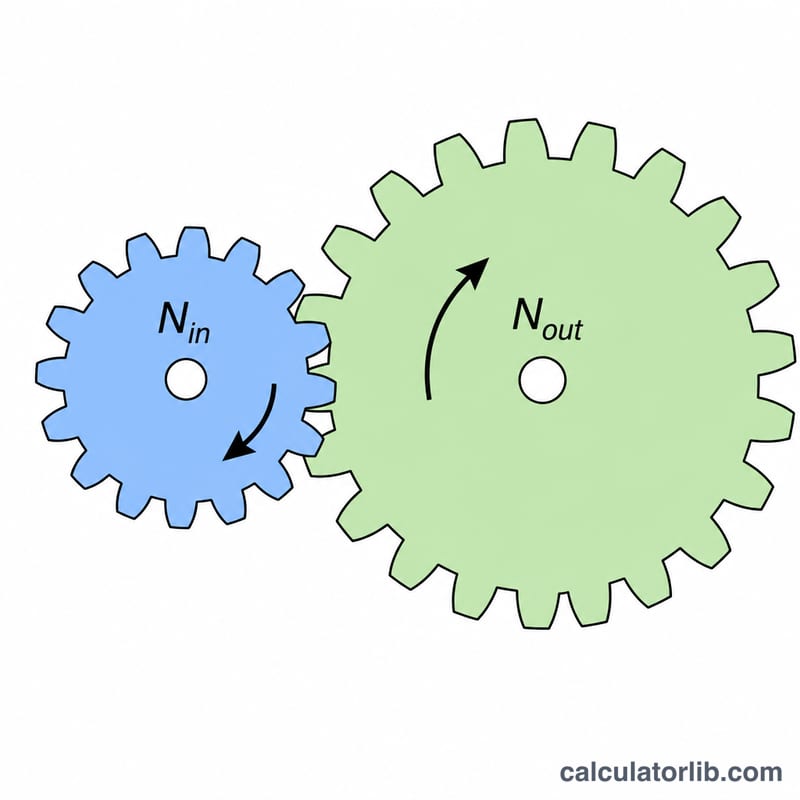
Enter the number of teeth on your driver gear (connected to the motor or input) and the driven gear (connected to the load or output). Then enter the input torque in newton-metres and the input speed in RPM. The calculator returns the gear ratio, the output torque, and the output speed.
The formula explained
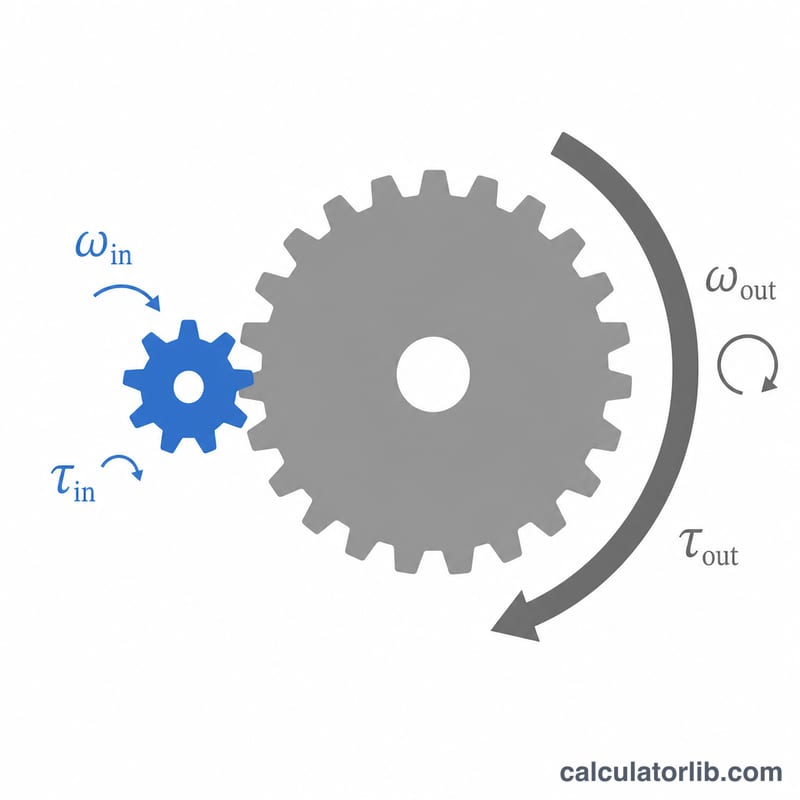
The ratio is \(N_{out} / N_{in}\). Because power is conserved in an ideal gearset, torque scales with the ratio:
$$\tau_{out} = \text{ratio}\cdot\tau_{in}$$while rotational speed scales inversely:
$$\omega_{out} = \dfrac{\omega_{in}}{\text{ratio}}$$These results assume 100% efficiency; real gears lose a few percent to friction, so actual output torque is slightly lower.
Worked example
A 12-tooth driver meshes with a 36-tooth driven gear, with 10 N·m input torque at 3000 RPM.
$$\text{ratio} = \frac{36}{12} = 3$$$$\tau_{out} = 3 \times 10 = 30\ \text{N}\cdot\text{m}$$$$\omega_{out} = \frac{3000}{3} = 1000\ \text{RPM}$$The gearset triples torque while cutting speed to a third.
FAQ
What does a 3:1 ratio mean? The input turns three times for every one turn of the output, tripling torque and reducing speed threefold.
Does this account for friction losses? No — it assumes an ideal, lossless gearset. Multiply output torque by your gearbox efficiency (e.g. 0.95) for a real-world estimate.
Can I use it for chain or belt drives? Yes. Use sprocket or pulley tooth counts (or pulley diameters) in place of gear teeth.