
What Is the Moles to Volume at STP Calculator?
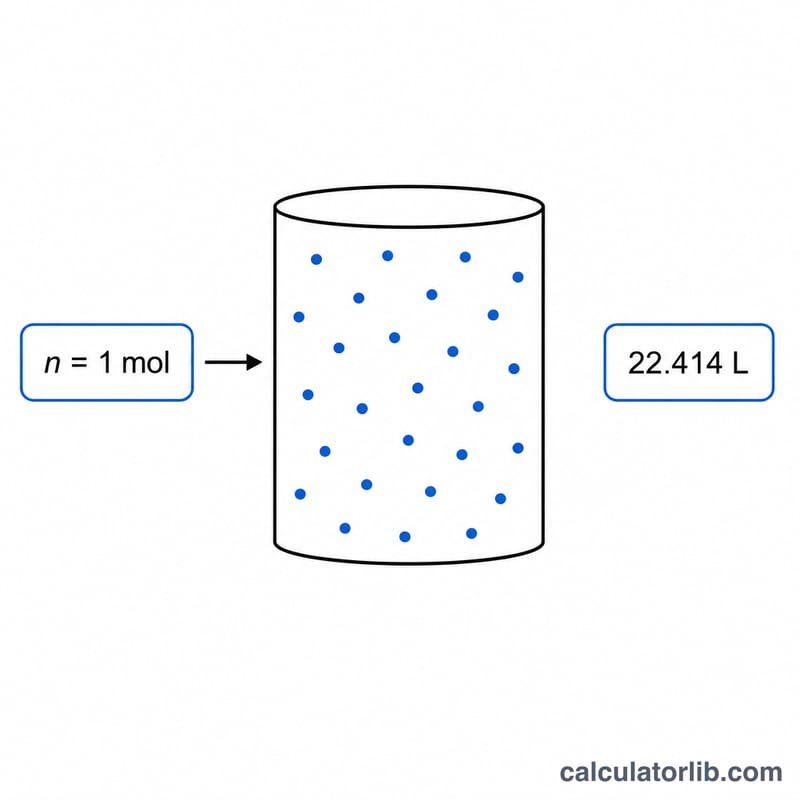
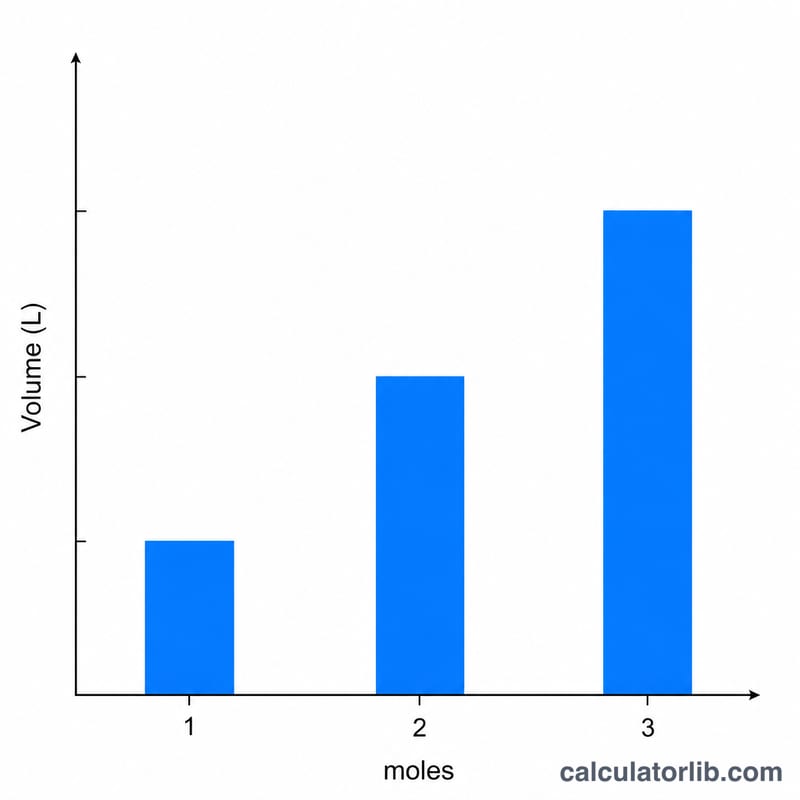
This calculator converts the amount of an ideal gas, measured in moles, into its volume at STP (Standard Temperature and Pressure). At STP — defined here as 0 °C (273.15 K) and 1 atm pressure — one mole of any ideal gas occupies the same molar volume of 22.414 liters. This relationship comes from the ideal gas law and makes it possible to switch between moles and volume with a single multiplication.
How to Use It
Enter the amount of gas in moles and the calculator returns the volume in liters and milliliters. The result assumes the gas behaves ideally and is at STP. This is a universal chemistry relationship, not specific to any country, though note that some textbooks use 22.4 L/mol or define STP as 25 °C — always check which convention your course uses.
The Formula Explained
The core equation is:
$$V = n \times 22.414\ \text{L/mol}$$Here V is the gas volume in liters, n is the number of moles, and \(22.414\ \text{L/mol}\) is the molar volume of an ideal gas at STP. It is derived from \(PV = nRT\) with \(T = 273.15\ \text{K}\), \(P = 1\ \text{atm}\) and \(R = 0.082057\ \text{L}\cdot\text{atm/(mol}\cdot\text{K)}\).
Worked Example
Suppose you have 2 moles of oxygen gas. Multiply: $$V = 2 \times 22.414 = 44.828\ \text{liters}.$$ So two moles of any ideal gas occupy about 44.83 L at STP, or 44,828 mL.
FAQ
Why 22.414 and not 22.4? \(22.414\ \text{L/mol}\) is the more precise value at 0 °C and 1 atm; 22.4 is a common rounding used in introductory courses.
Does this work for any gas? Yes, for ideal gases. All ideal gases share the same molar volume at the same temperature and pressure, regardless of identity.
What if my gas is at a different temperature? Then it is not at STP and you should use the full ideal gas law, \(V = nRT/P\), with the actual conditions.