
What Is the ABV Calculator?
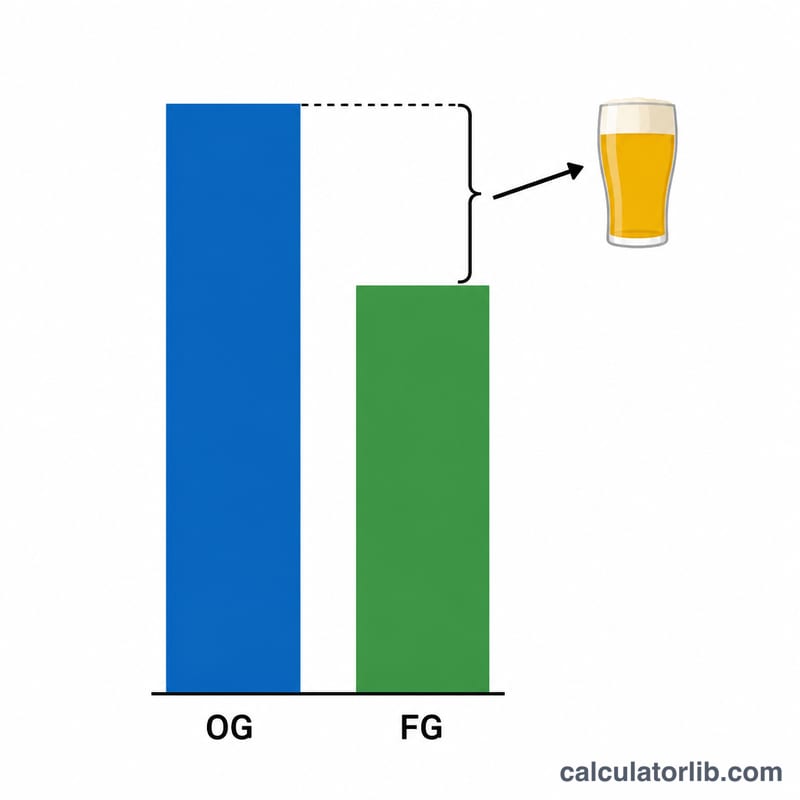
This calculator estimates the alcohol by volume (ABV) of beer, wine, mead, or cider from two hydrometer readings: the original gravity (OG) taken before fermentation and the final gravity (FG) taken after. As yeast converts sugar into alcohol and CO₂, the liquid's density drops — the size of that drop tells you how much alcohol was produced.
How to Use It
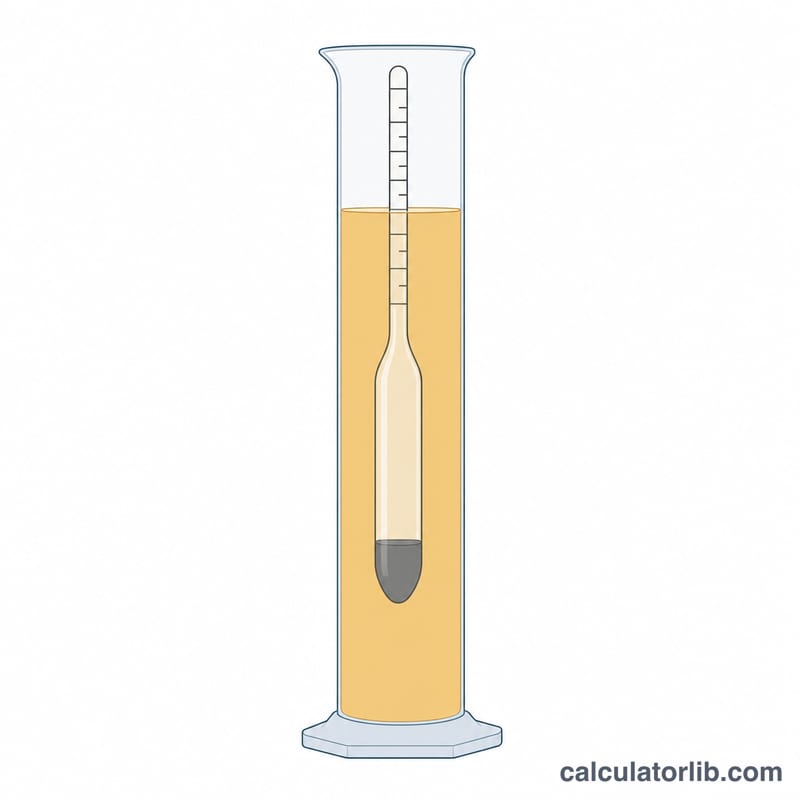
Measure OG with a calibrated hydrometer before pitching yeast, and FG once fermentation has finished (gravity stable for several days). Enter both values — typically between 0.990 and 1.120 — and read the estimated ABV instantly. The tool also reports apparent attenuation, the share of fermentable sugar the yeast consumed.
The Formula Explained
The standard homebrew approximation is:
$$\text{ABV\%} = (\text{OG} - \text{FG}) \times 131.25$$
The constant 131.25 converts the gravity difference into a percentage of alcohol by volume. It is an approximation that works well for typical beer strengths (under about 7% ABV); for stronger brews many brewers prefer more complex equations, but this formula remains the most widely used quick estimate.
Worked Example
Suppose your wort had an OG of 1.050 and finished at an FG of 1.010. The gravity drop is 0.040, so $$\text{ABV} = 0.040 \times 131.25 = 5.25\%$$ Apparent attenuation $$= (0.040 \div 0.050) \times 100 = 80\%$$ a healthy fermentation.
Typical OG, FG & ABV by Beverage Style
The values below show approximate ranges for common fermented beverages. Actual figures vary by recipe, yeast strain and fermentation conditions, but they give a useful sense of where a given gravity reading should land. ABV is estimated with the standard homebrew formula \(\text{ABV}\% = (\text{OG} - \text{FG}) \times 131.25\).
| Style | Typical OG | Typical FG | Typical ABV |
|---|---|---|---|
| Light lager | 1.040 – 1.050 | 1.006 – 1.012 | 3.8% – 5.0% |
| Pale ale | 1.045 – 1.060 | 1.010 – 1.015 | 4.5% – 6.0% |
| IPA | 1.056 – 1.075 | 1.010 – 1.018 | 5.5% – 7.5% |
| Stout | 1.045 – 1.075 | 1.010 – 1.022 | 4.0% – 7.0% |
| Cider | 1.045 – 1.060 | 0.998 – 1.005 | 5.5% – 8.0% |
| Wine | 1.075 – 1.100 | 0.990 – 1.005 | 10% – 14% |
| Mead | 1.090 – 1.140 | 0.995 – 1.020 | 10% – 18% |
Note that ciders, wines and dry meads often finish below 1.000 because most of the sugar is fermentable, leaving a liquid less dense than water.
ABV Across Different Gravity Readings
Each row applies \(\text{ABV}\% = (\text{OG} - \text{FG}) \times 131.25\). Apparent attenuation, the percentage of sugar consumed by the yeast, is found with \(\text{Attenuation}\% = \dfrac{\text{OG} - \text{FG}}{\text{OG} - 1} \times 100\).
| OG | FG | ABV | Apparent attenuation |
|---|---|---|---|
| 1.040 | 1.010 | 3.94% | 75.0% |
| 1.050 | 1.010 | 5.25% | 80.0% |
| 1.060 | 1.012 | 6.30% | 80.0% |
| 1.090 | 1.020 | 9.19% | 77.8% |
Worked example for the 1.060 / 1.012 batch: \((1.060 - 1.012) \times 131.25 = 0.048 \times 131.25 = 6.30\%\) ABV, with attenuation \(\tfrac{0.048}{0.060} \times 100 = 80.0\%\).
Key Terms Explained
- Original gravity (OG)
- The specific gravity of the wort or must before fermentation, reflecting the amount of dissolved sugar available to the yeast. Higher OG means more potential alcohol.
- Final gravity (FG)
- The specific gravity measured after fermentation is complete. The drop from OG to FG indicates how much sugar was converted to alcohol and carbon dioxide.
- Specific gravity (SG)
- The density of a liquid relative to pure water (which is 1.000 at the reference temperature). A reading of 1.050 means the liquid is 5% denser than water.
- Apparent attenuation
- The percentage of the original sugar that the yeast has fermented, calculated as \((\text{OG} - \text{FG}) / (\text{OG} - 1) \times 100\). It is "apparent" because alcohol is lighter than water, which exaggerates the measured density drop.
- Alcohol by volume (ABV)
- The volume of pure ethanol as a percentage of the total volume of the beverage — the standard measure of alcoholic strength.
- Hydrometer
- A floating glass instrument that measures specific gravity by how deeply it sinks into the liquid. It is the most common tool for taking OG and FG readings, ideally corrected for temperature.
- Degrees Plato (°P)
- An alternative scale expressing the dissolved sugar content as the equivalent percentage of sucrose by weight. As a rough guide, \(°P \approx (\text{SG} - 1) \times 1000 / 4\), so an SG of 1.048 is close to 12 °P.
FAQ
Why is OG usually greater than FG? Because dissolved sugar makes the liquid denser than water; fermentation removes sugar and lowers density.
What if my FG is higher than OG? That indicates a measurement error or a stuck/contaminated fermentation — recheck your readings and temperature.
Is this exact? No — it is a reliable estimate. Temperature correction and high-gravity refinements can adjust the figure by a few tenths of a percent.