
What Is the Brix to Specific Gravity Calculator?
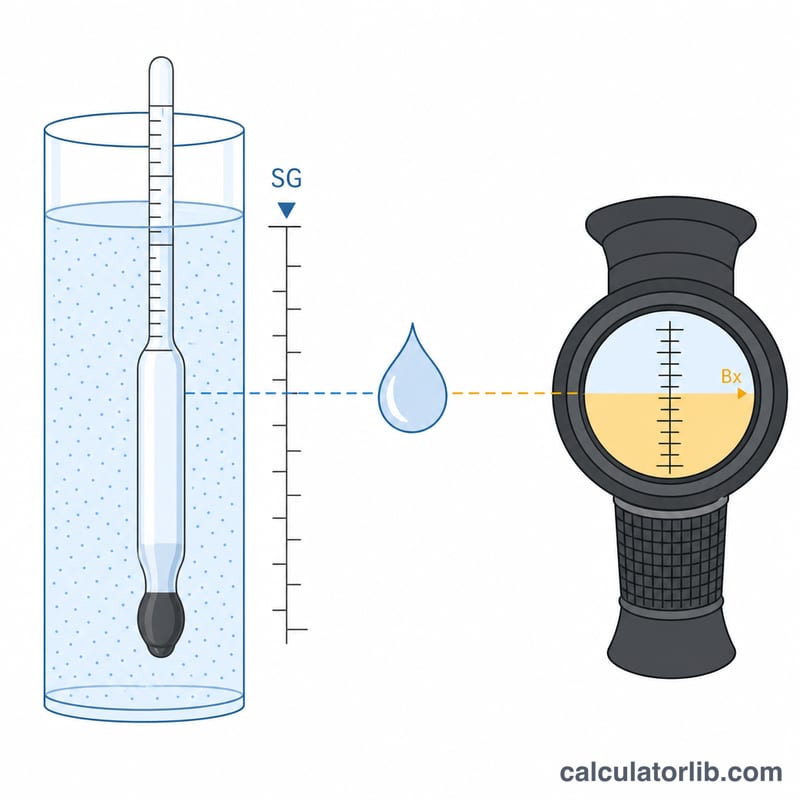
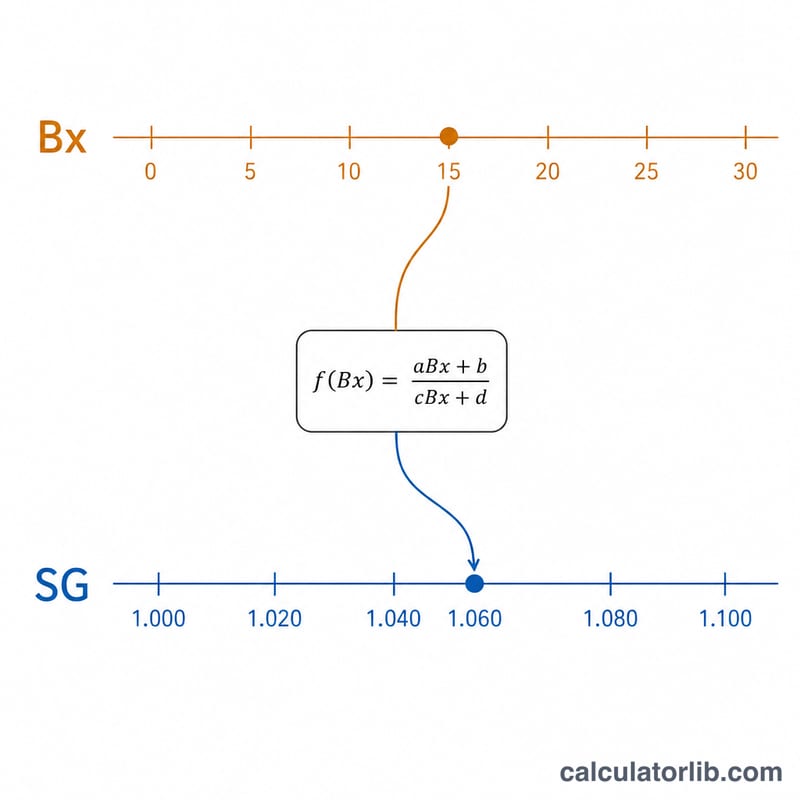
This calculator converts degrees Brix (°Bx)—a measure of dissolved sugar content used with a refractometer—into specific gravity (SG), the density measure used by hydrometers in brewing, winemaking, and other fermentation hobbies. Because refractometers report Brix and many recipes are written in SG, a quick, accurate conversion is essential for tracking sugar levels and predicting alcohol content.
How to Use It
Enter your Brix reading (typically between 0 and 40 for most worts and musts) and the calculator returns the equivalent specific gravity. A reading of 0 °Bx returns 1.000, exactly the density of pure water.
The Formula Explained
The conversion uses a widely adopted cubic-derived approximation:
$$\text{SG} = 1 + \frac{\text{°Bx}}{258.6 - \left(\frac{\text{°Bx}}{258.2}\times 227.1\right)}$$
The denominator shrinks slightly as Brix increases, which captures the nonlinear way sugar concentration affects density. This formula is accurate for the dilute-to-moderate sugar range common in brewing and winemaking.
Worked Example
Suppose your refractometer reads 12 °Bx. First compute the denominator: \(258.6 - (12/258.2)\times 227.1 = 258.6 - 10.554 = 248.046\). Then $$\text{SG} = 1 + \frac{12}{248.046} = 1 + 0.04838 \approx 1.0484$$ That matches the typical original gravity of a moderate-strength wort.
FAQ
Is this exact? It is a high-quality approximation valid across normal fermentation ranges. Very high sugar musts may drift slightly from precise lab values.
Should I correct for alcohol? Refractometers read inaccurately once fermentation begins; use this conversion mainly for the initial (pre-fermentation) reading, or apply a separate alcohol-correction formula for finished gravity.
What does SG = 1.000 mean? It is the density of pure water—zero dissolved sugar—so 0 °Bx correctly converts to 1.000.