
What Is API Gravity?
API gravity is a measure used by the petroleum industry to express how heavy or light a crude oil or refined product is compared to water. Devised by the American Petroleum Institute (API), the scale is an inverse function of specific gravity: lighter liquids have a higher °API value, while heavier liquids have a lower one. Pure water, with a specific gravity of 1.0, corresponds to exactly 10 °API.
How to Use This Calculator
Enter the specific gravity (SG) of your liquid, measured at 60°F relative to water at 60°F. The calculator instantly returns the equivalent API gravity in degrees (°API). Specific gravity must be greater than zero.
The Formula Explained
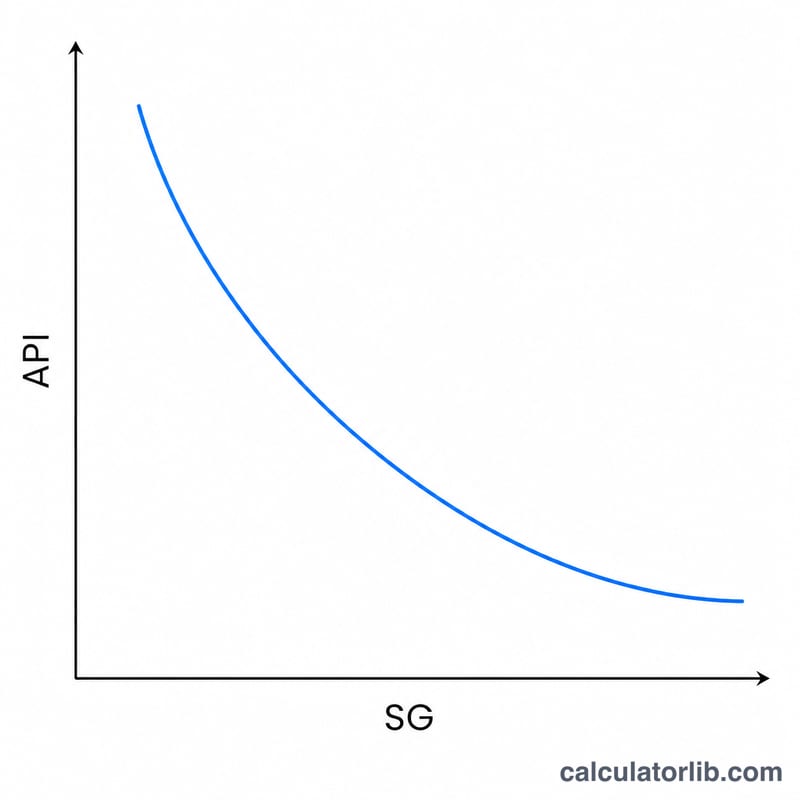
The conversion is defined as $$\text{API} = \frac{141.5}{\text{SG}} - 131.5$$ Because specific gravity appears in the denominator, the relationship is inverse: as SG falls (the liquid becomes lighter), API gravity rises. Crude oil is commonly classified as light (above 31.1 °API), medium (22.3–31.1 °API), or heavy (below 22.3 °API).
Worked Example
Suppose a crude oil sample has a specific gravity of 0.85. Then $$\text{API} = \frac{141.5}{0.85} - 131.5 = 166.4706 - 131.5 = \mathbf{34.97\ \degree\text{API}}$$ indicating a light crude.
Crude Oil Classification Thresholds
Petroleum is graded by API gravity into broad categories used in trading, refining, and regulation. The thresholds below follow conventions used by the American Petroleum Institute (API) and the Canadian National Energy Board (NEB). The corresponding specific-gravity ranges are obtained by inverting the API formula, \(SG = 141.5/(API + 131.5)\).
| Category | API gravity (°API) | Specific gravity (SG) | Behavior in water |
|---|---|---|---|
| Light crude | > 31.1 | < 0.870 | Floats |
| Medium crude | 22.3 – 31.1 | 0.870 – 0.920 | Floats |
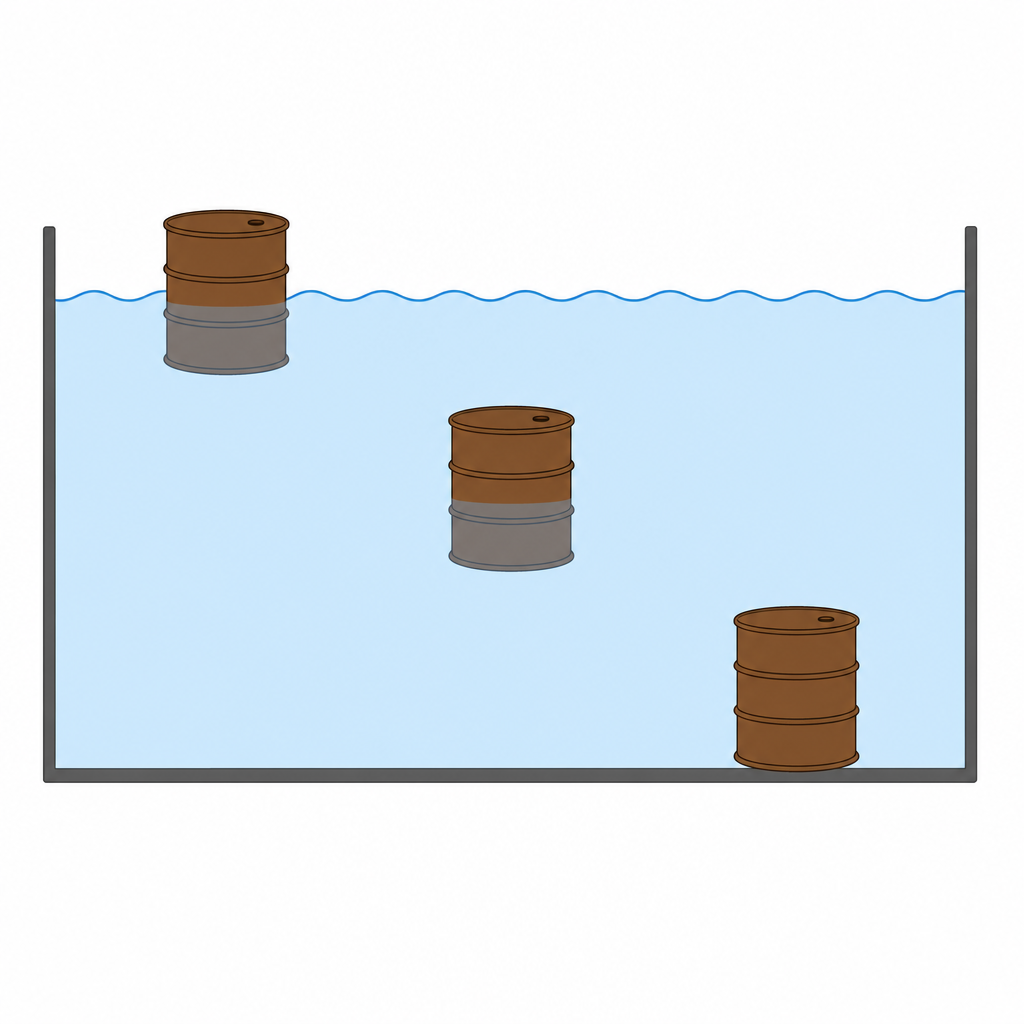
| Heavy crude | 10.0 – 22.3 | 0.920 – 1.000 | Floats (barely) |
| Extra-heavy crude / bitumen | < 10.0 | > 1.000 | Sinks |
The 10 °API line is significant: it marks SG = 1.000, the density of fresh water. Crudes below 10 °API are denser than water and are classed as extra-heavy oils or natural bitumen. The 31.1 °API and 22.3 °API boundaries correspond to specific gravities of about 0.870 and 0.920 respectively. Exact category cutoffs can vary slightly between agencies and contracts, so always confirm against the specification governing a given transaction.
FAQ
What is the API gravity of water? Water has SG = 1.0, giving \(\text{API} = 141.5/1 - 131.5 = 10\ \degree\text{API}\).
Can API gravity be negative? Yes. For very heavy liquids with SG above about 1.076, the formula yields a negative API value.
What temperature should SG be measured at? The standard reference is 60°F (15.56°C) for both the sample and water.