

What is an oxidation number?
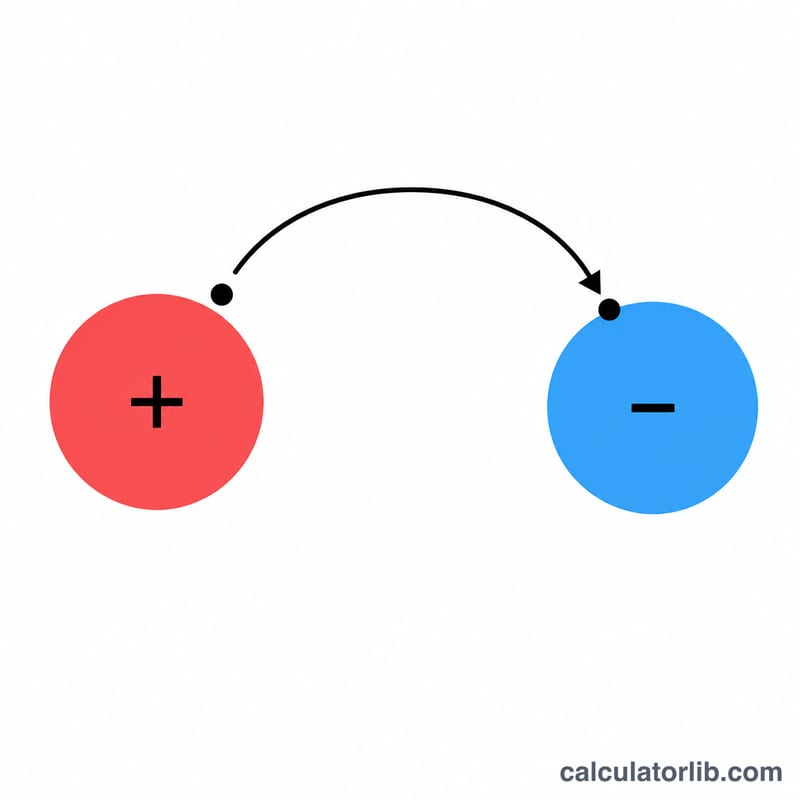
An oxidation number (or oxidation state) is the hypothetical charge an atom would carry if all its bonds were fully ionic. It is a bookkeeping tool used to balance redox equations, name compounds, and track electron transfer. This calculator finds the unknown oxidation state of one element in a molecule or polyatomic ion using the fundamental rule that the sum of all oxidation states equals the overall charge of the species.
How to use the calculator
Enter the symbol of the element you are solving for, how many atoms of it appear in the formula, the overall charge of the species (0 for a neutral molecule), and the combined oxidation-state sum of every other atom. The tool returns the oxidation state per atom of your chosen element.
The formula explained
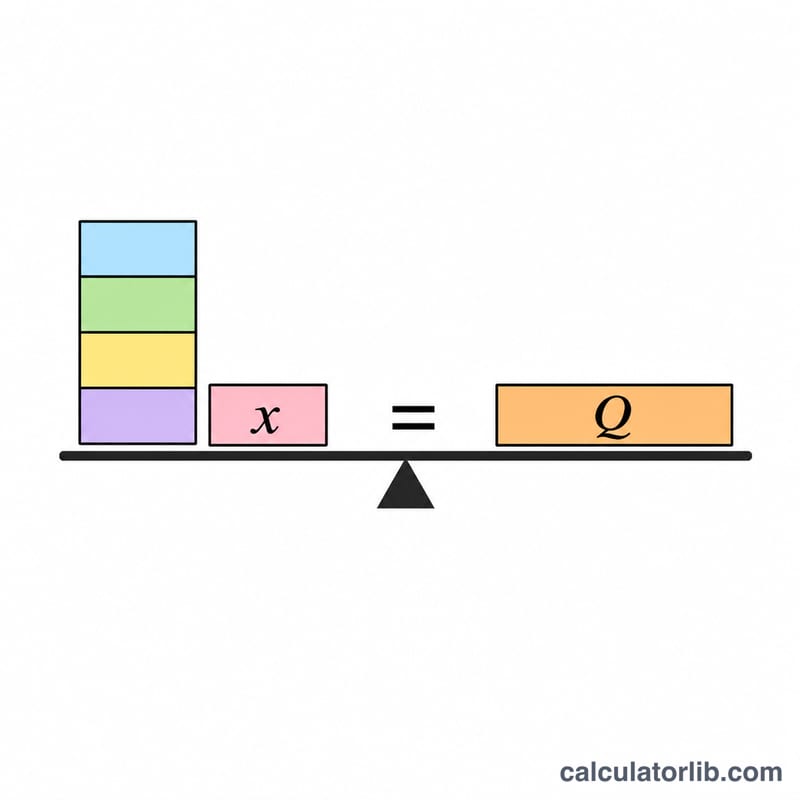
If a species contains n atoms of the unknown element with oxidation state x, and the other atoms contribute a known total S, then conservation of charge requires:
\(n\cdot x + S = Q\), which rearranges to $$x = \dfrac{Q - S}{n}$$ where Q is the overall charge.
Worked example: sulfate (SO₄²⁻)
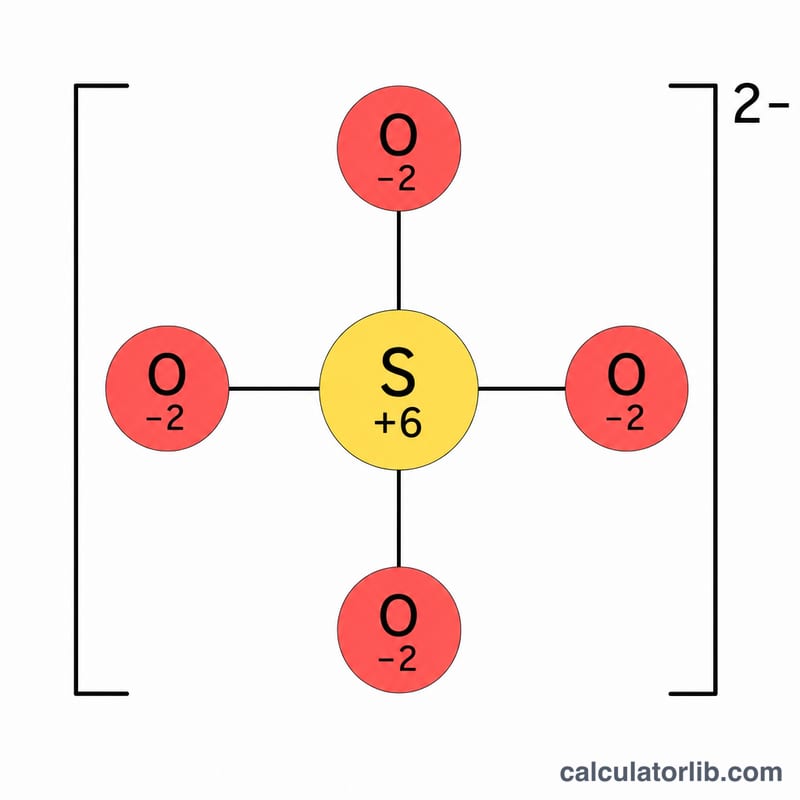
In the sulfate ion, oxygen is normally −2. Four oxygens give \(S = 4 \times (-2) = -8\). The overall charge \(Q = -2\) and there is \(n = 1\) sulfur atom. So $$x = \frac{-2 - (-8)}{1} = +6.$$ Sulfur in sulfate has an oxidation state of +6.
FAQ
What sign convention does it use? Positive values mean the atom is oxidized (lost electrons); negative means reduced (gained electrons).
Why might I get a fractional answer? Some compounds (like Fe₃O₄ or S₄O₆²⁻) genuinely give average fractional oxidation states because individual atoms differ.
What are common known values? Oxygen is usually −2 (−1 in peroxides), hydrogen +1 (−1 in metal hydrides), and Group 1 metals +1.