
What This Calculator Does
This tool tells you how many individual molecules (or formula units) are present in a sample of a substance. You supply the mass of the sample in grams and the molar mass of the compound in grams per mole, and the calculator returns both the number of moles and the total number of molecules using Avogadro number, \(6.022 \times 10^{23}\) per mole.
How to Use It
Enter the mass of your sample in grams. Then enter the molar mass (molecular weight) of the compound in g/mol — for example, water (H₂O) is about 18.015 g/mol, carbon dioxide (CO₂) is 44.01 g/mol, and table salt (NaCl) is 58.44 g/mol. The result updates instantly, showing both the amount of substance in moles and the number of molecules.
The Formula Explained
The calculation has two steps. First, divide the mass by the molar mass to get the number of moles: \(n = m / M\). Second, multiply the moles by Avogadro number (\(N_A = 6.022 \times 10^{23}\)) to get the molecule count: \(N = n \times N_A\). Combined, this gives
$$N = \frac{\text{Mass (g)}}{\text{Molar Mass (g/mol)}} \times 6.022 \times 10^{23}$$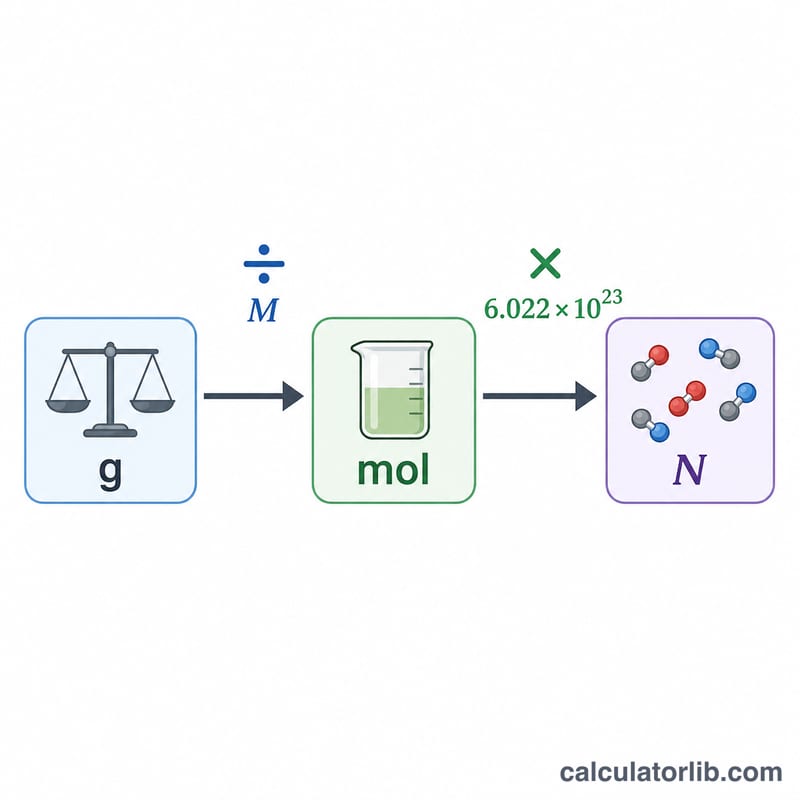
Worked Example
Suppose you have 36 grams of water. Water has a molar mass of about 18 g/mol, so the number of moles is \(36 / 18 = 2\) mol. Multiplying by Avogadro number:
$$2 \times 6.022 \times 10^{23} = 1.2044 \times 10^{24} \text{ molecules of water.}$$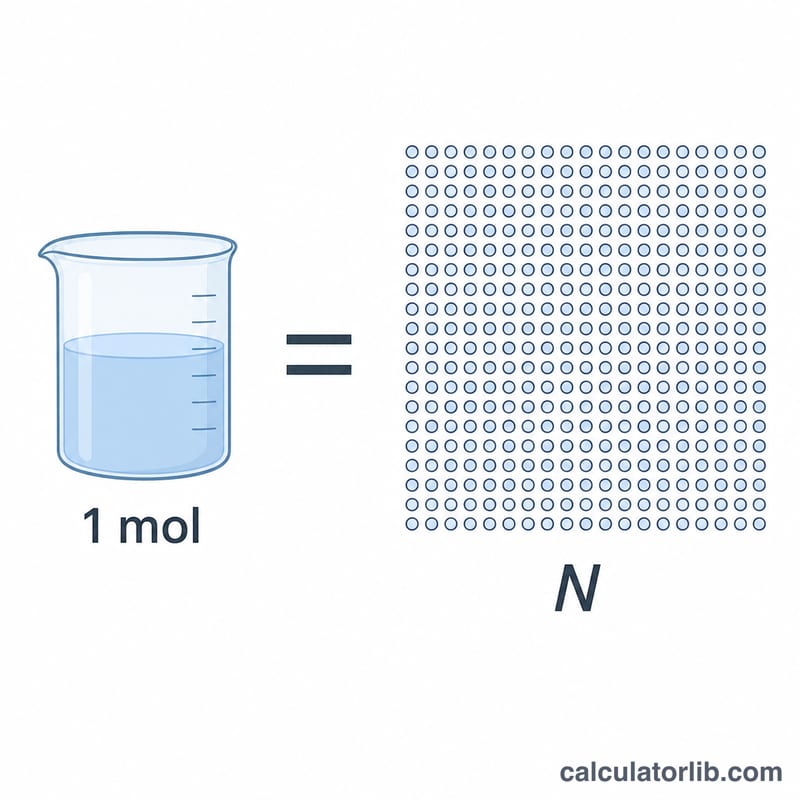
Common Molar Masses Reference
The molar mass (g/mol) is the mass of one mole of a substance. Dividing a sample's mass by its molar mass gives the number of moles, which is then multiplied by Avogadro's number to find the molecule count. The values below are useful inputs for the mw field.
| Compound | Chemical Formula | Molar Mass (g/mol) |
|---|---|---|
| Water | H₂O | 18.015 |
| Carbon dioxide | CO₂ | 44.01 |
| Oxygen | O₂ | 32.00 |
| Glucose | C₆H₁₂O₆ | 180.16 |
| Sodium chloride | NaCl | 58.44 |
| Ammonia | NH₃ | 17.03 |
| Ethanol | C₂H₅OH | 46.07 |
| Sulfuric acid | H₂SO₄ | 98.08 |
| Methane | CH₄ | 16.04 |
| Calcium carbonate | CaCO₃ | 100.09 |
If you need the molar mass of a compound not listed here, you can derive it from the chemical formula with a molar mass from formula calculator.
Constants Used
This calculator relies on the Avogadro constant, which defines how many elementary entities (atoms, molecules, or formula units) are contained in exactly one mole of a substance.
- Avogadro constant: \(N_A = 6.02214076 \times 10^{23}\ \text{mol}^{-1}\). Since the 2019 redefinition of the SI base units, this value is exact by definition.
- Rounded value: \(N_A \approx 6.022 \times 10^{23}\ \text{mol}^{-1}\), the form used in most textbook calculations and in this tool.
- Molar mass constant: \(M_u \approx 1\ \text{g/mol}\), which links the dimensionless atomic/molecular weight to a molar mass in grams per mole.
By definition, one mole = \(6.02214076 \times 10^{23}\) particles. So a sample's molecule count is simply its number of moles multiplied by this constant:
$$N = n \times N_A = \frac{\text{mass}}{\text{molar mass}} \times 6.022 \times 10^{23}$$FAQ
What is Avogadro number? It is the number of particles in one mole of a substance, defined as approximately \(6.022 \times 10^{23}\).
Does this work for ionic compounds? Yes — for ionic compounds such as NaCl the result represents formula units rather than discrete molecules.
Where do I find the molar mass? Add up the atomic masses of all atoms in the chemical formula using the periodic table, or look it up for common compounds.