
What this calculator does
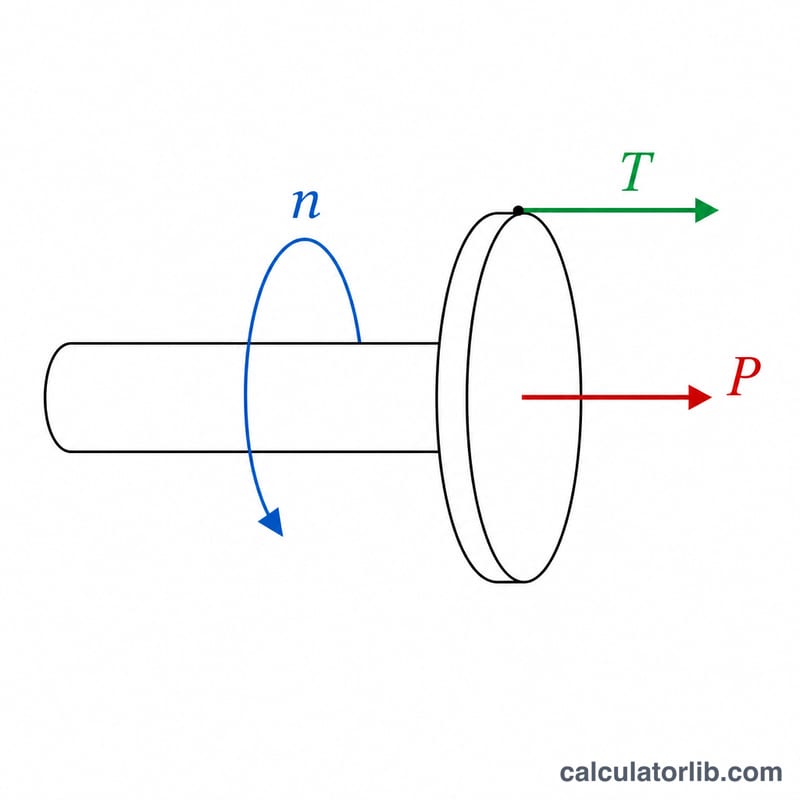
This tool links three quantities of rotating machinery: mechanical power \(P\), torque \(T\), and rotational speed \(n\). Given any two of them, it computes the third using the rotational power relation. It is a universal physics tool with no region-specific rules, useful for sizing motors, engines, gearboxes, and pumps when a datasheet lists only torque and speed, for example.
How to use it
Pick what you want to compute from the "Solve For" menu. Enter the two known values and choose their units. Power accepts kW, PS (metric horsepower), or HP (mechanical horsepower); torque accepts N.m, kgf.m, or lbf.ft; speed accepts rpm, rev per second, or rev per hour. The calculator normalises every input to SI (watts, newton-metres, rpm), applies the formula, and reports the answer in several common units.
The formula explained
The angular velocity is \(\omega = \frac{2\pi n}{60}\) in radians per second, where \(n\) is in rpm. Mechanical power is force times speed, which for rotation becomes \(P = T \cdot \omega\). Substituting gives $$P = \frac{2\pi\,T\,n}{60}$$ with \(T\) in N.m and \(P\) in watts. Rearranged, \(T = \frac{60P}{2\pi n}\) and \(n = \frac{60P}{2\pi T}\). When solving for speed, torque must be non-zero; when solving for torque, speed must be non-zero, otherwise the result is undefined.
Worked example
Suppose torque is 1500 N.m and speed is 4200 rpm. Then $$P = \frac{2\pi \cdot 1500 \cdot 4200}{60} = 2\pi \cdot 105000 = 659{,}734 \text{ W}$$ about 659.73 kW, equivalent to roughly 897 PS or 885 HP. Reversing it: 5000 kW at 4200 rpm gives $$T = \frac{5{,}000{,}000 \cdot 60}{2\pi \cdot 4200} = 11{,}368.21 \text{ N.m}$$
FAQ
Why divide by 60? Speed is entered in rev per minute, so dividing by 60 converts to rev per second before multiplying by \(2\pi\) to get rad/s.
Which horsepower should I use? PS is metric horsepower (735.49875 W); HP is mechanical/imperial horsepower (745.69987 W). Match the unit your datasheet uses.
Can I enter zero? Zero power is allowed, but torque or speed of zero in the denominator produces an undefined result and the tool warns you instead of dividing by zero.