
What this calculator does
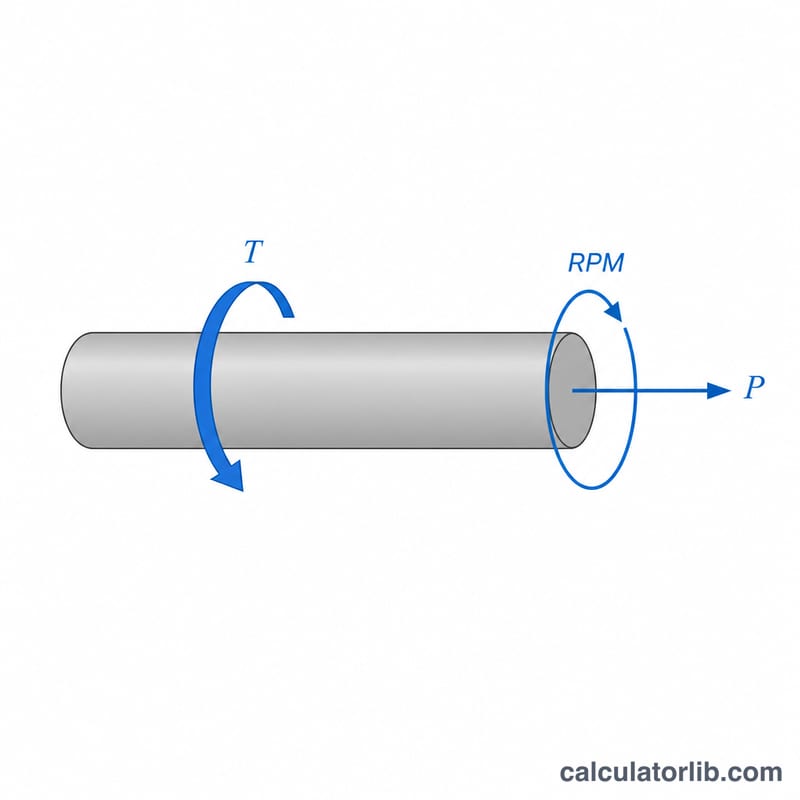
This tool converts a rotational torque and speed into the mechanical power being delivered by a shaft. Enter the torque in newton-metres (N·m) and the rotational speed in revolutions per minute (RPM), and it returns the power in kilowatts, watts and horsepower. It is widely used by engineers, mechanics and students working with electric motors, engines, pumps, gearboxes and turbines.
How to use it
Type the shaft torque and the running speed, then read off the result. For a motor nameplate that lists torque and rated speed, this gives the rated output power. To go the other way (find torque from a known power), rearrange to \(T = 9549 \times P_{kW} / \text{RPM}\).
The formula explained
Power equals torque multiplied by angular velocity: \(P = T \times \omega\), where \(\omega\) is in radians per second. Since RPM is revolutions per minute, \(\omega = 2\pi \times \text{RPM} / 60\). Substituting and converting watts to kilowatts gives the constant \(60000 / (2\pi) \approx 9549\). So $$P_{kW} = \frac{T_{Nm} \times \text{RPM}}{9549}$$ The horsepower figure uses \(1\ \text{hp} = 745.7\ \text{W}\) (metric/mechanical horsepower).
Worked example
A motor produces 50 N·m at 3000 RPM. $$P = \frac{50 \times 3000}{9549} = \frac{150000}{9549} \approx 15.71\ \text{kW}$$ which is about 15706 W or 21.06 hp.
FAQ
Where does 9549 come from? It is \(60000 \div 2\pi\), the factor that converts N·m and RPM directly into kilowatts.
Which horsepower is used? The mechanical/metric horsepower of 745.7 watts.
Does this work for engines and turbines? Yes — any rotating shaft with a known torque and speed follows \(P = T \times \omega\).