
What this calculator does
This tool converts an electrical load expressed in amps and volts, running for a set number of hours, into energy consumption measured in kilowatt-hours (kWh) — the unit your electricity bill is charged in. It also reports the instantaneous power draw in watts and, if you enter a price, the estimated cost of running the device.
How to use it
Enter the supply voltage (typically 120 V in North America or 230 V in Europe), the current the device draws in amps, and how many hours it runs. Optionally add your electricity price per kWh to estimate the cost. Press calculate to see the energy used and the matching cost.
The formula explained
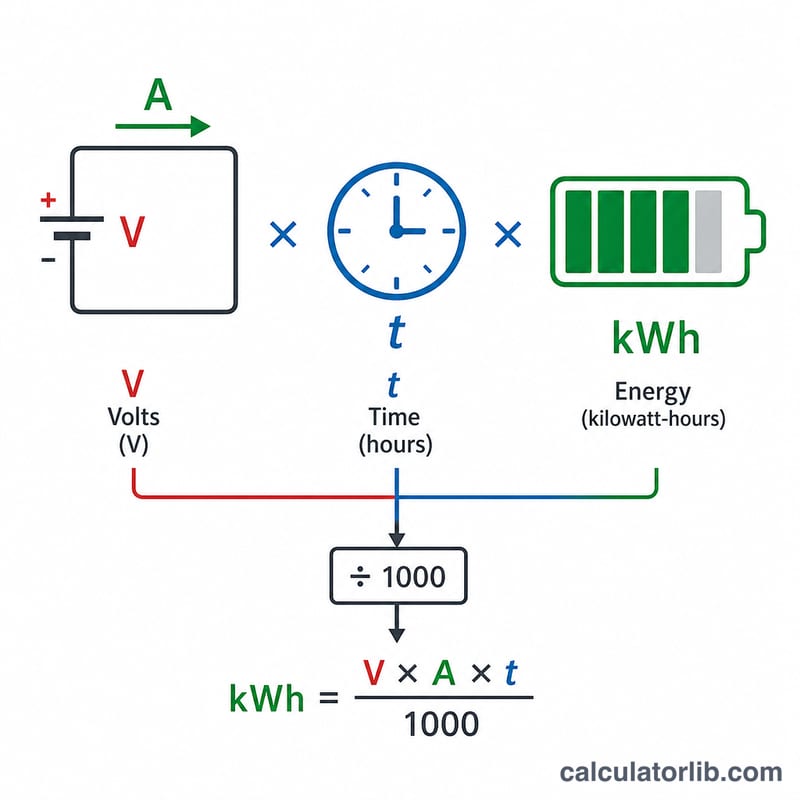
Electrical power in watts equals voltage multiplied by current: \(W = V \times A\). Energy is power multiplied by time, so over t hours the device uses \(W \times t\) watt-hours. Dividing by 1000 converts watt-hours to kilowatt-hours: $$\text{kWh} = \frac{V \times A \times t}{1000}$$ Cost is simply the kWh multiplied by your per-kWh rate.
Worked example
A space heater on a 120 V circuit draws 10 A and runs for 3 hours. Power = \(120 \times 10 = 1200\) W. Energy = $$\frac{1200 \times 3}{1000} = 3.6 \text{ kWh}$$ At a rate of 0.15 per kWh the cost is \(3.6 \times 0.15 = 0.54\).
FAQ
Does this work for AC and DC? The \(V \times A\) formula gives real power directly for DC and for resistive AC loads. For reactive AC loads (motors), multiply by the power factor for true power.
What voltage should I use? Use your local mains voltage — 120 V in the US/Canada, 230 V in most of Europe, or the rating printed on the device.
How do I find the amps? Check the device label or nameplate, or measure with a clamp meter; many appliances list their current draw in amps.