What is the kWh to kW Calculator?
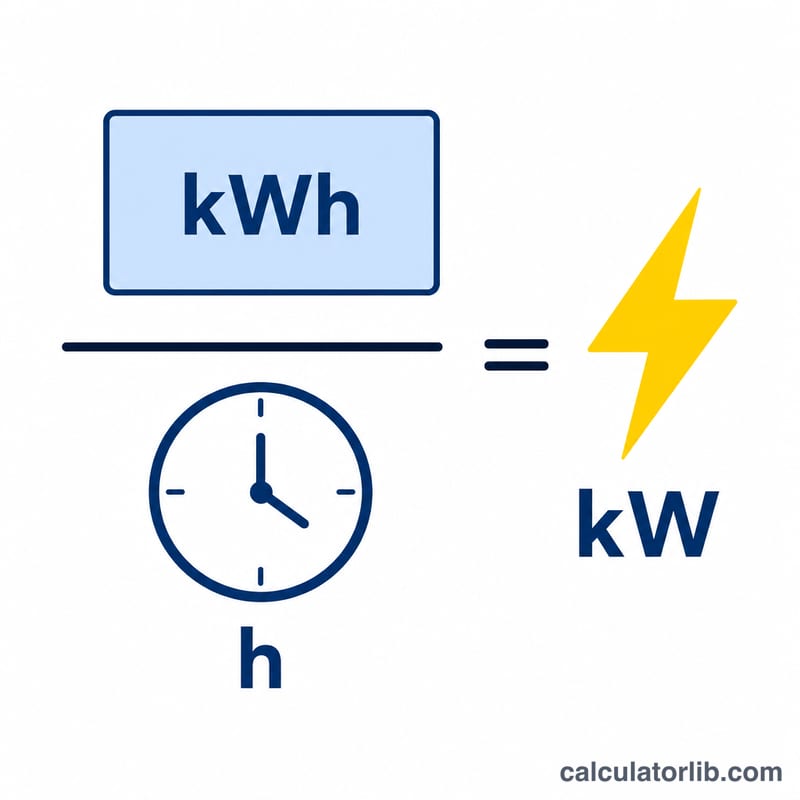
This calculator converts energy measured in kilowatt-hours (kWh) into average power measured in kilowatts (kW). Energy and power are related but different: a kilowatt is a rate of using energy, while a kilowatt-hour is the total amount of energy used when that rate is sustained for one hour. To go from energy back to power, you simply divide the energy by the number of hours over which it was used.
How to use it
Enter the total energy in kilowatt-hours and the time period in hours. The calculator returns the average power in kilowatts (and also in watts). For example, if an appliance used 10 kWh over 5 hours, its average power draw was 2 kW.
The formula explained
The relationship is $$\text{Power (kW)} = \frac{\text{Energy (kWh)}}{\text{Time (h)}}$$ Because 1 kWh is defined as 1 kW sustained for 1 hour, dividing total energy by elapsed time recovers the average power. Multiply the result by 1000 to express the power in watts (W).
Worked example
Suppose a heater consumed 24 kWh over an 8-hour period. The average power is $$24 \div 8 = 3 \text{ kW},$$ which equals 3,000 W. This is the steady power level that would consume the same energy in the same time.
Typical Appliance Power Ratings
The table lists approximate typical values. Actual power depends on the model, settings and region, so check the rating label on your own appliance. Power in kW is the watts divided by 1,000.
| Appliance | Typical power (kW) | Typical power (W) |
|---|---|---|
| LED bulb | 0.01 | 10 |
| Laptop | 0.05 | 50 |
| Refrigerator (average running draw) | 0.15 | 150 |
| Microwave oven | 1.0–1.2 | 1,000–1,200 |
| Space heater | 1.5 | 1,500 |
| Electric kettle | 1.8–3.0 | 1,800–3,000 |
| Electric oven | 2–3 | 2,000–3,000 |
| EV home charger (single-phase, common in the UK and Europe) | 7.4 | 7,400 |
A refrigerator cycles on and off, so 0.15 kW is a long-run average rather than a constant draw. Use the kWh to kW calculator to find the average power of a device from its energy use over a known time.
Same Energy, Different Time Periods
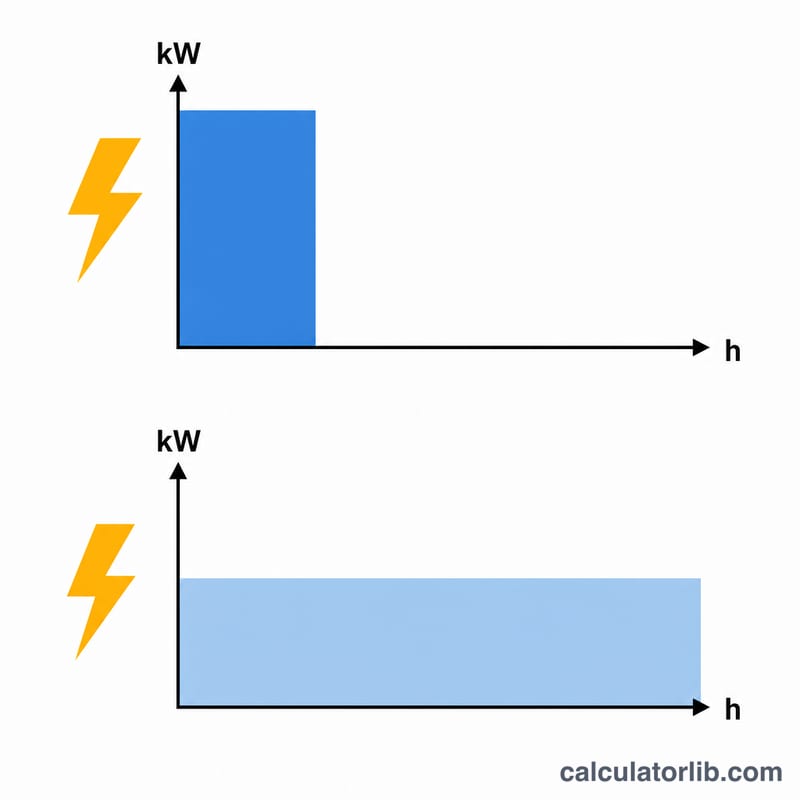
The energy is fixed at 12 kWh, and the average power is \(P = \frac{E}{t}\). The longer the energy is spread over, the lower the average power.
| Time (h) | Calculation | Power (kW) | Power (W) |
|---|---|---|---|
| 1 | \(12 \div 1\) | 12 kW | 12,000 W |
| 2 | \(12 \div 2\) | 6 kW | 6,000 W |
| 4 | \(12 \div 4\) | 3 kW | 3,000 W |
| 6 | \(12 \div 6\) | 2 kW | 2,000 W |
| 12 | \(12 \div 12\) | 1 kW | 1,000 W |
| 24 | \(12 \div 24\) | 0.5 kW | 500 W |
Note that kW is an average over the period. The real power may be higher or lower at any moment.
Power and Energy Unit Conversions
Power
| Unit | Equivalent |
|---|---|
| 1 kW | 1,000 W = 0.001 MW |
| 1 kW | ≈ 1.341 horsepower (mechanical hp) |
Energy
| Unit | Equivalent |
|---|---|
| 1 kWh | 1,000 Wh = 3.6 MJ = 3,600,000 J |
Minutes to hours
| Minutes | Hours |
|---|---|
| 15 min | 0.25 h |
| 30 min | 0.5 h |
| 45 min | 0.75 h |
Always enter time in hours. For example, 3 kWh used in 45 minutes gives \(3 \div 0.75 = 4\) kW.
FAQ
Is this the same as instantaneous power? No. The result is the average power over the time period. Real devices may draw more or less at any instant.
What if my time is in minutes? Convert minutes to hours first by dividing by 60, then enter the value in hours.
Why divide by zero is blocked? Power is undefined over zero time, so a time of 0 hours returns 0.