What is the Cost Per kWh Calculator?
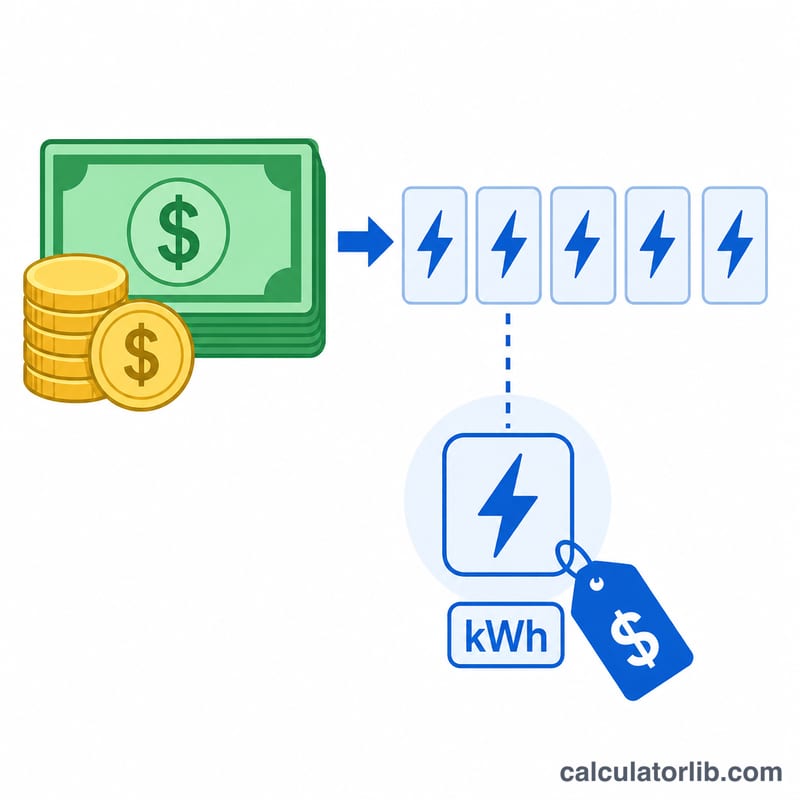
This calculator reveals the real, all-in price you pay for each kilowatt-hour (kWh) of electricity. Utility bills bundle energy charges, delivery fees, taxes and surcharges together, so the "rate" printed on your tariff sheet rarely matches what you actually pay. By dividing your total monthly bill by the kWh you consumed, you get your true effective rate — perfect for comparing suppliers, spotting bill creep, or estimating the cost of running an appliance.
How to use it
Enter two numbers from your statement: the total amount billed for the month and the total energy used in kWh. Your usage figure is usually shown near the meter readings (current reading minus previous reading). Click calculate and you'll see your effective rate per kWh, plus the same figure expressed in cents for easy comparison.
The formula explained
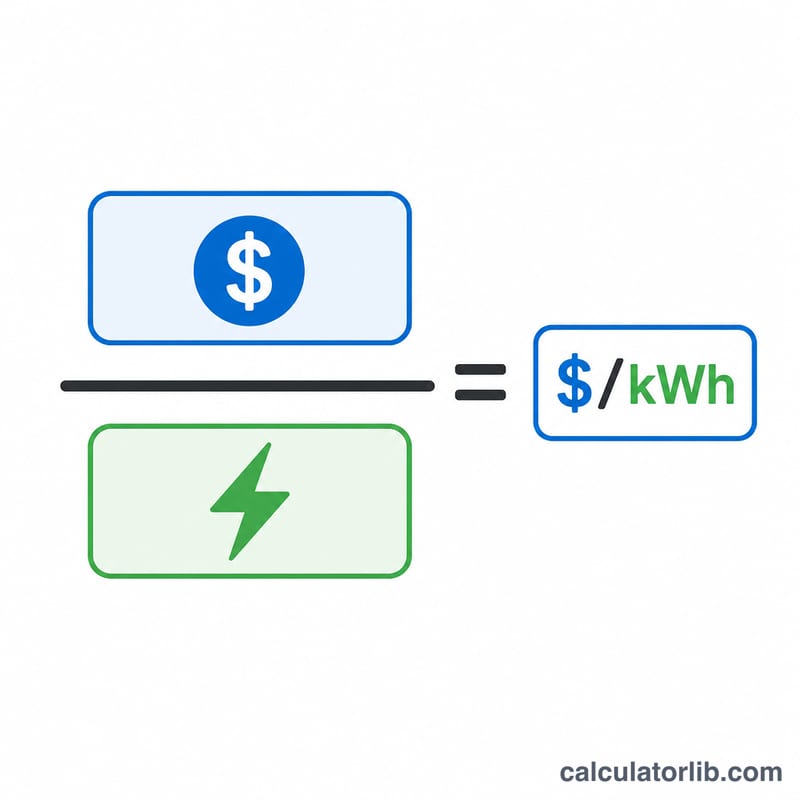
The math is simple division: $$\text{Rate} = \frac{\text{Total Bill}}{\text{kWh Used}}$$ Because the total bill already includes every fee and tax, the result is your blended effective rate — a more honest number than the headline tariff. Multiplying by 100 converts dollars (or your currency) into cents per kWh.
Worked example
Suppose your monthly bill was $150 and you used 1,000 kWh. Your effective rate is $$150 \div 1000 = 0.15 \text{ per kWh},$$ or 15 ¢/kWh. If a competitor advertises 12 ¢/kWh but adds heavy fixed charges, this calculation lets you compare apples to apples.
Interpreting Your Effective Rate
The figure this calculator returns is a blended (effective) rate: your total bill divided by the kilowatt-hours used. It is not the price of a single kWh. The total usually combines several components:
- Energy (supply) charges for the electricity itself.
- Delivery or distribution charges for the wires and network, often billed per kWh.
- Fixed (customer or standing) charges that apply regardless of how much you use.
- Taxes, levies and surcharges, which vary by jurisdiction and may be a percentage or a per-kWh amount.
Because the fixed charges are spread over the kWh you used, low-usage months produce a higher effective rate. A month with little consumption (for example, while away) can show a much higher cost per kWh than a busy month, even though the tariff did not change.
To compare, find the supply rate on your tariff sheet (or the per-kWh price on your bill) and set it beside your effective rate. The gap is roughly the per-kWh impact of fixed charges, delivery, taxes and any other items. Check that the bill covers a single billing period and that the kWh figure matches the same period. Tiered, time-of-use or seasonal tariffs can also move the blended figure from month to month.
Formula: \(\text{Cost per kWh} = \frac{ \text{Total monthly bill} }{ \text{kWh used} }\)
This is a factual description of how the figure is calculated, not advice. Rules and bill structures differ between countries and utilities.
Effective Rate at Different Usage Levels
The table below is illustrative only. It assumes a fixed monthly charge of $20 and a constant variable rate of $0.12 per kWh. These are not real tariff figures for any utility or country.
| Usage (kWh) | Variable cost | Fixed charge | Total bill | Effective cost per kWh |
|---|---|---|---|---|
| 300 | $36 | $20 | $56 | 18.7¢ |
| 600 | $72 | $20 | $92 | 15.3¢ |
| 1,000 | $120 | $20 | $140 | 14.0¢ |
| 1,500 | $180 | $20 | $200 | 13.3¢ |
Worked check for the 1,000 kWh row: total bill = $20 + (1,000 × $0.12) = $140, so the effective rate is $140 ÷ 1,000 kWh = $0.14 per kWh.
The variable rate never changes in this example, yet the effective rate falls from 18.7¢ to 13.3¢ as usage rises. The reason is that the $20 fixed charge is divided across more kWh. As usage grows, the effective rate approaches the variable rate of 12¢ but never falls below it.
Key Electricity Billing Terms
- kWh (kilowatt-hour)
- A unit of energy. 1 kWh equals 1,000 watts of power used for one hour, for example a 100 W bulb running for 10 hours.
- Effective (blended) rate
- Total bill divided by total kWh used, including all charges, fixed and variable.
- Tariff / supply rate
- The published price per kWh for the electricity itself, as listed in the utility or retailer's rate schedule. It may vary by tier, time of day or season.
- Delivery or distribution charge
- A charge for transporting electricity over the local network to your premises. It may be per kWh, fixed, or both.
- Fixed, standing or customer charge
- A set amount charged per day or month for being connected, regardless of consumption.
- Demand charge
- A charge based on your peak power draw (in kW) during a billing period. It is more common on commercial and some residential tariffs.
- Taxes and surcharges
- Government taxes, levies, regulatory fees and program charges added to the bill. They differ widely by location.
- Meter reading
- The recorded cumulative kWh on your meter. The difference between two readings gives the usage for a period. Some bills use estimated readings until an actual reading is taken.
FAQ
Should I include taxes and fees? Yes — using your total bill gives the most realistic effective rate, since those charges are unavoidable.
Where do I find kWh used? It's listed on your bill as "usage" or "consumption", often alongside meter readings.
Why is my rate higher than the advertised price? Fixed connection charges and taxes are spread across your kWh, raising the effective per-unit cost — especially in low-usage months.