
What is the EV Cost Per Mile Calculator?
This calculator tells you how much electricity costs to drive your electric vehicle one mile. By combining your vehicle's efficiency (how many miles it travels per kilowatt-hour) with your local electricity price (dollars per kWh), it produces a simple, comparable per-mile figure. This makes it easy to compare an EV against a gasoline car or to estimate the energy cost of any trip. The formula is universal and works with any currency by entering your own per-kWh rate.
How to use it
Enter three values: your EV's efficiency in miles per kWh (typical EVs range from 3 to 4.5 mi/kWh), your electricity rate in dollars per kWh (a common US average is around $0.15), and optionally a trip distance in miles. The calculator returns the cost per mile, the energy used per mile, the cost per 100 miles, and the total cost of the trip you entered.
The formula explained
Energy used per mile is simply the inverse of efficiency: \(\text{kWh/mile} = 1 \div (\text{miles/kWh})\). Multiply that by your rate to get the cost: \(\text{cost/mile} = \text{rate} \div \text{efficiency}\). A higher efficiency or a lower rate both lower the cost per mile.
$$\text{Cost per Mile} = \frac{\text{Rate (\$/kWh)}}{\text{Efficiency (mi/kWh)}}$$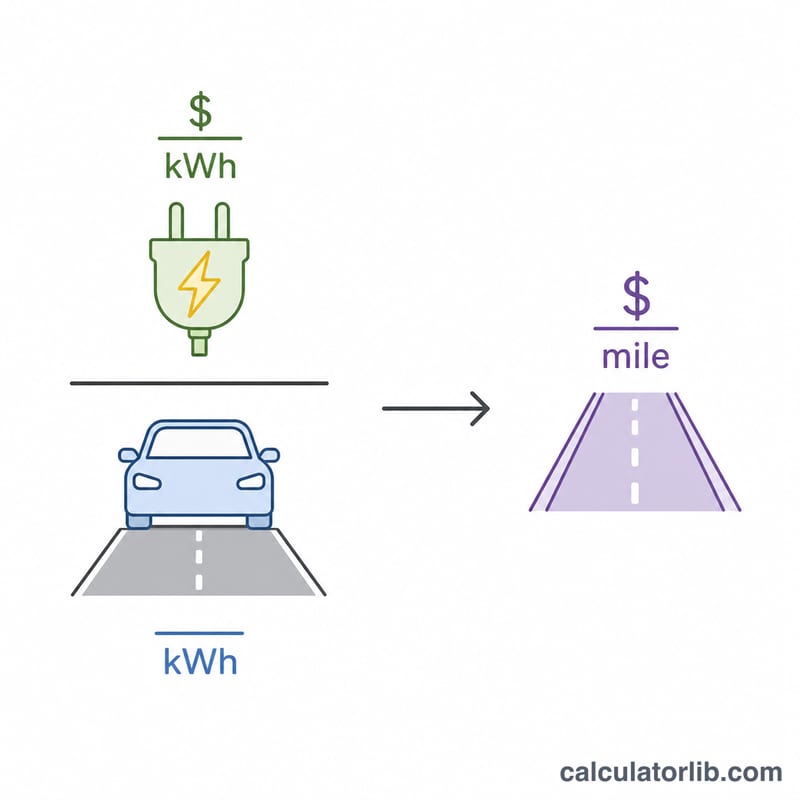
Worked example
Suppose your EV gets 3.5 miles/kWh and you pay $0.15/kWh. Cost per mile = $$0.15 \div 3.5 = \mathbf{\$0.0429}$$ Energy per mile = $$1 \div 3.5 = 0.2857 \text{ kWh}$$ Over a 100-mile drive that's $$0.0429 \times 100 = \mathbf{\$4.29}$$
FAQ
How do I find my EV's miles per kWh? Most EVs display lifetime or trip efficiency on the dashboard or app. You can also divide miles driven by kWh consumed.
Should I use my home rate or a charging-station rate? Use whichever applies. Home charging is usually cheapest; public DC fast chargers cost more per kWh, so enter that rate to see real road-trip costs.
Does this include charging losses? No — efficiency from the dashboard is energy delivered to the motor. Home charging loses roughly 10-15% to heat, so multiply your rate slightly or lower your effective efficiency for a conservative estimate.