

What Is Cost Per Unit?
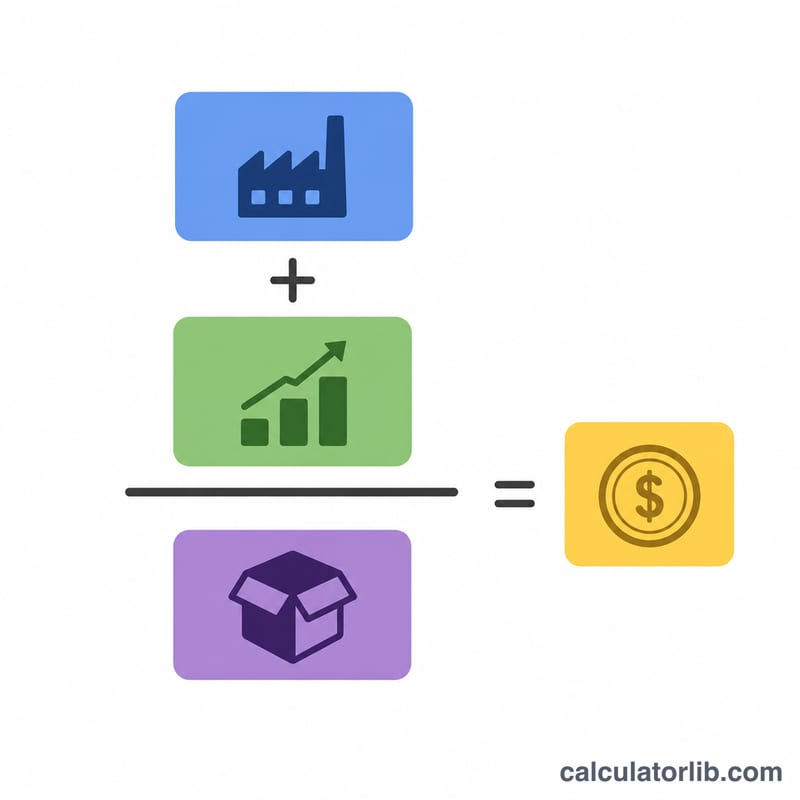
Cost per unit (also called unit cost) is the total cost a business incurs to produce, store, and sell one unit of a product. It combines fixed costs — expenses that stay the same regardless of output, like rent, salaries, and equipment — with variable costs — expenses that rise and fall with production, like raw materials, packaging, and per-unit labor. Knowing your cost per unit is essential for setting profitable prices, controlling expenses, and measuring efficiency.
How to Use This Calculator
Enter your total fixed costs, your total variable costs, and the number of units produced over the same period. The calculator adds the two cost types together and divides by units produced to give you the cost per unit, along with a breakdown of fixed and variable cost per unit.
The Formula Explained
The core formula is simple:
$$\text{Cost Per Unit} = \frac{\text{Fixed Costs} + \text{Variable Costs}}{\text{Units Produced}}$$
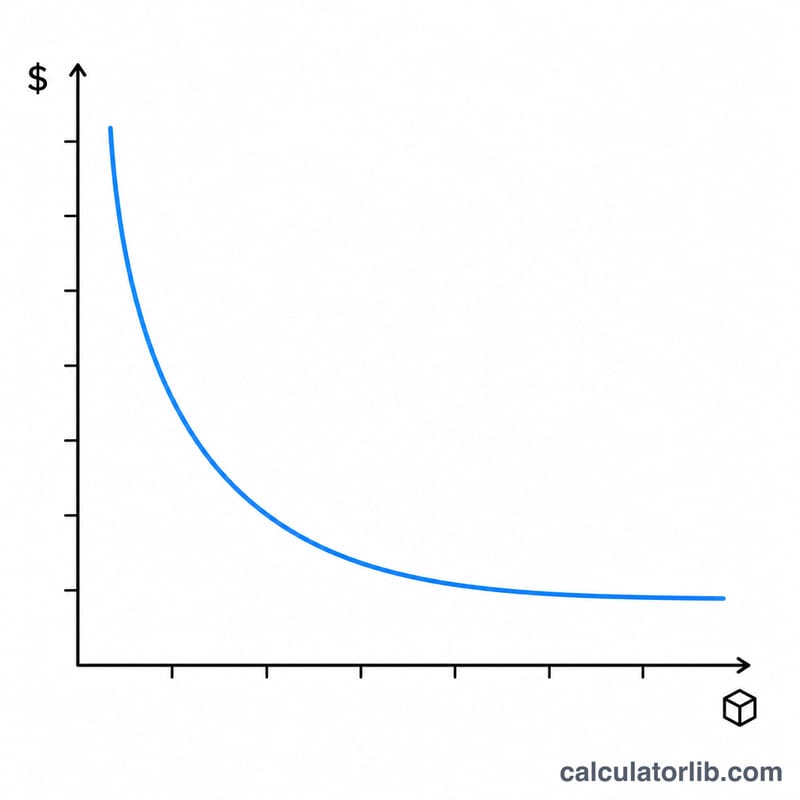
As production volume rises, fixed costs spread across more units, lowering the fixed cost per unit — this is known as economies of scale. Variable cost per unit usually stays roughly constant because it scales with output.
Worked Example
Suppose a factory has fixed costs of $10,000, variable costs of $5,000, and produces 1,000 units. Total cost is $15,000. Dividing by 1,000 units gives a cost per unit of $15.00. The fixed cost per unit is $10.00 and the variable cost per unit is $5.00.
$$\text{Cost Per Unit} = \frac{\$10{,}000 + \$5{,}000}{1{,}000} = \frac{\$15{,}000}{1{,}000} = \$15.00$$
FAQ
What's the difference between fixed and variable costs? Fixed costs don't change with production volume (rent, insurance), while variable costs change directly with output (materials, hourly labor).
Why does cost per unit drop as I produce more? Fixed costs are shared across more units, so each unit absorbs a smaller portion of those overheads.
Should I price above my cost per unit? Yes — your selling price must exceed cost per unit to earn a profit and cover any additional selling and administrative expenses.