
What Is the CFM Airflow Calculator?
This calculator works out how much airflow — measured in CFM (cubic feet per minute) — a fan or ventilation system must move to properly ventilate a room. It uses the room's volume and your target air changes per hour (ACH) to size exhaust fans, supply fans, HVAC, or grow-room ventilation. The math is universal and applies anywhere.
How to Use It
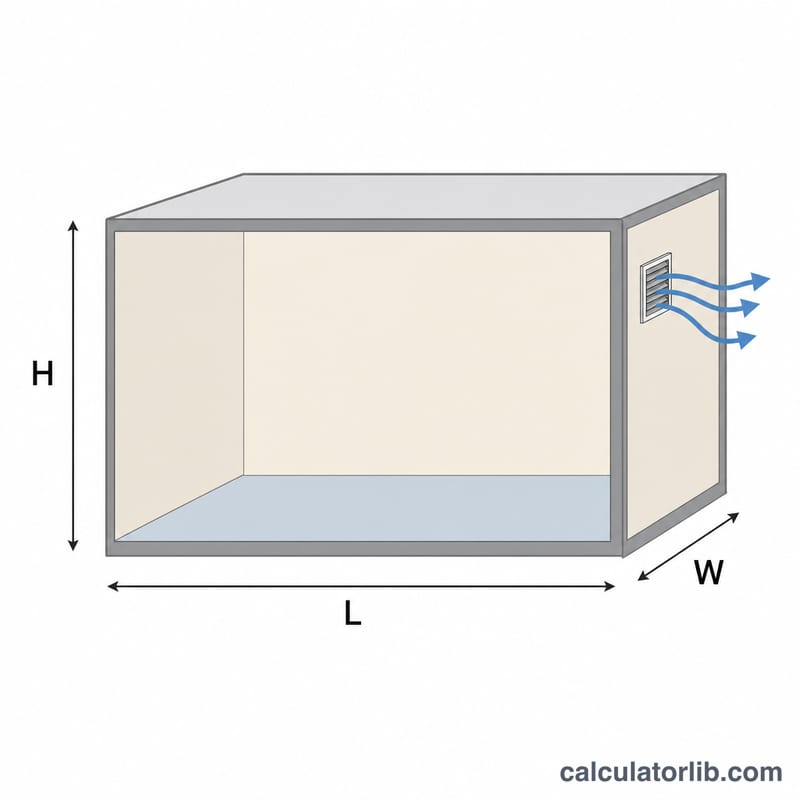
Enter the room's length, width, and ceiling height in feet, then enter the desired air changes per hour. The calculator multiplies the three dimensions to get volume, multiplies by ACH, and divides by 60 (minutes in an hour) to give the required CFM. Typical ACH targets: living rooms 6–8, kitchens 7–8, bathrooms 8–10, grow rooms 30–60.
The Formula Explained
Room volume is Length \(\times\) Width \(\times\) Height. One "air change" replaces the entire volume of air in the room. To achieve a given number of changes each hour you must move that volume \(\times\) ACH cubic feet of air per hour. Dividing by 60 converts an hourly figure into a per-minute figure, which is what CFM means:
$$\text{CFM} = \frac{\text{Volume} \times \text{ACH}}{60}$$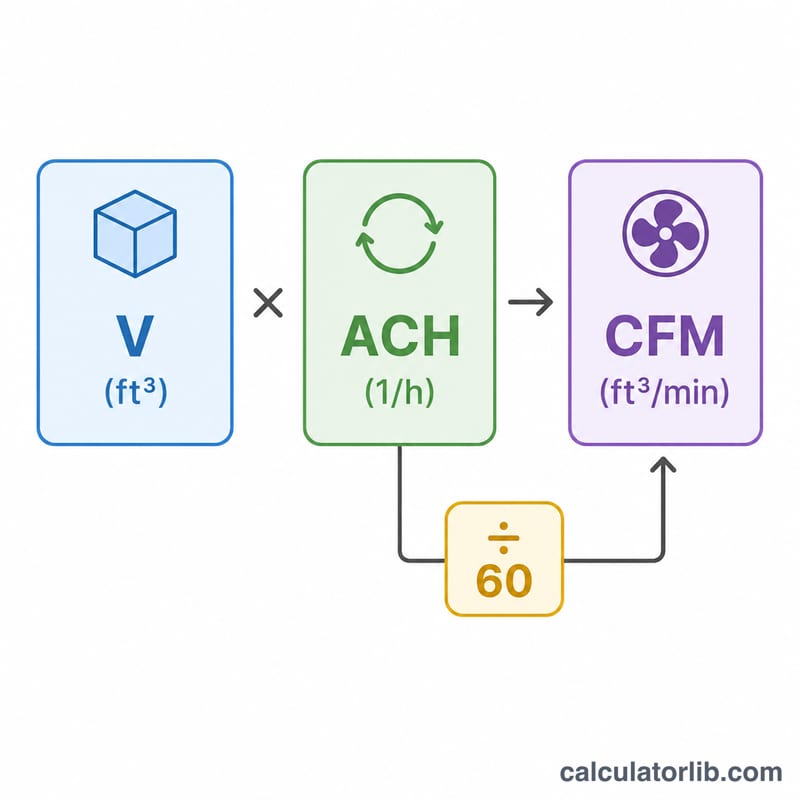
Worked Example
A 12 ft \(\times\) 10 ft room with an 8 ft ceiling has a volume of $$12 \times 10 \times 8 = 960 \text{ ft}^3.$$ For 6 air changes per hour: $$\text{CFM} = \frac{960 \times 6}{60} = 96 \text{ CFM}.$$ So you'd want a fan rated for at least 96 CFM.
FAQ
What is a good ACH for my room? It depends on use — bedrooms 5–6, kitchens 7–8, bathrooms 8–10, and high-load spaces like grow rooms or workshops 20–60.
Should I add extra capacity? Yes. Ducting, filters, and bends reduce real-world airflow, so size your fan 20–25% above the calculated CFM.
Does ceiling height matter? Absolutely — taller rooms hold more air and need proportionally more CFM for the same number of air changes.