
What This Calculator Does
This tool applies to US LTL (less-than-truckload) shipping and uses the standard NMFC (National Motor Freight Classification) density-to-class chart. It computes your shipment's density in pounds per cubic foot and estimates the freight class carriers use to price your load. Density is the single biggest factor in class for most non-hazardous, non-fragile freight, though actual class can also depend on stowability, handling, and liability.
How to Use It
Enter the total weight of the shipment in pounds, the number of pieces, and the dimensions (length, width, height) of a single piece in inches. The calculator multiplies the dimensions, converts cubic inches to cubic feet (dividing by 1,728), multiplies by the number of pieces, then divides total weight by total volume to get density.
The Formula Explained
Volume in cubic feet = \((\text{L} \times \text{W} \times \text{H} \times \text{pieces}) \div 1728\). Density = total weight \(\div\) total cubic feet. The resulting density is matched against the standard class breakpoints: denser freight earns a lower (cheaper) class, lighter/bulkier freight a higher class.
$$\begin{gathered} \text{Density} = \frac{\text{Weight (lb)}}{V} \\[1.5em] \text{where}\quad \left\{ \begin{aligned} V &= \frac{\text{Length} \times \text{Width} \times \text{Height} \times \text{Pieces}}{1728} \end{aligned} \right. \end{gathered}$$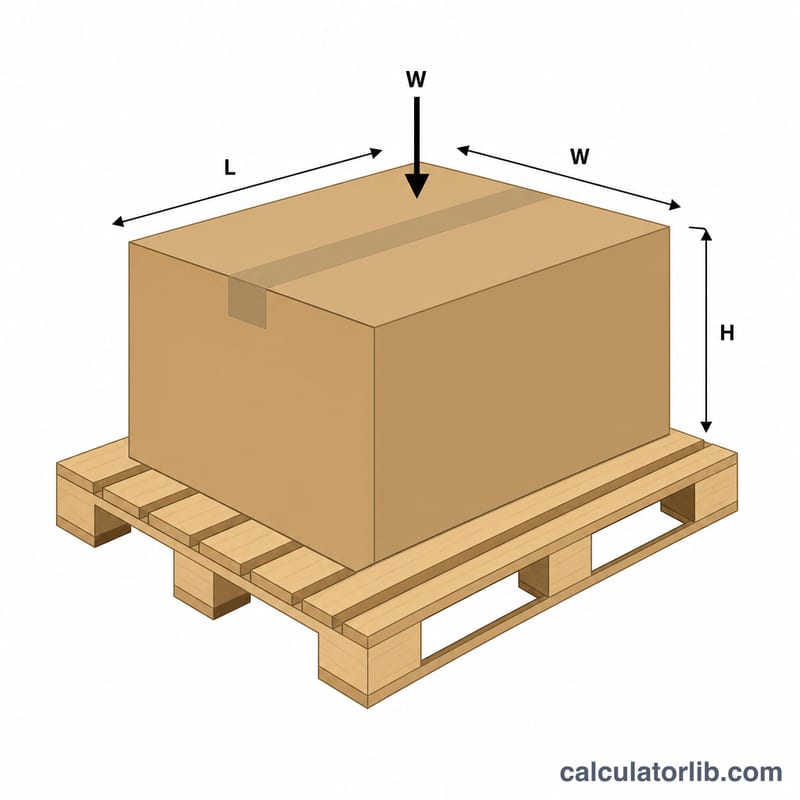
Worked Example
A pallet measuring 48 × 40 × 48 inches weighs 150 lb. Volume = \(48 \times 40 \times 48 = 92{,}160\) in³ \(\div 1728 = 53.33\) ft³. Density = \(150 \div 53.33 = 2.81\) lb/ft³. A density between 2 and 4 lb/ft³ maps to freight class 250.
$$V = \frac{48 \times 40 \times 48}{1728} = 53.33 \ \text{ft}^3$$ $$\text{Density} = \frac{150}{53.33} = 2.81 \ \text{lb/ft}^3$$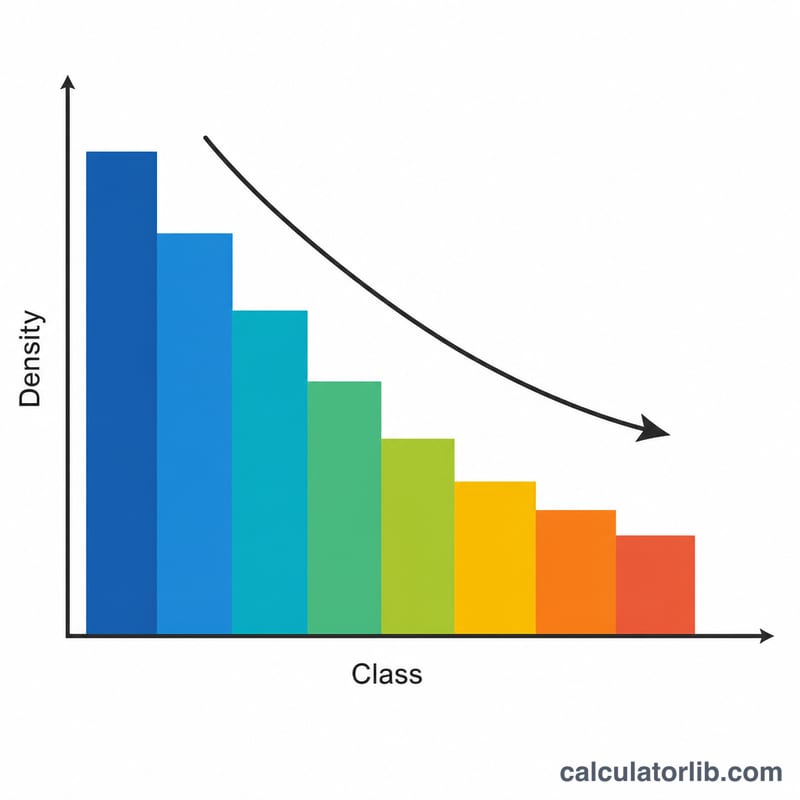
FAQ
Is the estimated class guaranteed? No. Density gives a strong estimate, but the official NMFC class may differ for certain commodities. Always confirm with your carrier or NMFC code.
Why divide by 1728? There are 1,728 cubic inches in one cubic foot (\(12^3\)), so it converts your inch measurements to cubic feet.
Does pallet weight count? Yes — use the total shipped weight including the pallet and packaging.