
What is the Carburetor CFM Calculator?
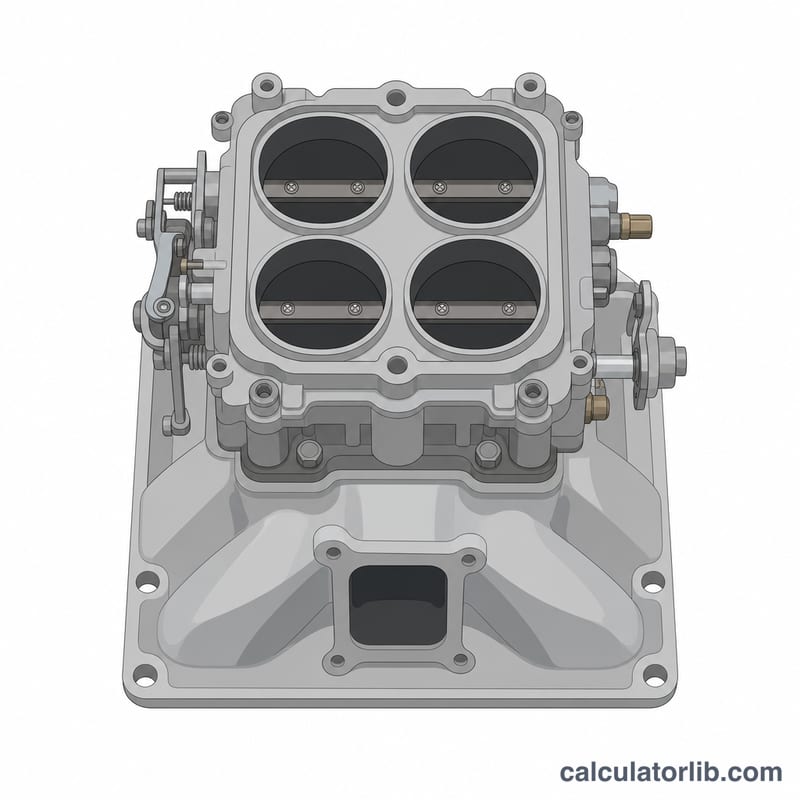
This tool estimates the airflow capacity, measured in cubic feet per minute (CFM), that a carburetor should flow to feed your engine at its maximum operating speed. Choosing a carburetor that flows too little restricts top-end power, while one that flows far too much can hurt throttle response and drivability. The calculator gives you a science-based starting point for selecting a carburetor or throttle body.
How to use it
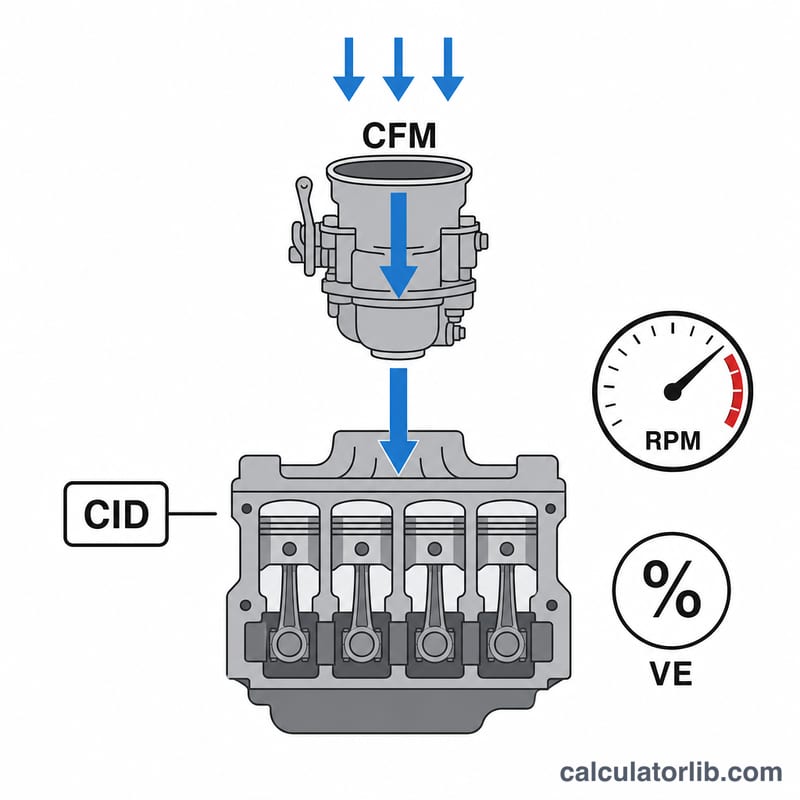
Enter three values: your engine's displacement in cubic inches (CID), the maximum RPM you expect to use, and the volumetric efficiency (VE) as a percentage. A stock engine is often around 80–85% VE, a well-built street engine 85–95%, and a fully race-prepped engine can reach 100% or slightly more. Press calculate to see the required CFM.
The formula explained
The core relationship is $$\text{CFM} = \frac{\text{CID} \times \text{RPM} \times \text{VE}}{3456}$$ A four-stroke engine completes one intake event every two revolutions, so the engine "breathes" half its displacement per revolution. Converting cubic inches and RPM into cubic feet per minute, and accounting for the two-revolution cycle, produces the constant near 3456. Volumetric efficiency scales the theoretical airflow down to what the engine actually ingests.
Worked example
For a 350 CID small block turning 6,000 RPM at 85% VE: $$\text{CFM} = \frac{350 \times 6000 \times 0.85}{3456} \approx 517 \text{ CFM}$$ That suggests a carburetor in the 500–600 CFM range is a sensible match for a street build, with a slightly larger unit acceptable if you favor top-end power.
FAQ
Should I round up or down? For street use, choose a carburetor close to the calculated value; for racing, sizing slightly larger is common.
What VE should I use? Use 80–85% for stock engines, 90–95% for performance street engines, and 100% for race engines with excellent breathing.
Does this work for fuel injection? The airflow estimate is valid for throttle-body sizing too, since it reflects the engine's air demand regardless of the fuel-metering method.