
What This Calculator Does
This tool computes the volumetric air flow rate in CFM (cubic feet per minute) from a measured air velocity and the cross-sectional area of a rectangular duct. It is widely used in HVAC design, ventilation balancing, and indoor air quality assessments to verify that a duct delivers the required airflow.
How to Use It
Enter the air velocity in feet per minute (ft/min) — typically read from an anemometer or hot-wire probe. Then enter the duct width and height in inches. The calculator converts the duct dimensions to feet, computes the cross-sectional area, and multiplies it by the velocity to give the airflow in CFM.
The Formula Explained
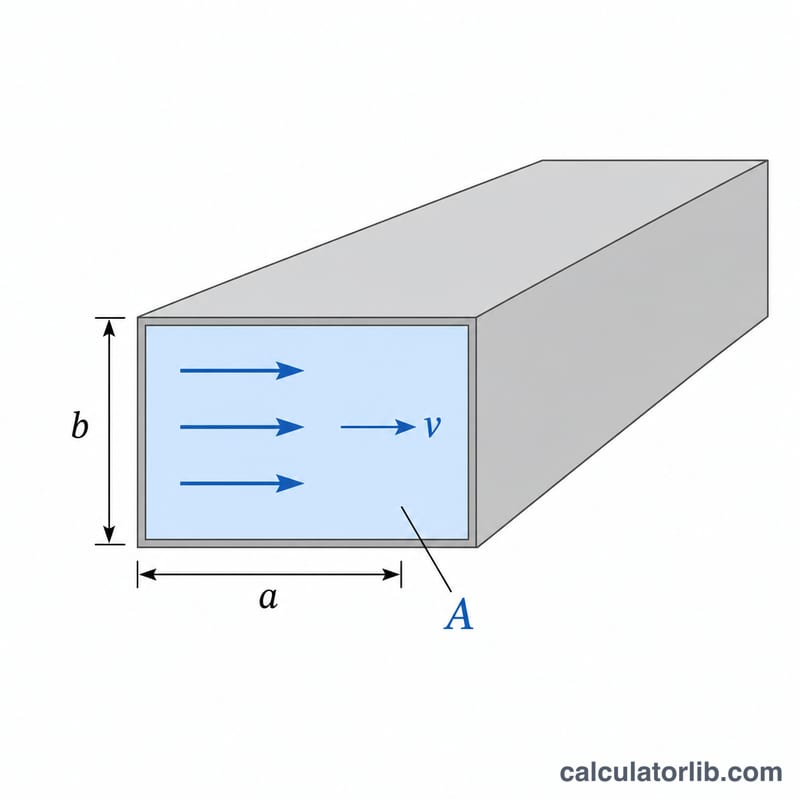
The governing relationship is \(\text{CFM} = v \times A\), where \(v\) is velocity in ft/min and \(A\) is the duct cross-sectional area in square feet. Because duct dimensions are usually measured in inches, area is found with $$A = \frac{\text{width}}{12} \times \frac{\text{height}}{12}$$ The result is the volume of air passing a point each minute.
Worked Example
Suppose air moves at 800 ft/min through a 12 in × 8 in rectangular duct. The area is $$\frac{12}{12} \times \frac{8}{12} = 1 \times 0.6667 = 0.6667 \text{ ft}^2$$ Airflow = \(800 \times 0.6667 =\) 533.33 CFM.
FAQ
Does this work for round ducts? This version assumes a rectangular duct. For a round duct, compute area as \(\pi(d/2)^2\) in feet and multiply by velocity.
What is a typical duct velocity? Supply ducts commonly run 700–1500 ft/min; lower velocities reduce noise and friction loss.
Why convert inches to feet? Velocity is in ft/min, so area must be in ft² for the units to cancel and yield ft³/min (CFM).